Subset Selection
Today
- Used car prices
- Best subset selection
- Algorithm
- Fitting
- Training RSS
- Computational cost
- Stepwise selection
- Forward stepwise
- Backward stepwise
- Path comparison
- Model size
- Penalized criteria
- Likelihood criteria
- Within-fold cross-validation
- Chosen sizes
- Selected model
- Coefficients
- Optimistic inference
Used car prices
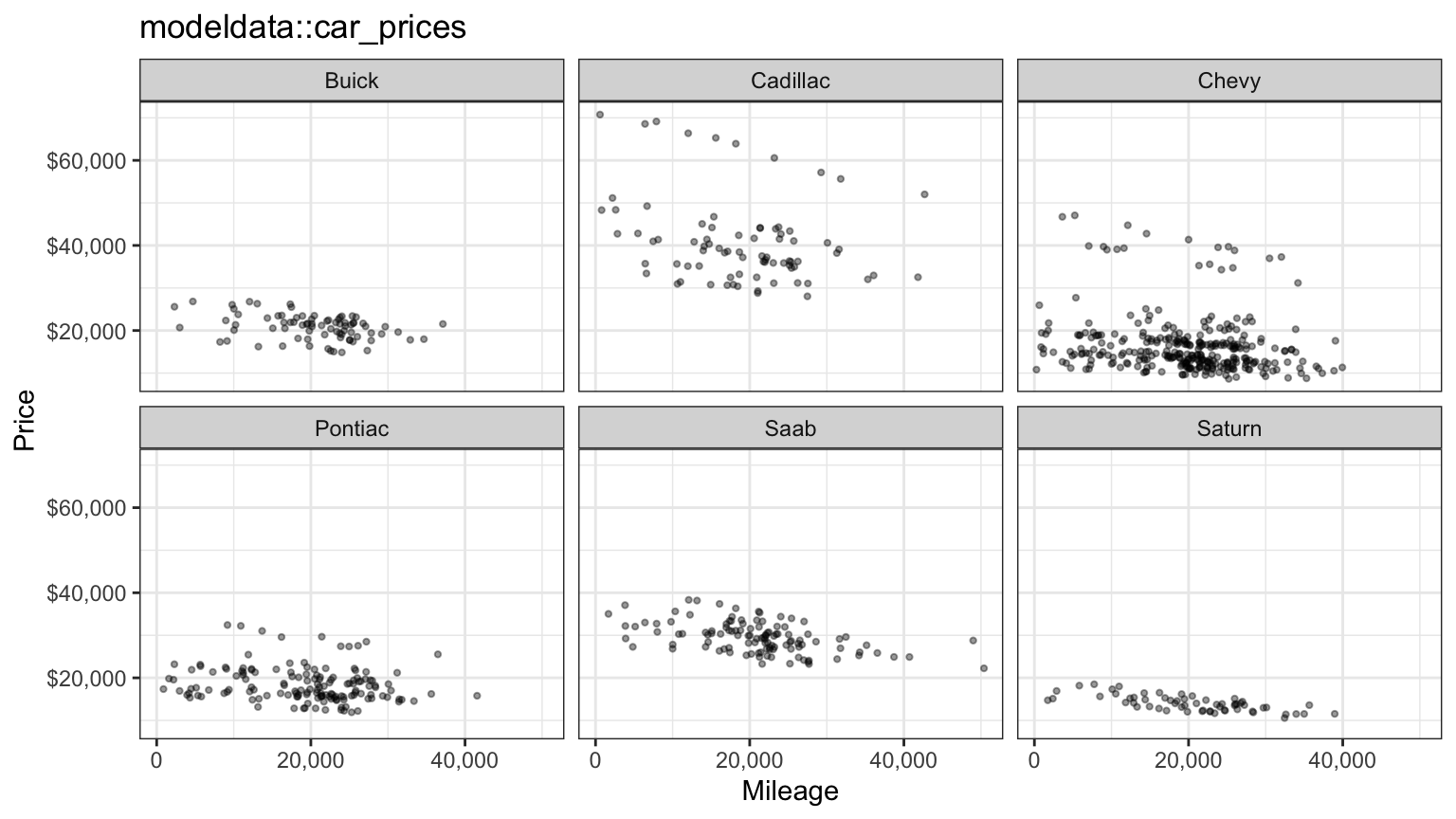
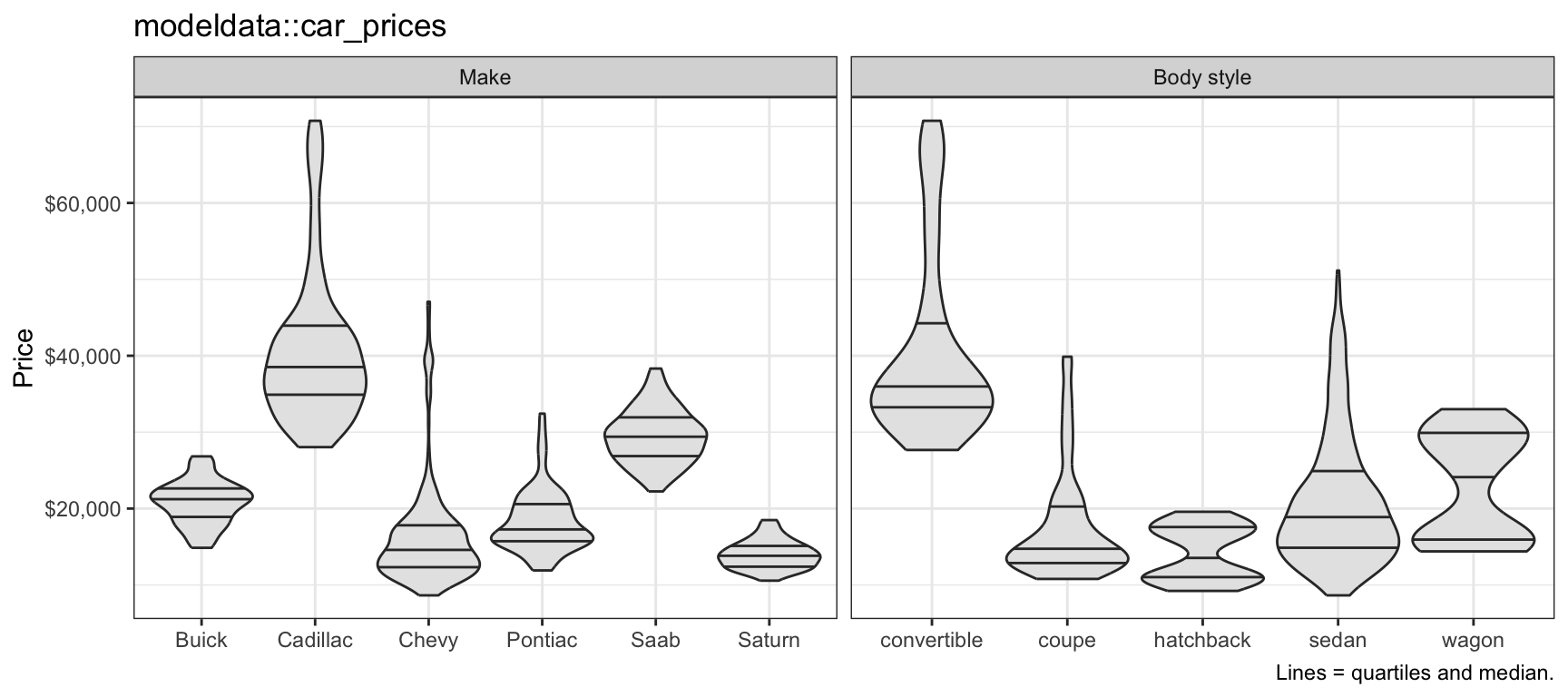
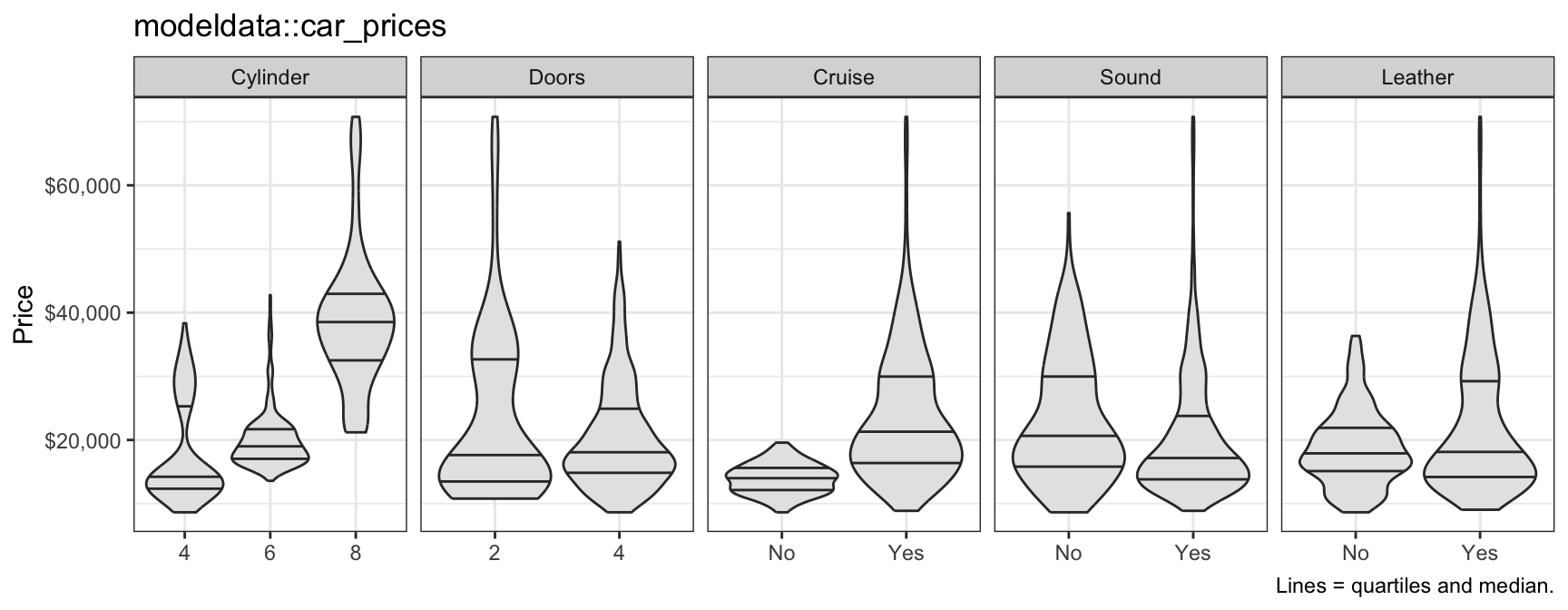
Price scale
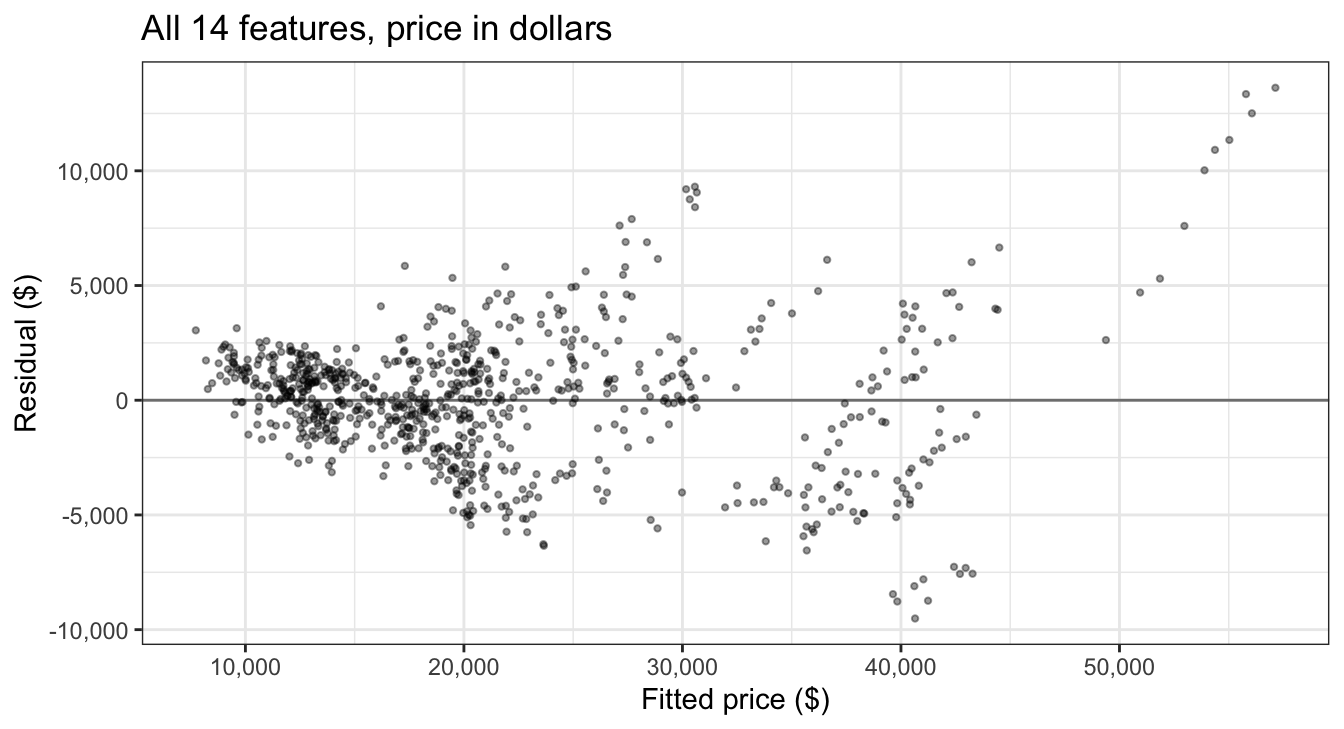
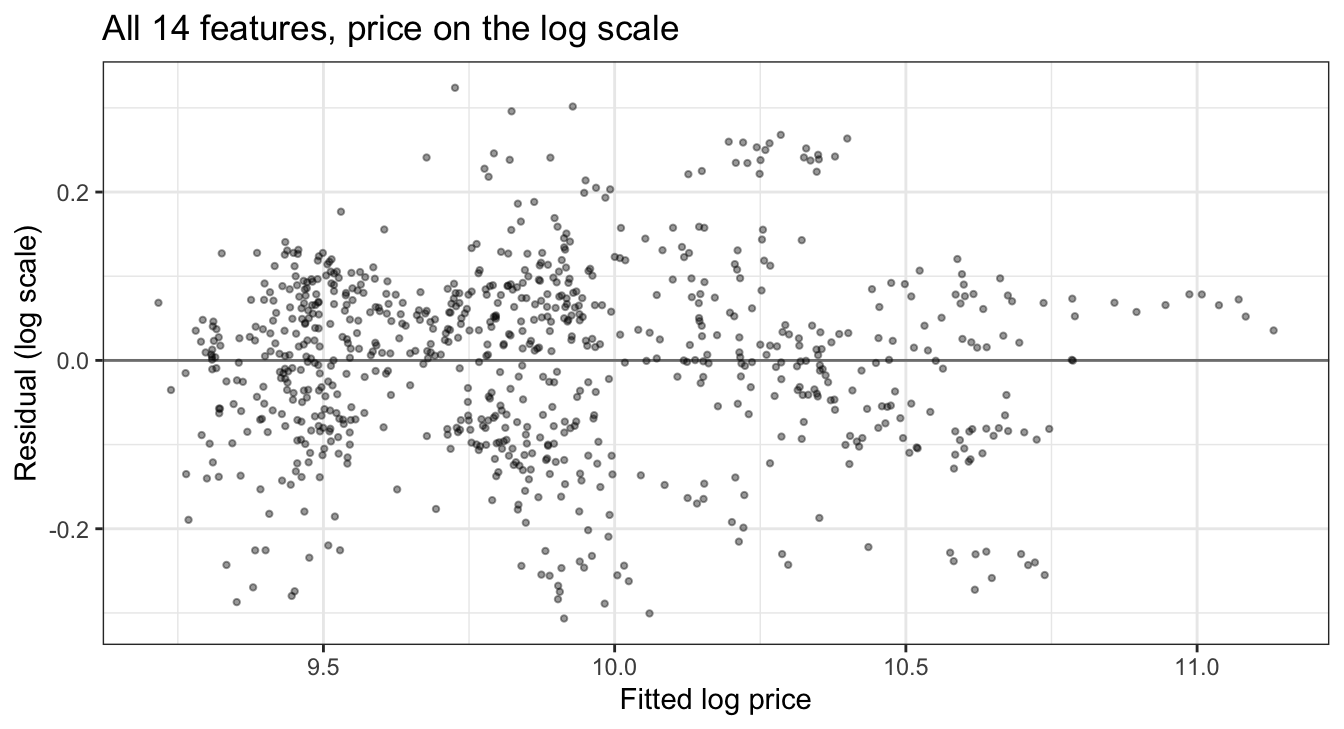
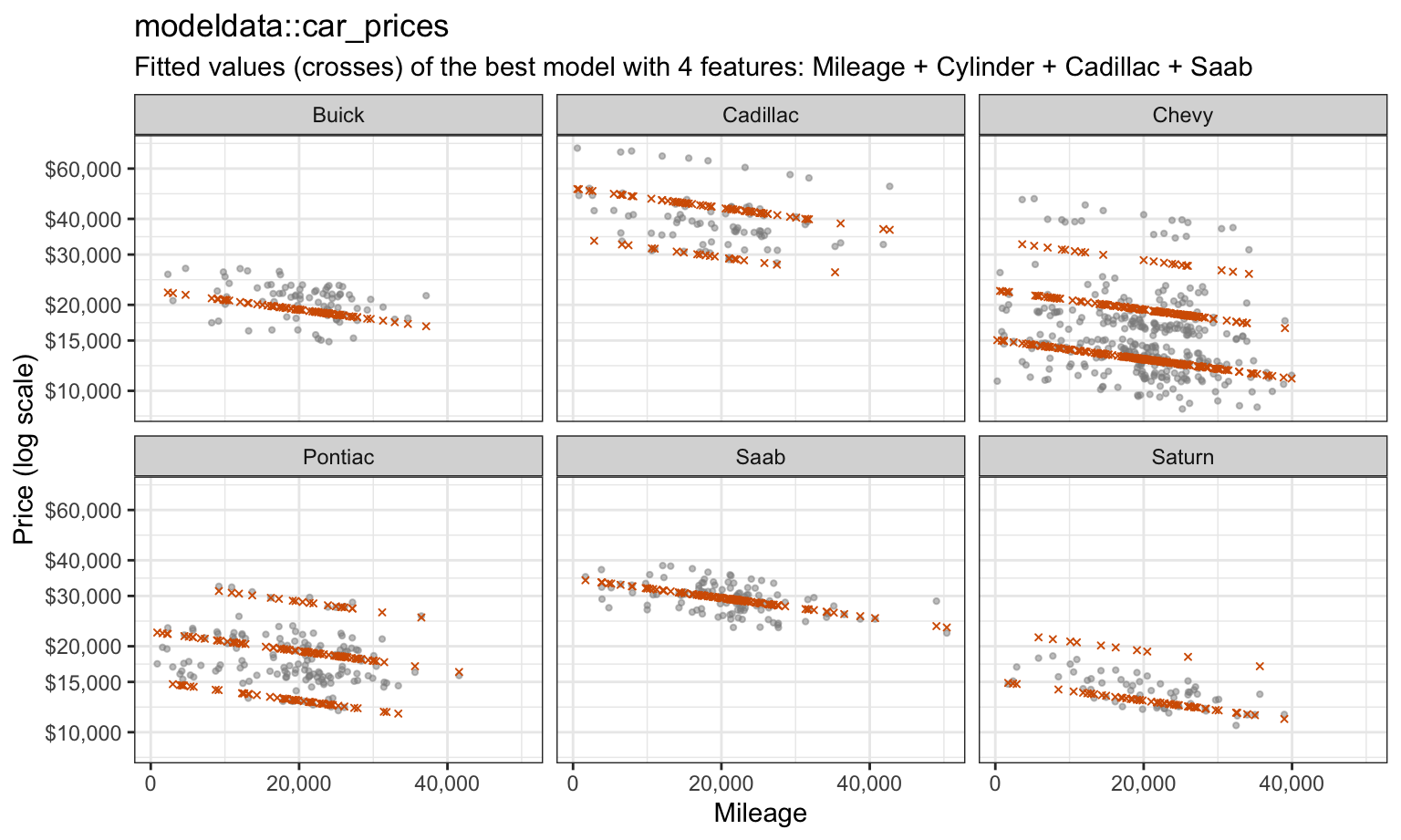
Candidate features
- Response variable: \(\log(\texttt{Price})\)
- Explanatory variables:
Mileage,Cylinder,Doors,Cruise,Sound,Leather, make, body style
- Features, \(p = 14\):
Mileage,Cylinder,Cruise,Sound,Leather,Buick,Cadillac,Chevy,Pontiac,Saab,convertible,coupe,hatchback,sedan
- Reference levels:
Saturn,wagon
Selection motives
- Interpretability
- Variance
- Search: \(2^p\) candidate models
Best subset selection
Algorithm
- \(\mathcal{M}_0\): the null model, no features
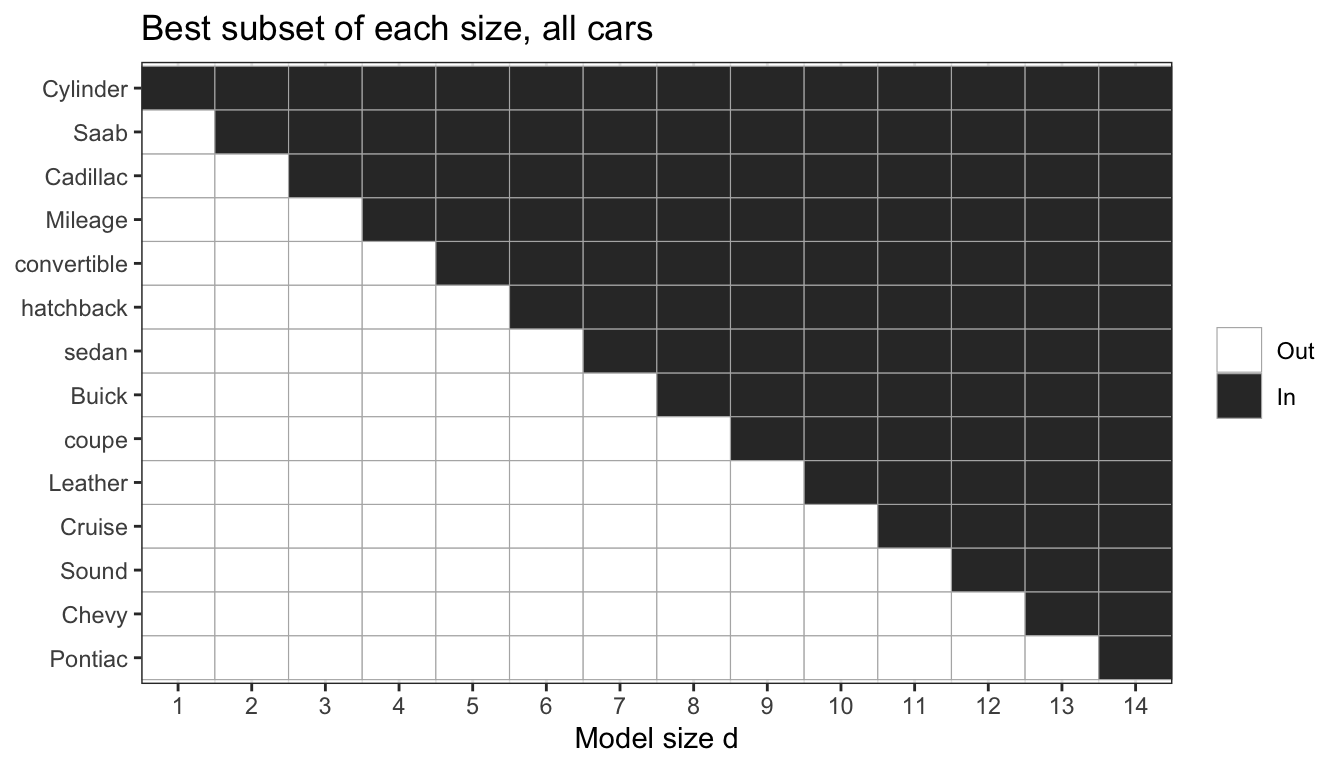
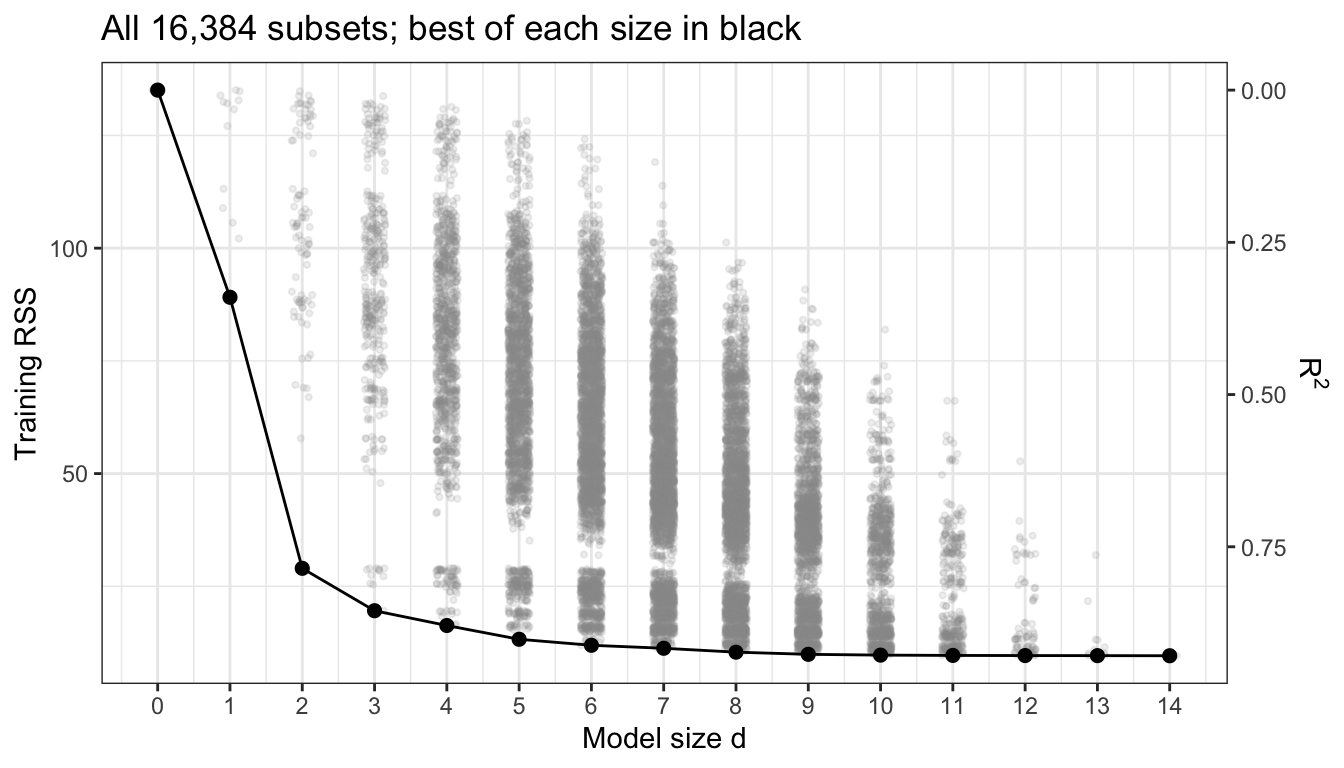
- For \(d = 1, \ldots, p\): fit all \(\binom{p}{d}\) models with \(d\) features; \(\mathcal{M}_d\) is the one with the smallest RSS
- Choose among \(\mathcal{M}_0, \ldots, \mathcal{M}_p\) by \(C_p\), BIC, adjusted \(R^2\), or cross-validation
Fitting
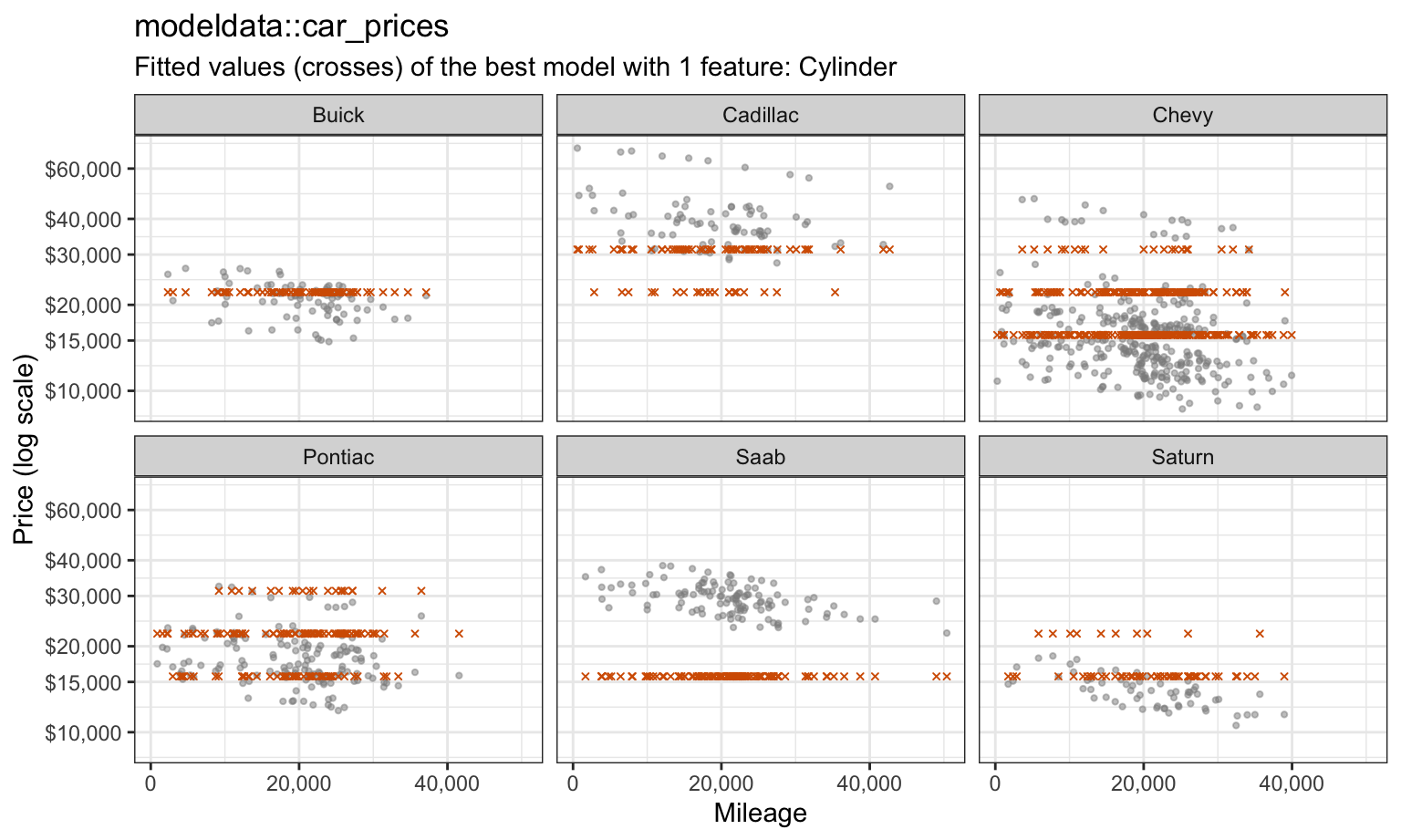
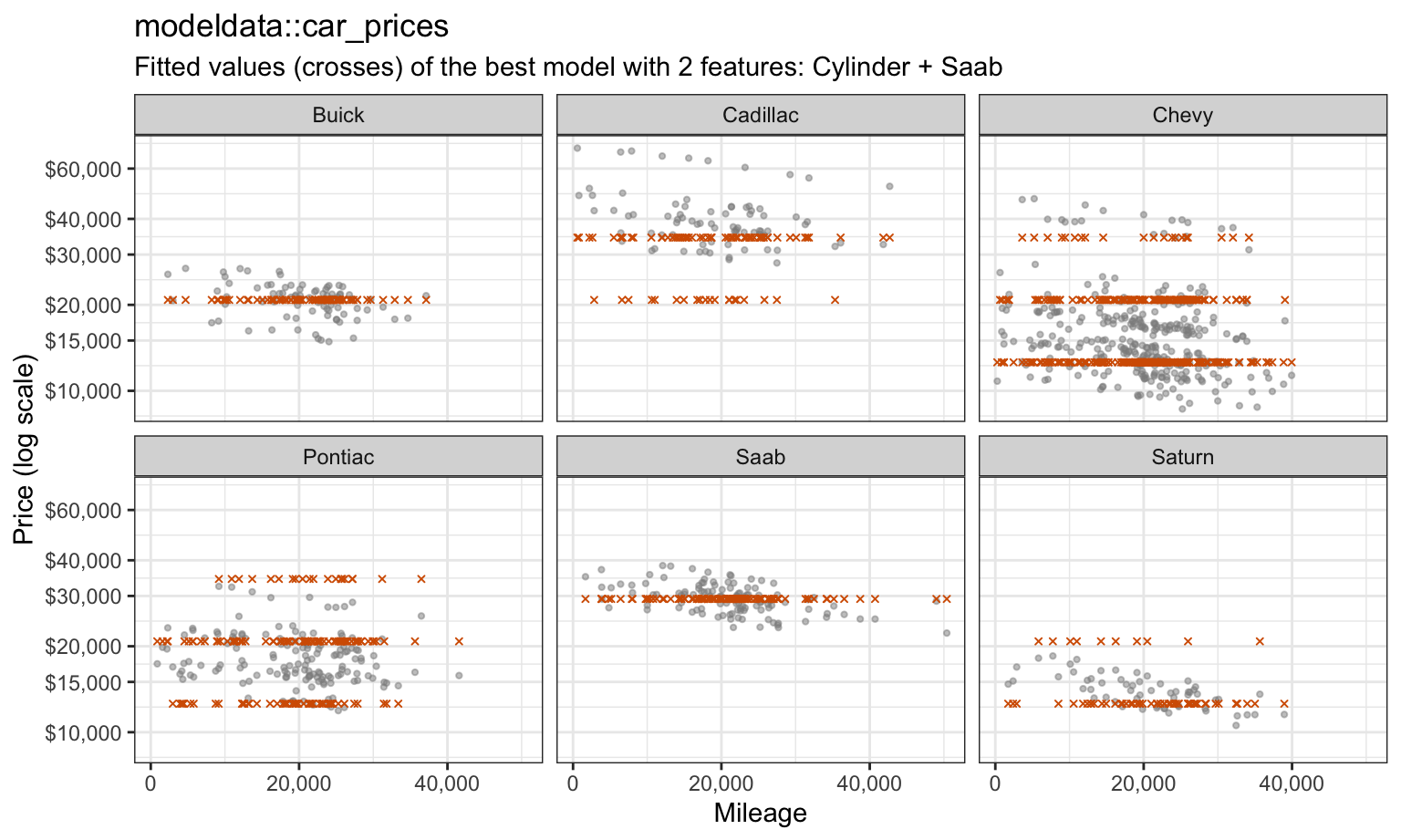
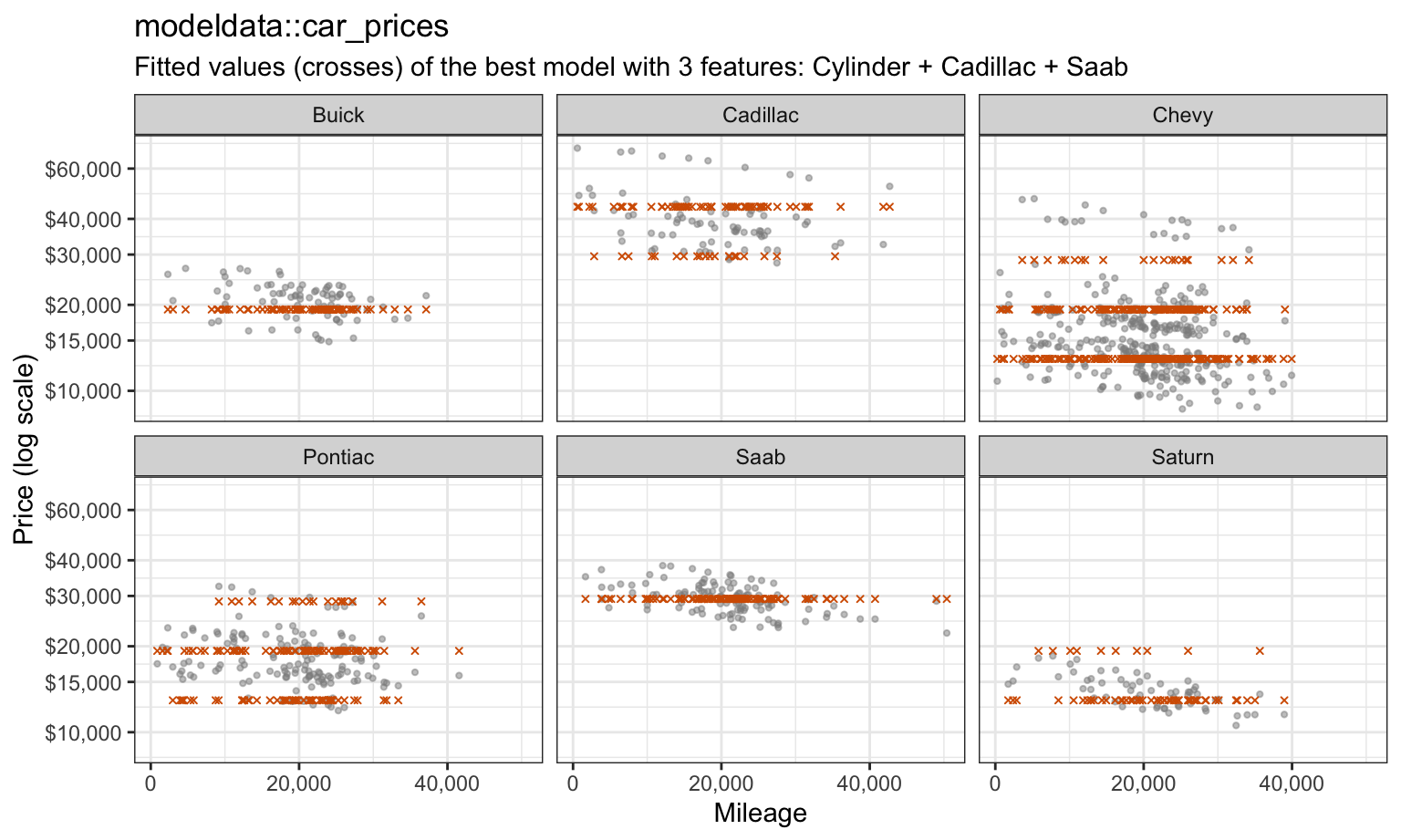
Training RSS
Computational cost
- \(2^p\) least squares fits
- \(2^{14} = 16{,}384\) for these cars
- \(2^{20}\) is about a million
- \(2^{30}\) about a billion
- \(2^{40}\) about a trillion
Stepwise selection
Forward stepwise
- \(\mathcal{M}_0\): the null model
- For \(d = 0, \ldots, p - 1\): add the one feature to \(\mathcal{M}_d\) with the smallest RSS to get \(\mathcal{M}_{d+1}\)
- Choose among \(\mathcal{M}_0, \ldots, \mathcal{M}_p\) as in best subset selection
\[1 + \sum_{d=0}^{p-1}(p - d) = 1 + \frac{p(p+1)}{2}\]
106 models for \(p = 14\), against 16,384 for best subset selection
Backward stepwise
- \(\mathcal{M}_p\): the model with all \(p\) features
- For \(d = p, \ldots, 1\): remove the one feature from \(\mathcal{M}_d\) that leaves the smallest RSS to get \(\mathcal{M}_{d-1}\)
- Choose among \(\mathcal{M}_0, \ldots, \mathcal{M}_p\) as before
Greedy: forward never removes a feature it has added, backward never restores one it has removed
Path comparison
| Method | Size 1 (RSS) | Size 2 (RSS) | Size 3 (RSS) |
|---|---|---|---|
| Best subset | Cadillac (44.51) | Cylinder + Saab (14.51) | Cylinder + Cadillac + Saab (9.56) |
| Forward | Cadillac (44.51) | Cadillac + Saab (27.51) | Cylinder + Cadillac + Saab (9.56) |
| Backward | Cylinder (45.52) | Cylinder + Saab (14.51) | Cylinder + Cadillac + Saab (9.56) |
Model size
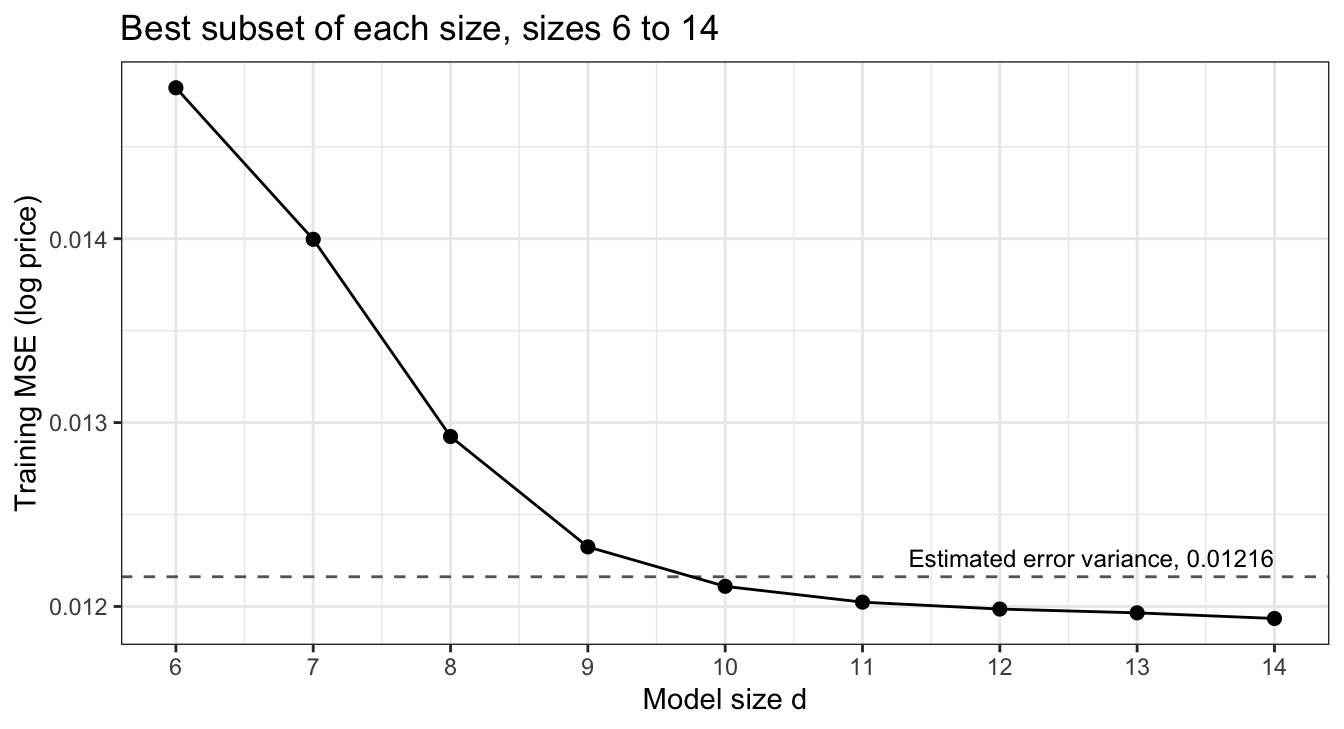
Training MSE
Training error optimism
\[E\left[\sum_{i=1}^n\left(y_i^0 - \widehat y_i\right)^2\right] = E\left[RSS\right] + 2\sigma^2\,\text{tr}(\mathbf{H}) = E\left[RSS\right] + 2(d+1)\sigma^2\]
- \(y_i^0\) — new response at \(x_i\)
- \(\mathbf{H}\) — hat matrix
- \(d\) — number of features
Penalized criteria
\[C_p = \frac{1}{n}\left(RSS + 2d\widehat\sigma^2\right)\]
\[\text{BIC} = \frac{1}{n}\left[RSS + \log(n)\,d\widehat\sigma^2\right]\]
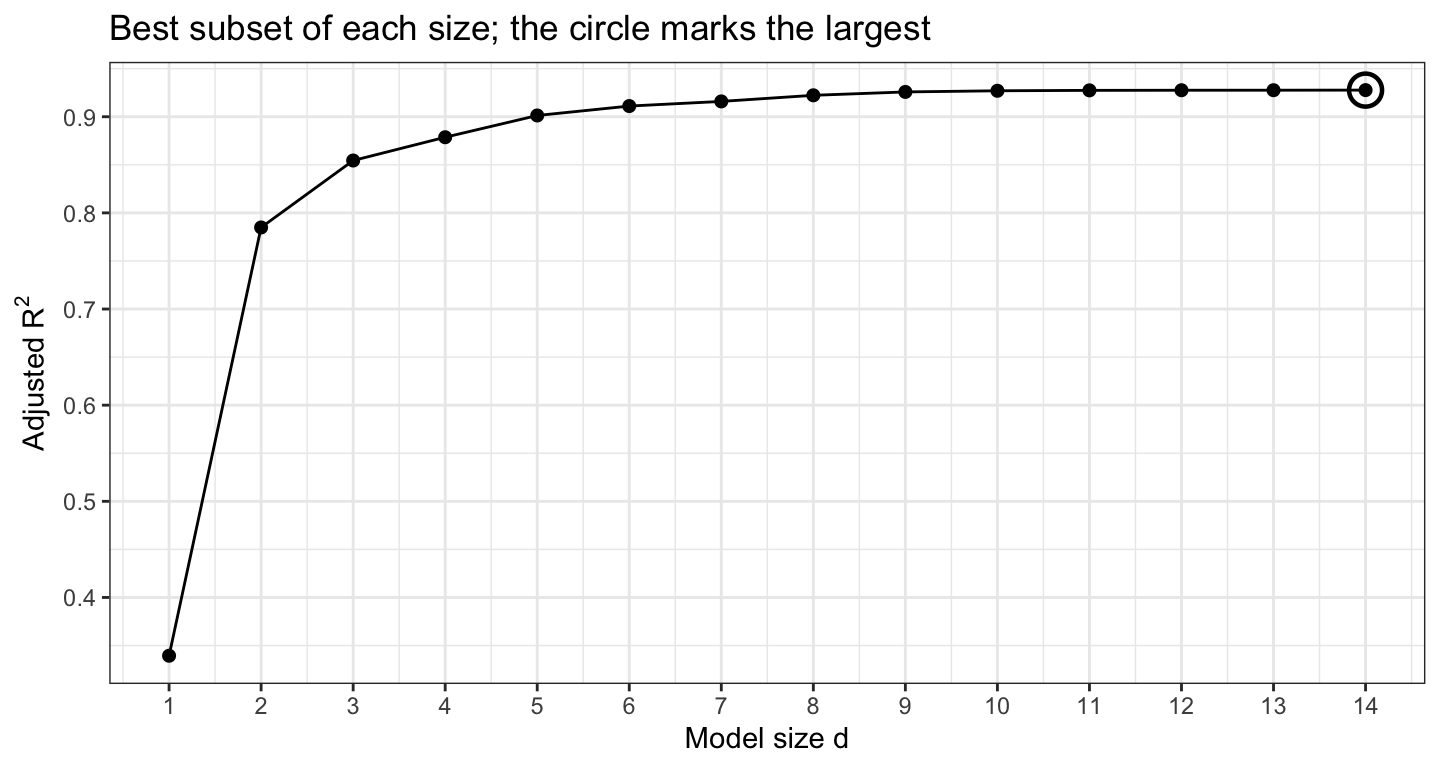
\[\text{Adjusted } R^2 = 1 - \frac{RSS/(n - d - 1)}{TSS/(n - 1)}\]
- \(RSS\) — training residual sum of squares
- \(d\) — number of features
- \(\widehat\sigma^2\) — error variance estimate from the model with all \(p\) features
- \(TSS\) — total sum of squares
Choose the smallest \(C_p\) or BIC, the largest adjusted \(R^2\)
Likelihood criteria
\[\log L = -\frac{n}{2}\log\left(2\pi\widehat\sigma^2\right) - \frac{RSS}{2\widehat\sigma^2}\]
\[\text{AIC} = -2\log L + 2(d + 1), \qquad \text{BIC} = -2\log L + \log(n)(d + 1)\]
- \(L\) — maximized likelihood under \(\epsilon_i \stackrel{ind}{\sim} N\left(0, \sigma^2\right)\) with \(\sigma^2\) fixed at \(\widehat\sigma^2\)
- \(d + 1\) — coefficients, including the intercept
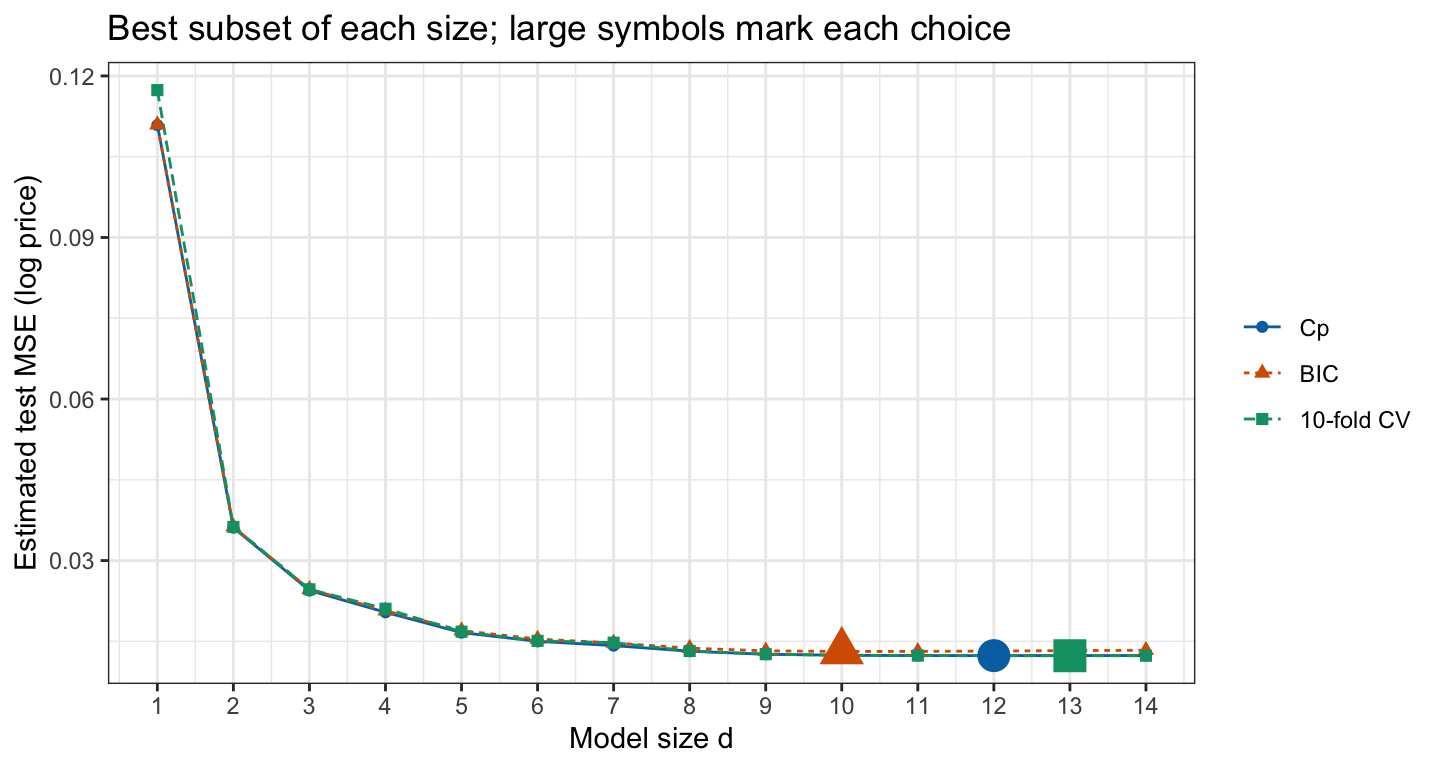
Within-fold cross-validation
- Best subset search inside each fold, from the training folds only
- Predict the held-out fold with the best model of each size
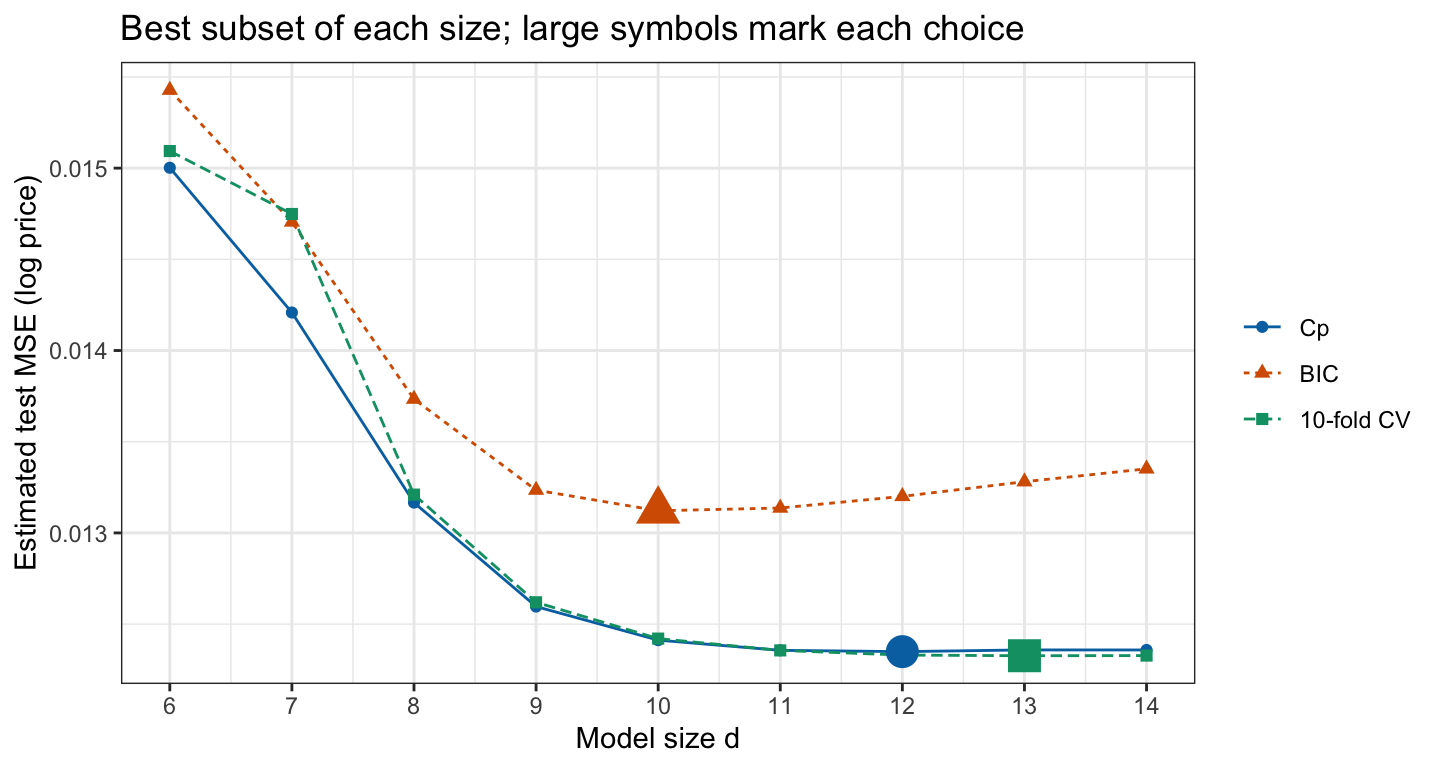
- \(\text{CV}_{(k)}(d)\) estimates the test MSE of the procedure “fit the best model of size \(d\)”
Chosen sizes
Selected model
Coefficients
| Feature | \(\widehat\beta_j\) | Change in median price |
|---|---|---|
| (Intercept) | 9.015 | |
| Mileage | -8.199e-06 | -7.9% |
| Cylinder | 0.1865 | 20.5% |
| Leather | 0.03446 | 3.5% |
| Buick | 0.1204 | 12.8% |
| Cadillac | 0.4288 | 53.5% |
| Saab | 0.7032 | 102.0% |
| convertible | 0.1572 | 17.0% |
| coupe | -0.1178 | -11.1% |
| hatchback | -0.2924 | -25.4% |
| sedan | -0.1681 | -15.5% |
Reference make
- Dropped:
Cruise,Sound,Chevy,Pontiac - Reference make:
Chevy,PontiacandSaturntogether - Dropping a dummy variable merges its level into the reference
Optimistic inference
Conclusion
- Training error always falls as features are added, so it cannot choose model size
- Best subset selection searches every model; stepwise selection is cheaper but greedy
- \(C_p\), AIC, BIC and adjusted \(R^2\) penalize model size
- Cross-validation chooses model size too, with the search repeated inside every fold
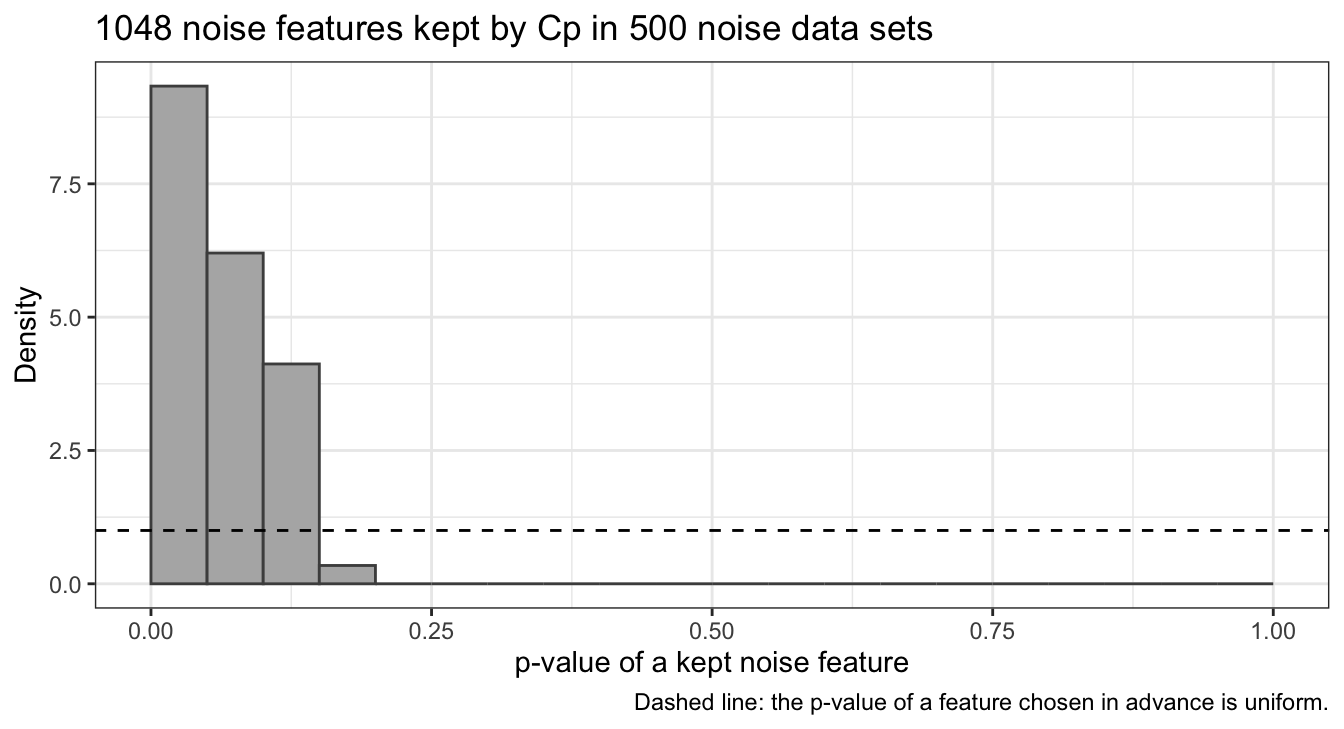
- Selection makes standard errors and \(p\)-values optimistic
DS 3030