Ridge Regression
Today
- Delivery times
- Data
- Features
- Least squares
- Ridge regression
- Item counts
- Penalized criterion
- Closed form
- Estimate path
- Bias-variance tradeoff
- Prediction spread
- Training sample size
- Tuning parameter selection
- Cross-validation
- Test evaluation
Delivery times
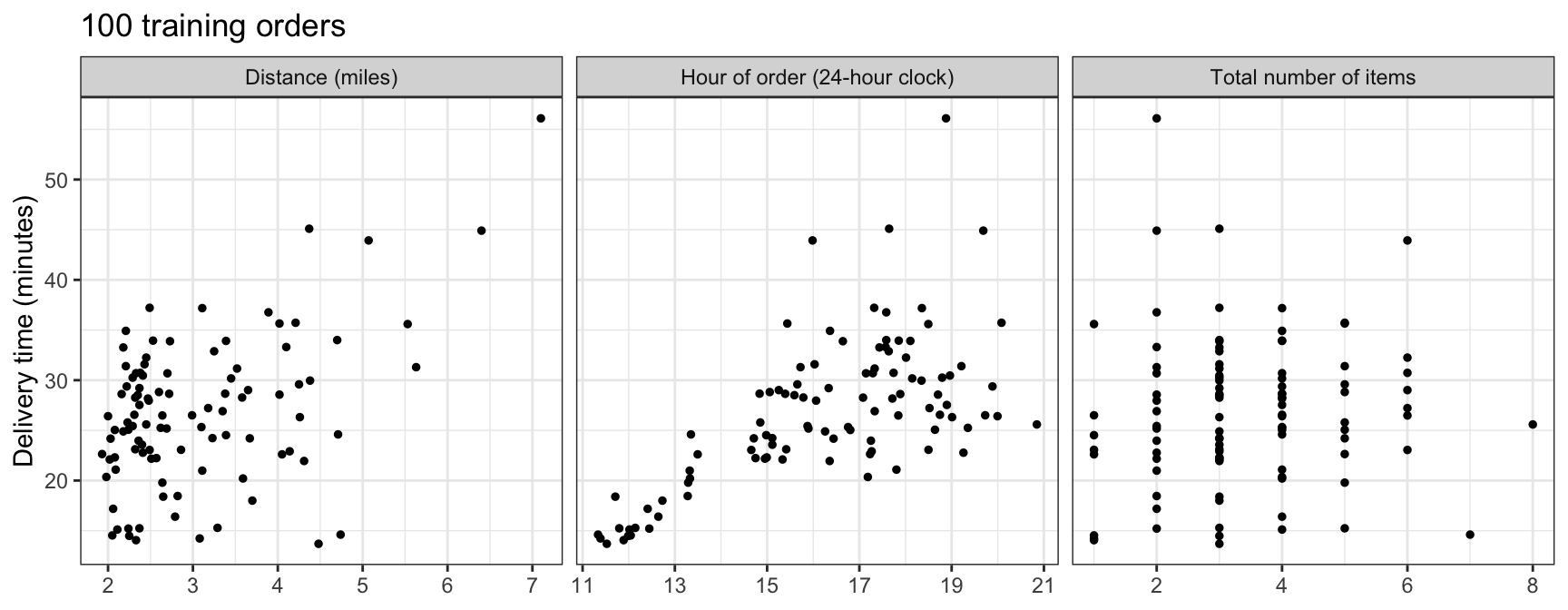
- Question: how long will a food delivery order take?
- Response variable:
time_to_delivery, in minutes - Explanatory variables:
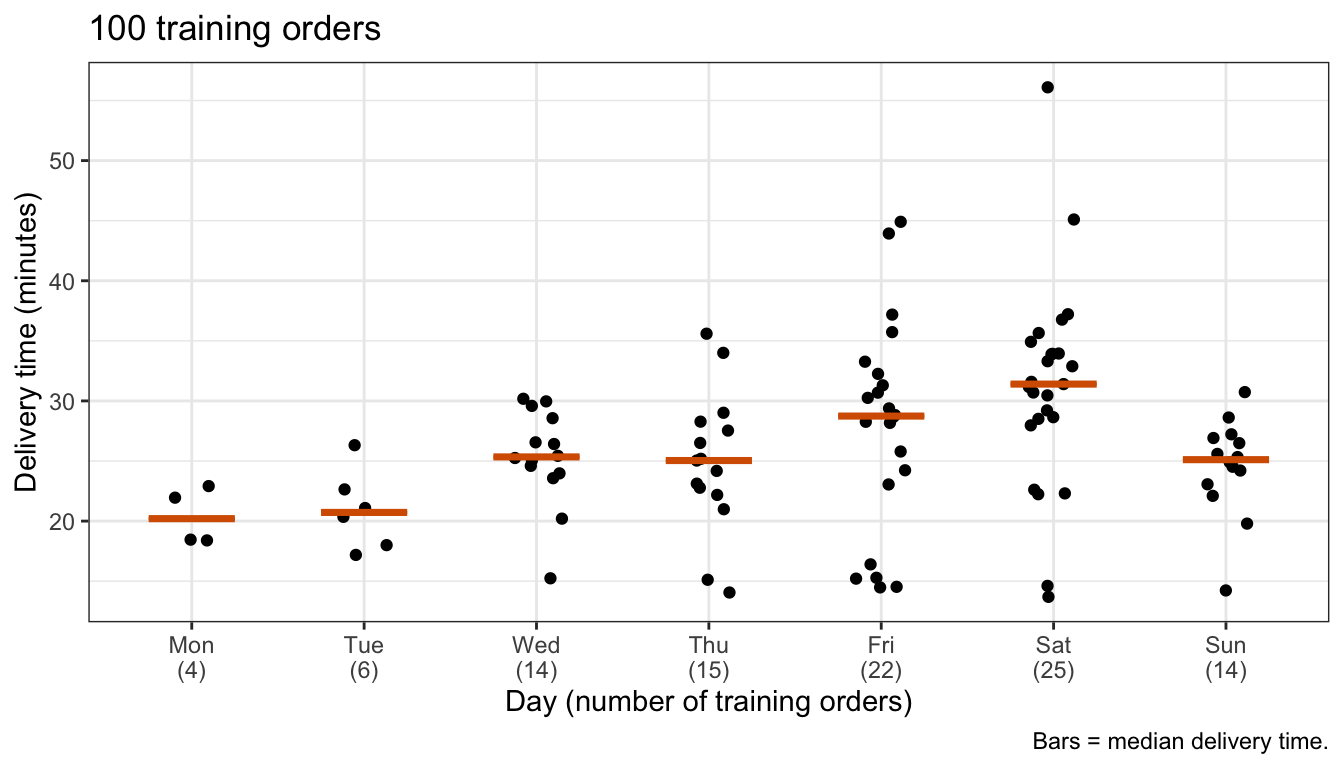
hour,day,distance,item_01, …,item_27
- Training orders: 100, a small random sample
- Test orders: 9,912, every other order
Data
Features
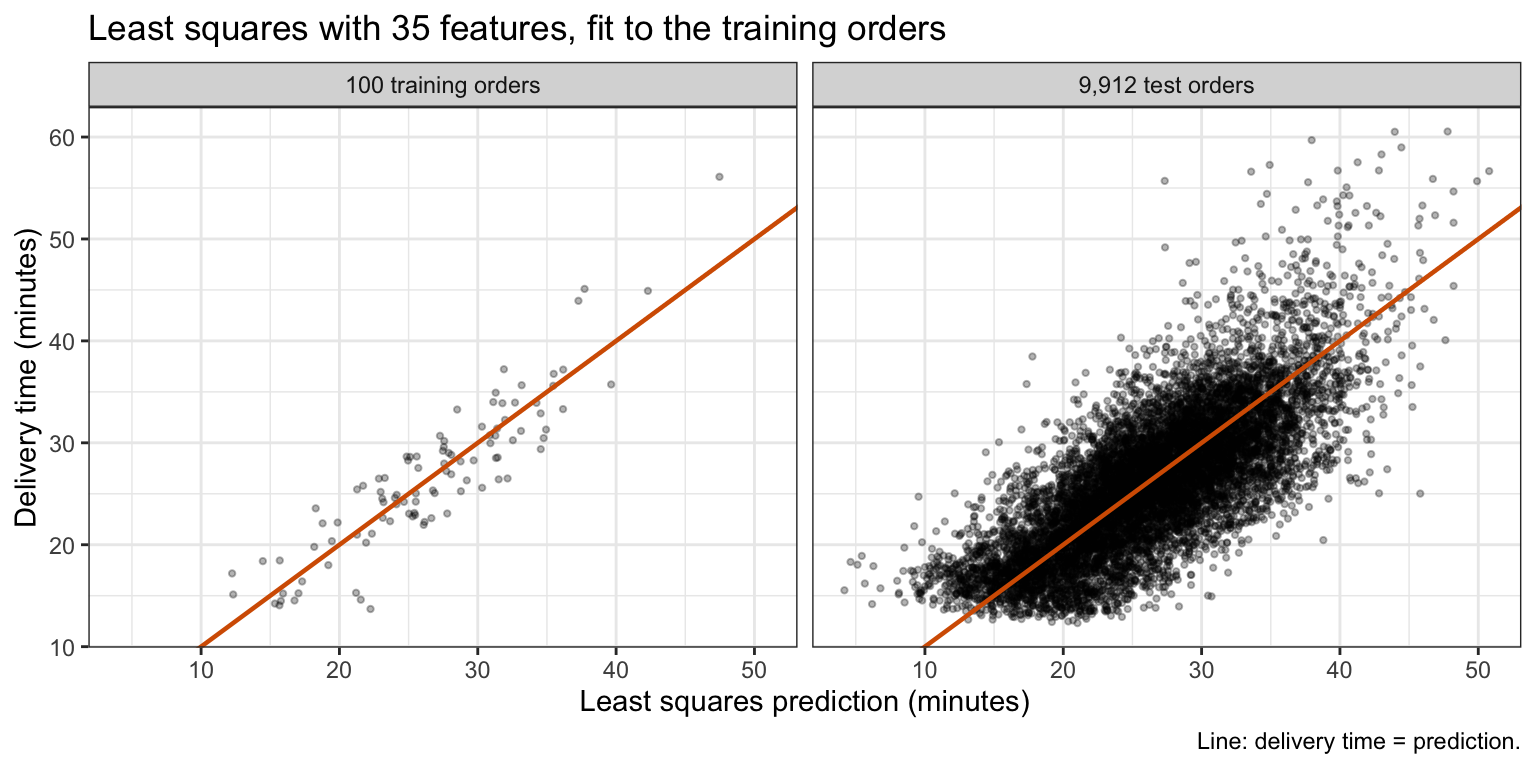
- Features, \(p = 35\):
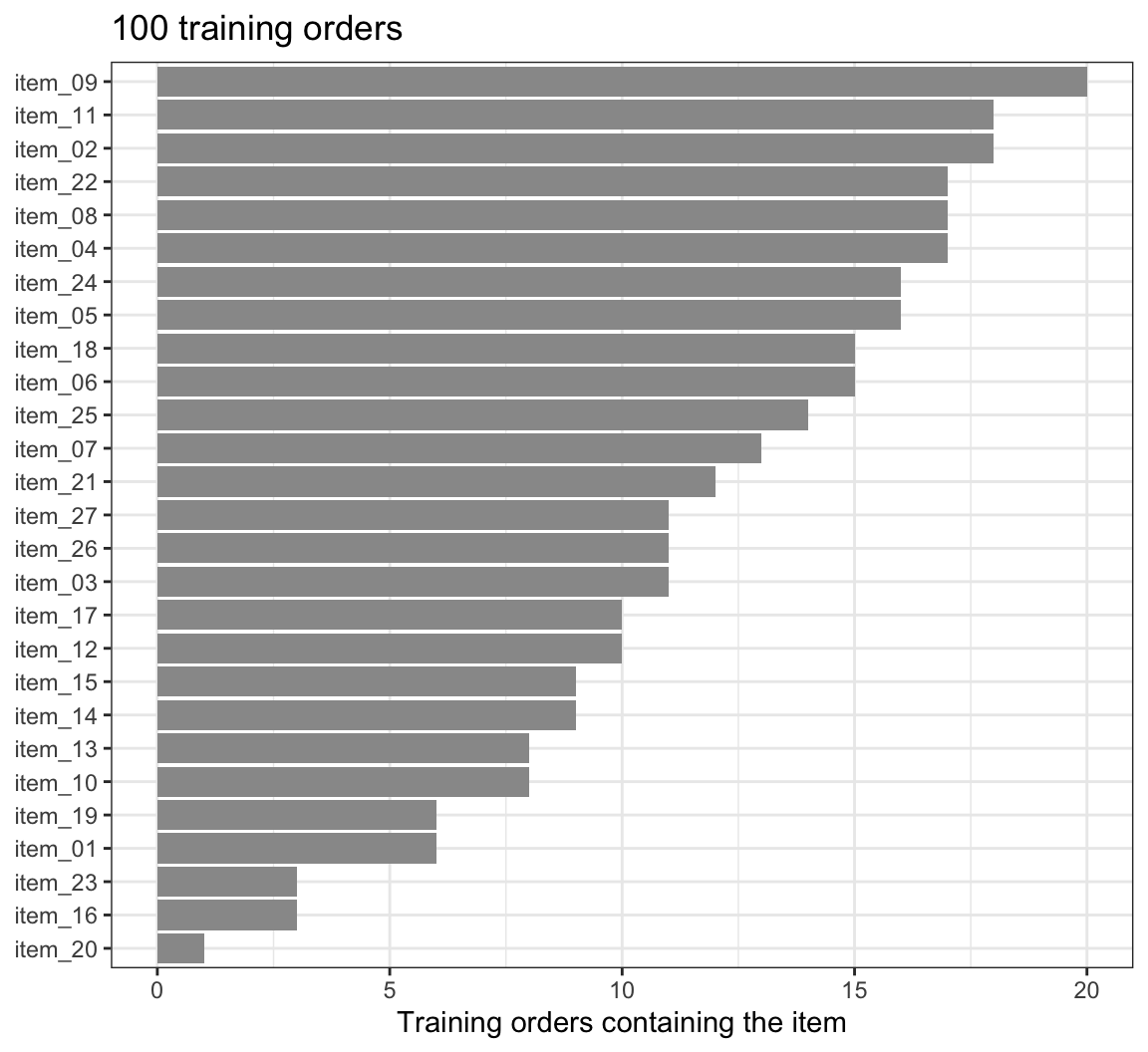
hour,distance, 27 item counts, 6 day dummies
- Reference level: Monday
Least squares
Ridge regression
Item counts
Penalized criterion
\[\sum_{i=1}^n\left(y_i - \beta_0 - \sum_{j=1}^p\beta_j\tilde x_{ij}\right)^2 + \lambda\sum_{j=1}^p\beta_j^2 = RSS + \lambda\sum_{j=1}^p\beta_j^2\]
- \(\tilde x_{ij} = \left(x_{ij} - \bar x_j\right)/s_j\) — feature \(j\) of order \(i\), standardized
- \(\lambda \ge 0\) — tuning parameter
- \(\lambda\sum_{j=1}^p\beta_j^2\) — shrinkage penalty
- \(\beta_0\) — intercept, not penalized
Closed form
\[\widehat\beta_0 = \bar y, \qquad \widehat\beta^R_\lambda = \left(\tilde{\mathbf{X}}^\top\tilde{\mathbf{X}} + \lambda\mathbf{I}_p\right)^{-1}\tilde{\mathbf{X}}^\top\left(y - \bar y\mathbf{1}\right)\]
- \(\tilde{\mathbf{X}}\) — standardized features, without a column of ones
- \(\mathbf{I}_p\) — \(p \times p\) identity matrix
- \(\lambda = 0\): least squares
- \(\lambda \to \infty\): \(\widehat\beta^R_\lambda \to 0\), the null model
glmnet scaling
\[\frac{1}{2n}RSS + \frac{\lambda_{\text{glmnet}}}{2}\sum_{j=1}^p\beta_j^2\]
\[\lambda = \frac{n\,\lambda_{\text{glmnet}}}{s_y}\]
- \(\lambda_{\text{glmnet}}\) — the value
glmnet()callslambda - \(s_y\) — standard deviation of \(y\), divisor \(n\)
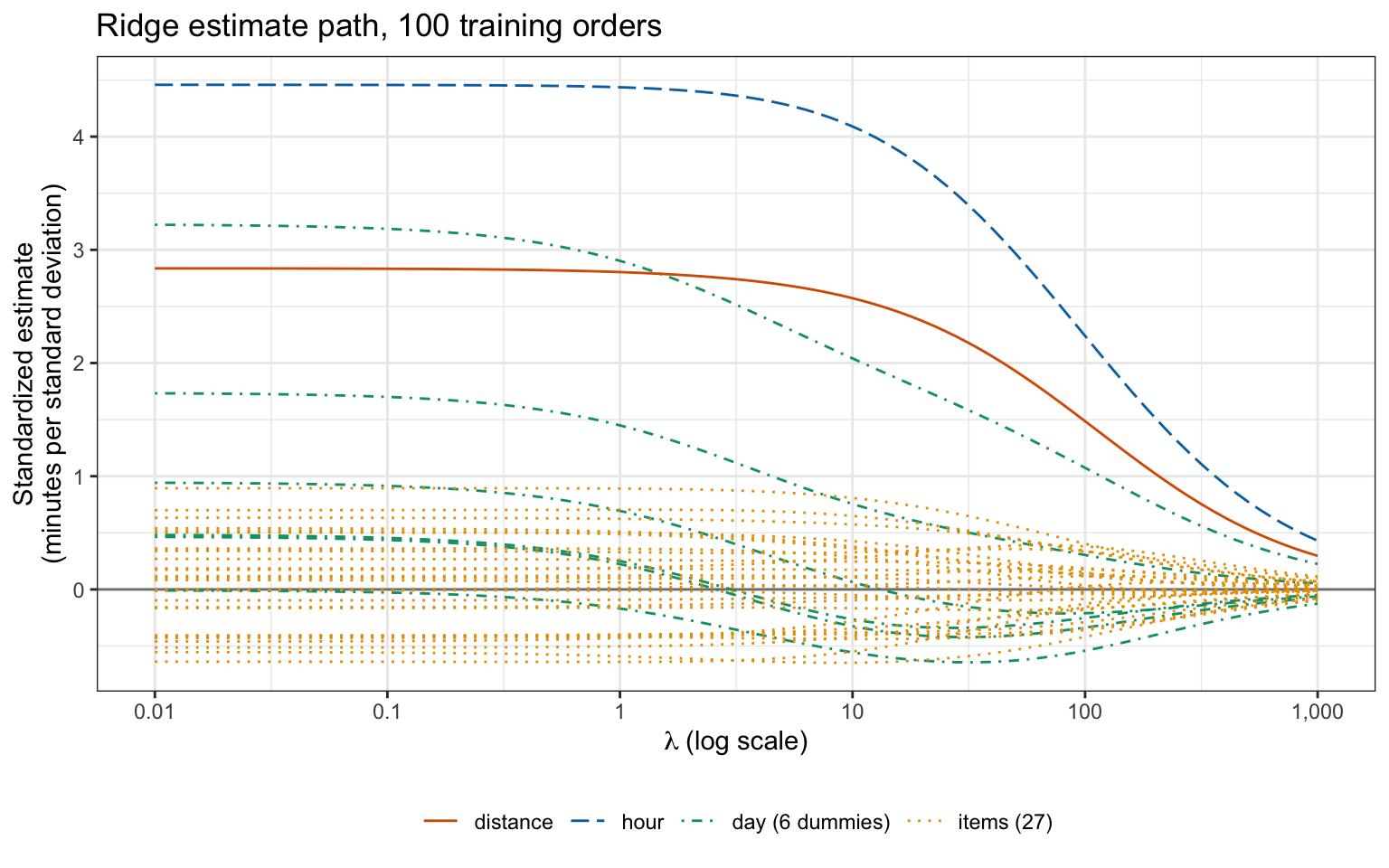
Estimate path
Bias-variance tradeoff
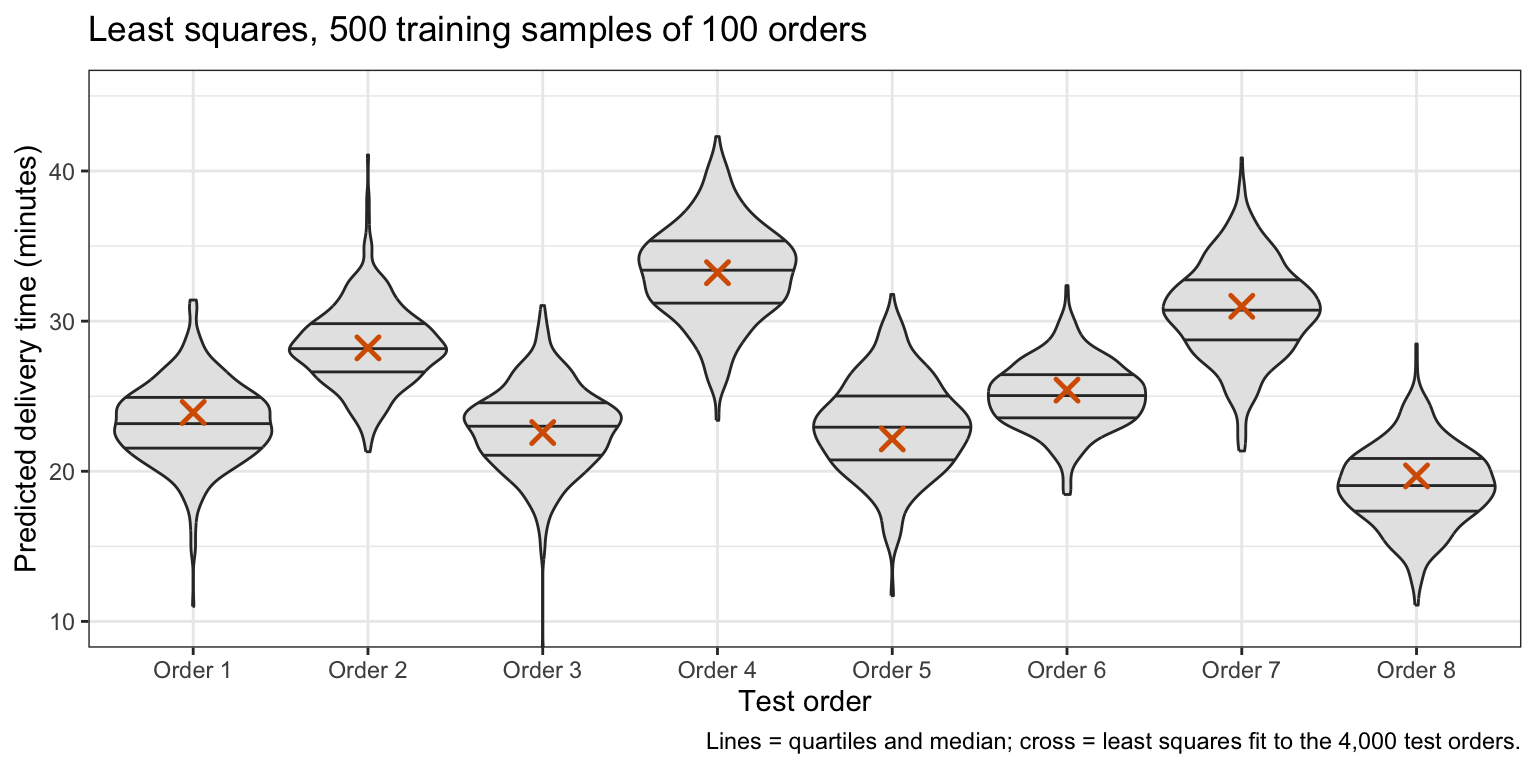
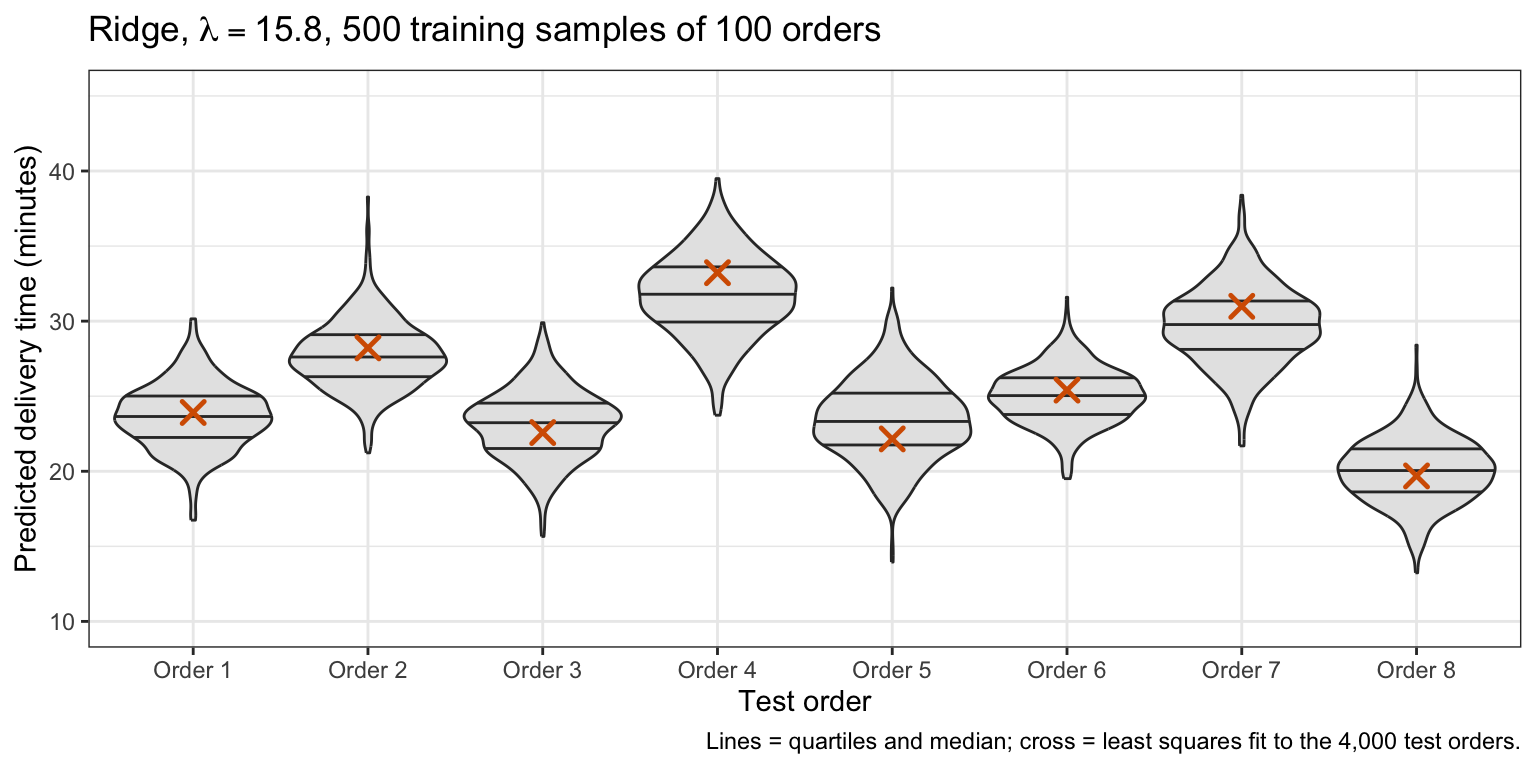
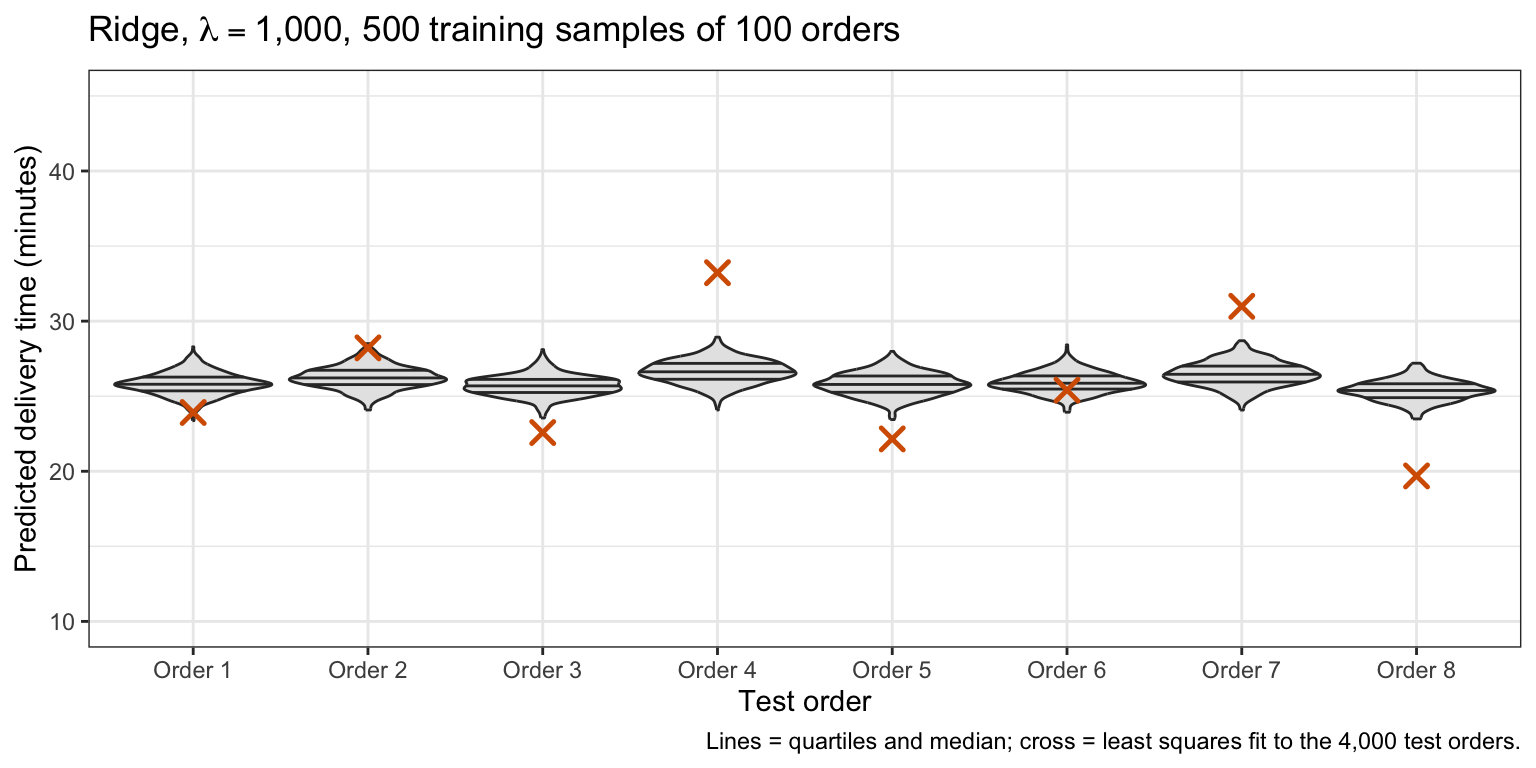
Prediction spread
Training sample size
Tuning parameter selection
Cross-validation
Test evaluation
| Method | \(\lambda\) | Training MSE | 10-fold CV estimate | Test MSE |
|---|---|---|---|---|
| Least squares | 0 | 10.13 | 29.23 | 22.02 |
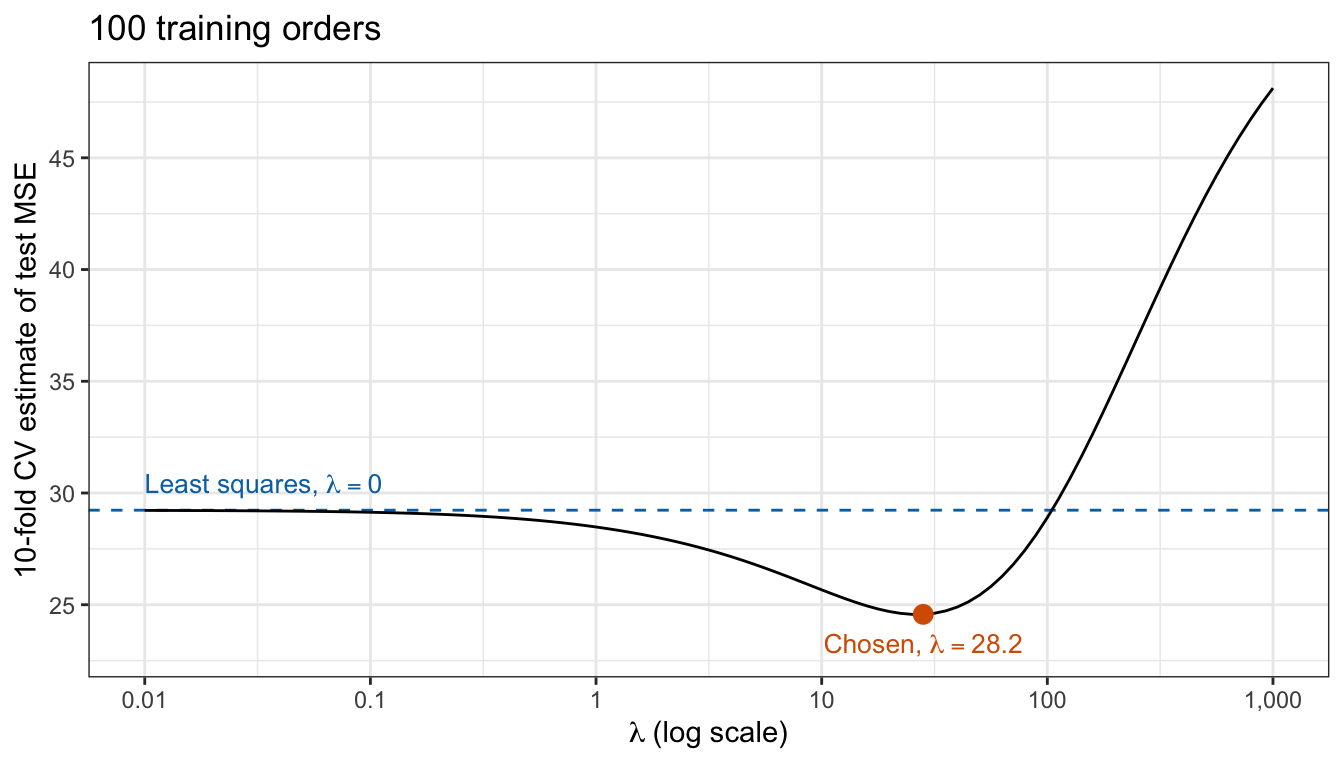
| Ridge | 28.2 | 12.23 | 24.57 | 20.38 |
Conclusion
- Ridge penalizes the squared coefficients, not the intercept
- The ridge estimate has a closed form between least squares and the null model
- Estimates shrink smoothly toward zero as \(\lambda\) grows, and none reaches it
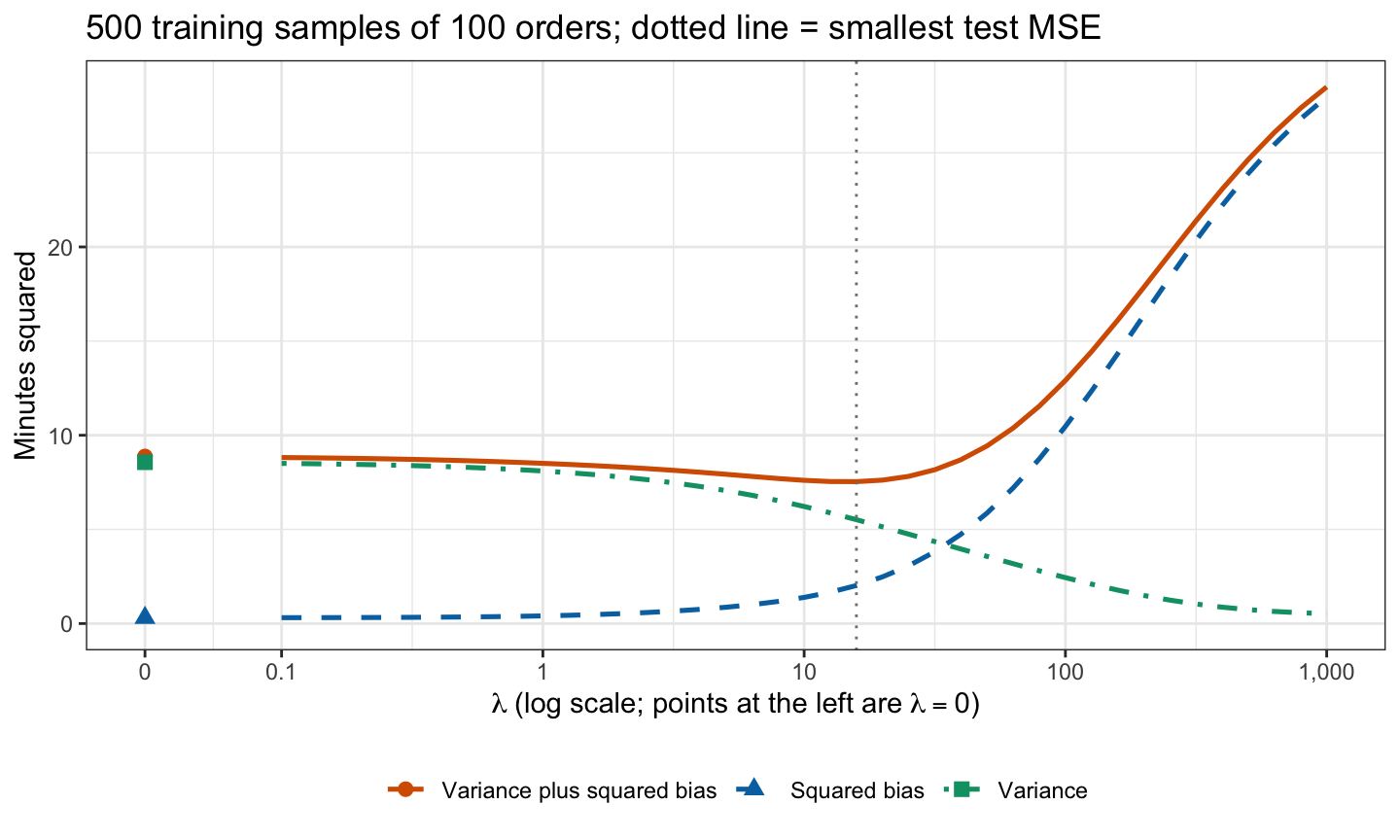
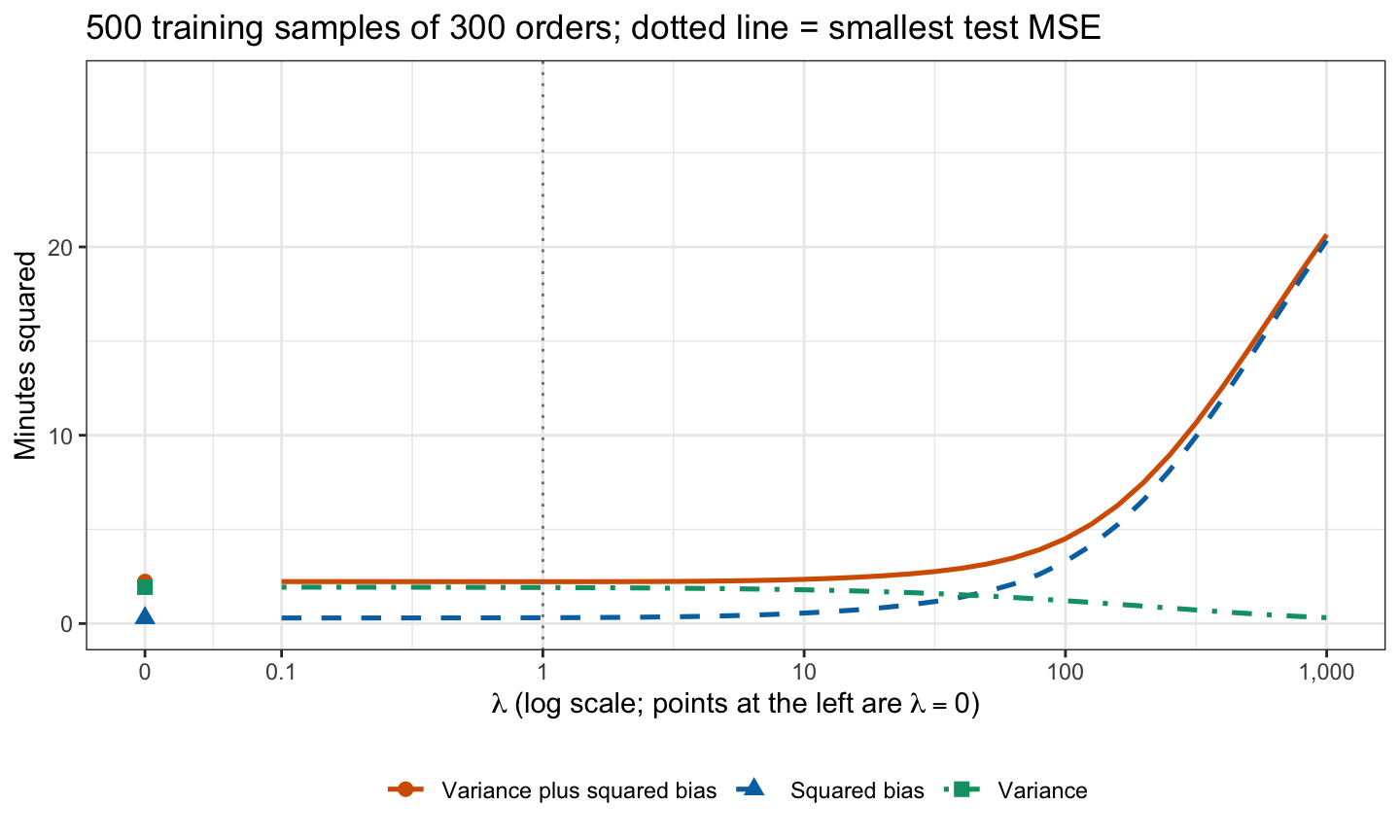
- The gain over least squares is largest for small training samples
- Choose \(\lambda\) by cross-validation, evaluate once on test data
DS 3030