The Lasso
Today
- Delivery times
- Lasso
- Penalized criterion
- Constraint regions
- Soft thresholding
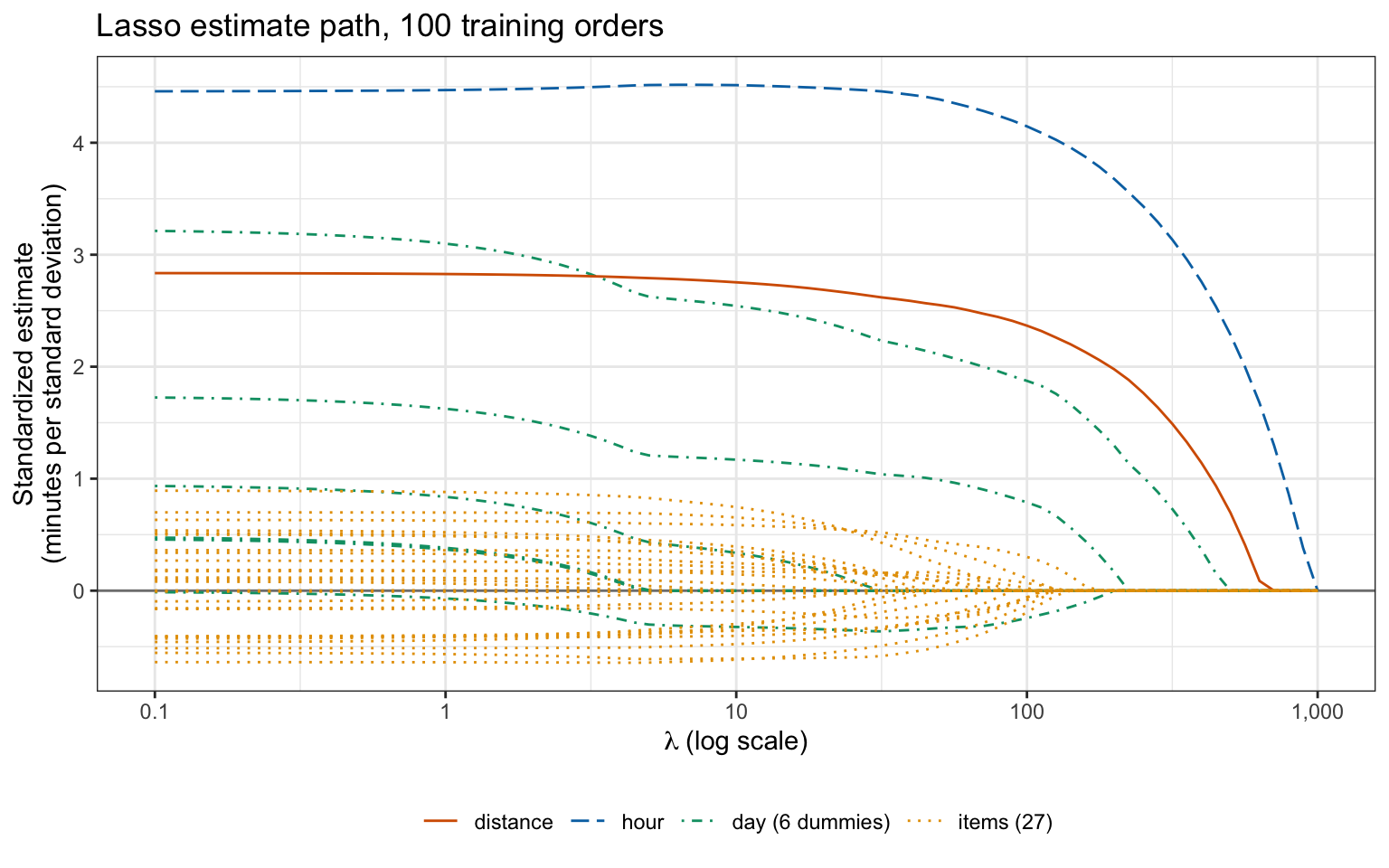
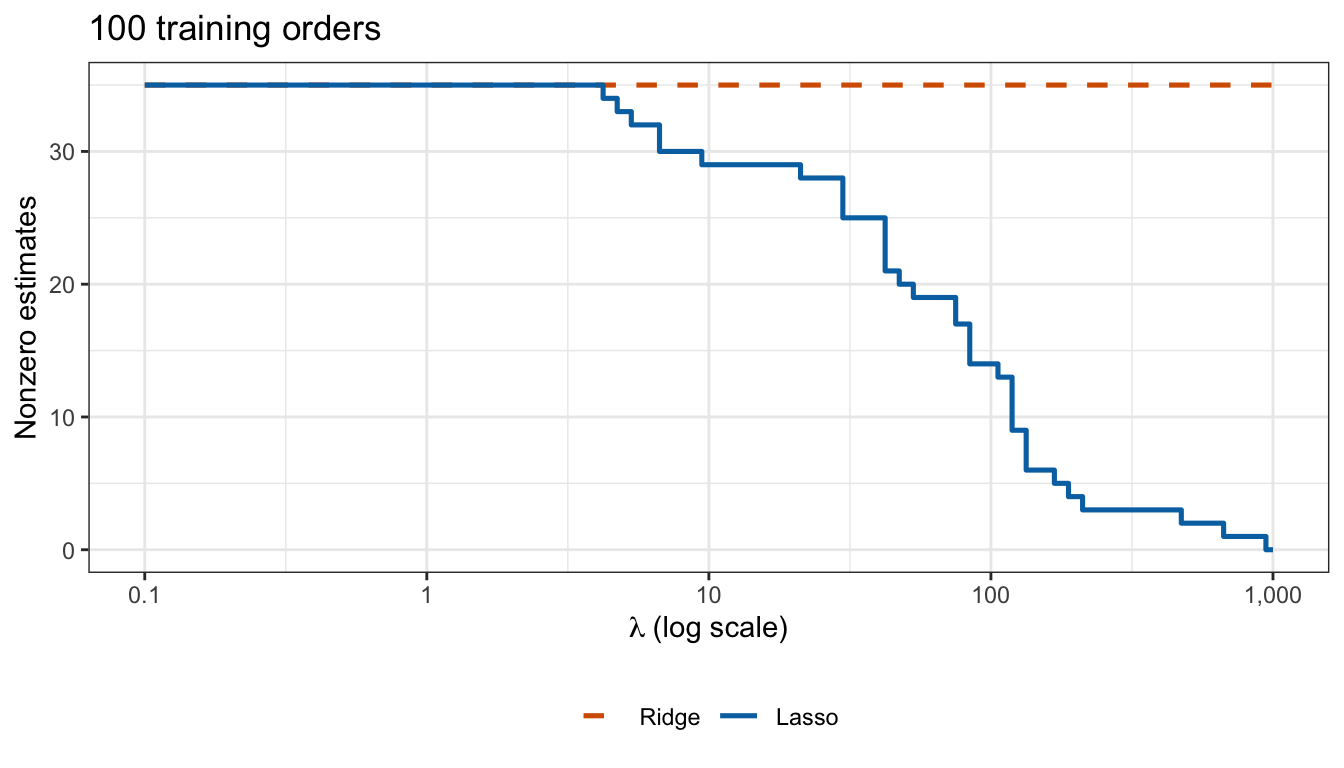
- Estimate path
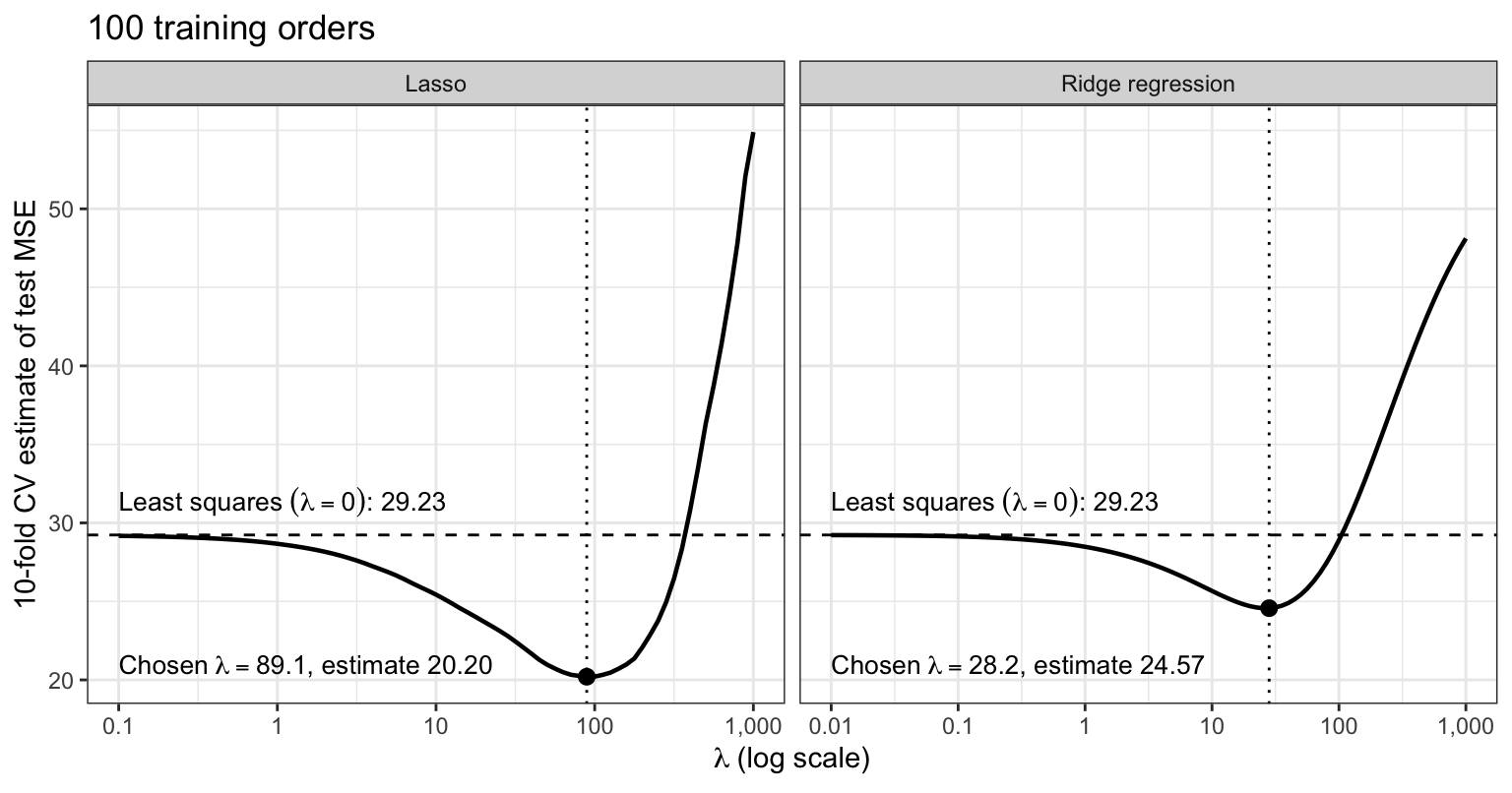
- Tuning parameter selection
- Cross-validation
- Test evaluation
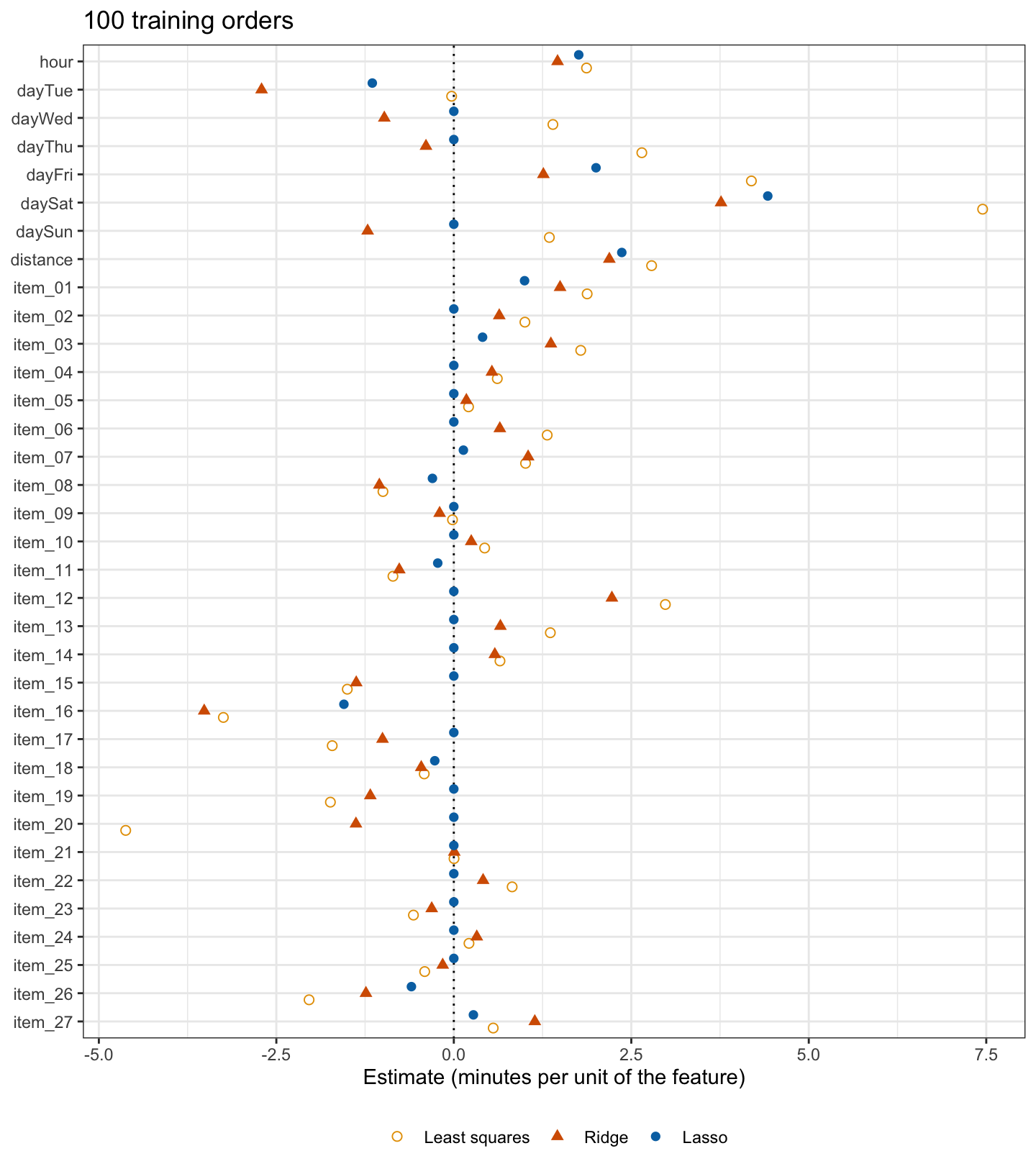
- Lasso estimates
- Repeated training samples
- Test MSE
- Selected sets
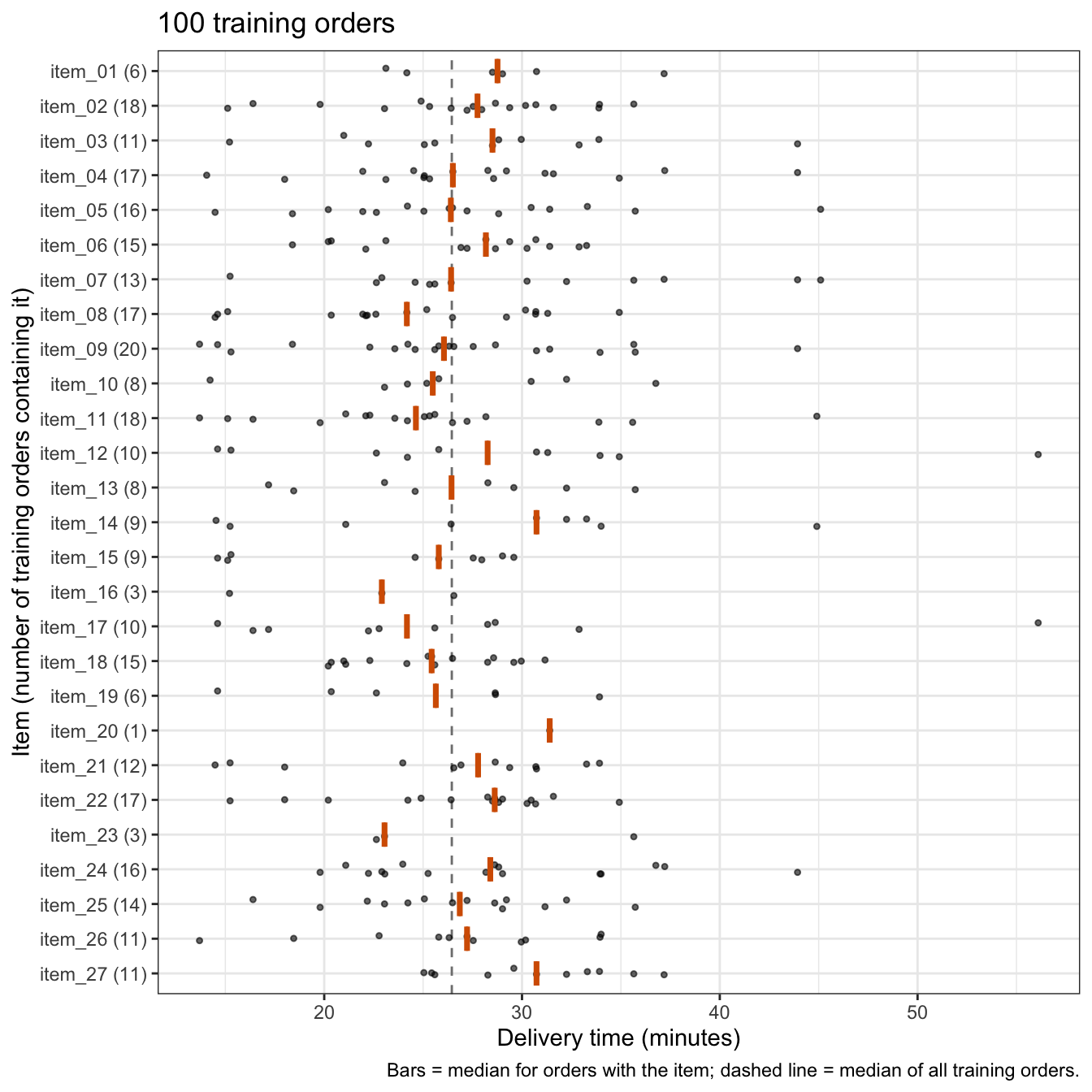
Delivery times
- Question: does a model that keeps only some of the 35 features predict delivery times better than one that uses all of them?
- Response variable:
time_to_delivery, in minutes - Explanatory variables:
hour,day,distance,item_01, …,item_27
- Training orders: 100, the ridge lecture’s sample
- Test orders: 9,912, the ridge lecture’s test orders
Data
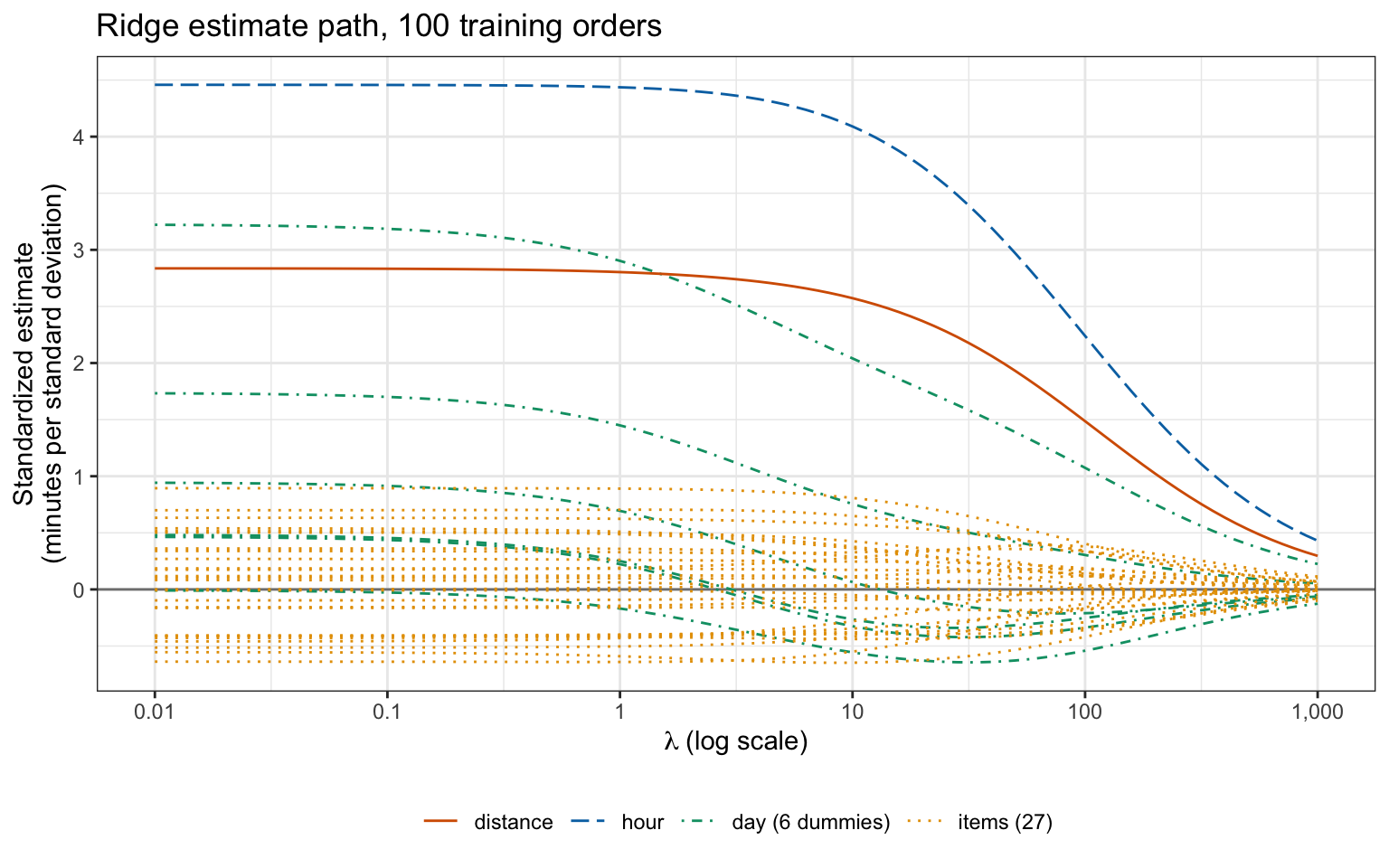
Ridge estimates
Lasso
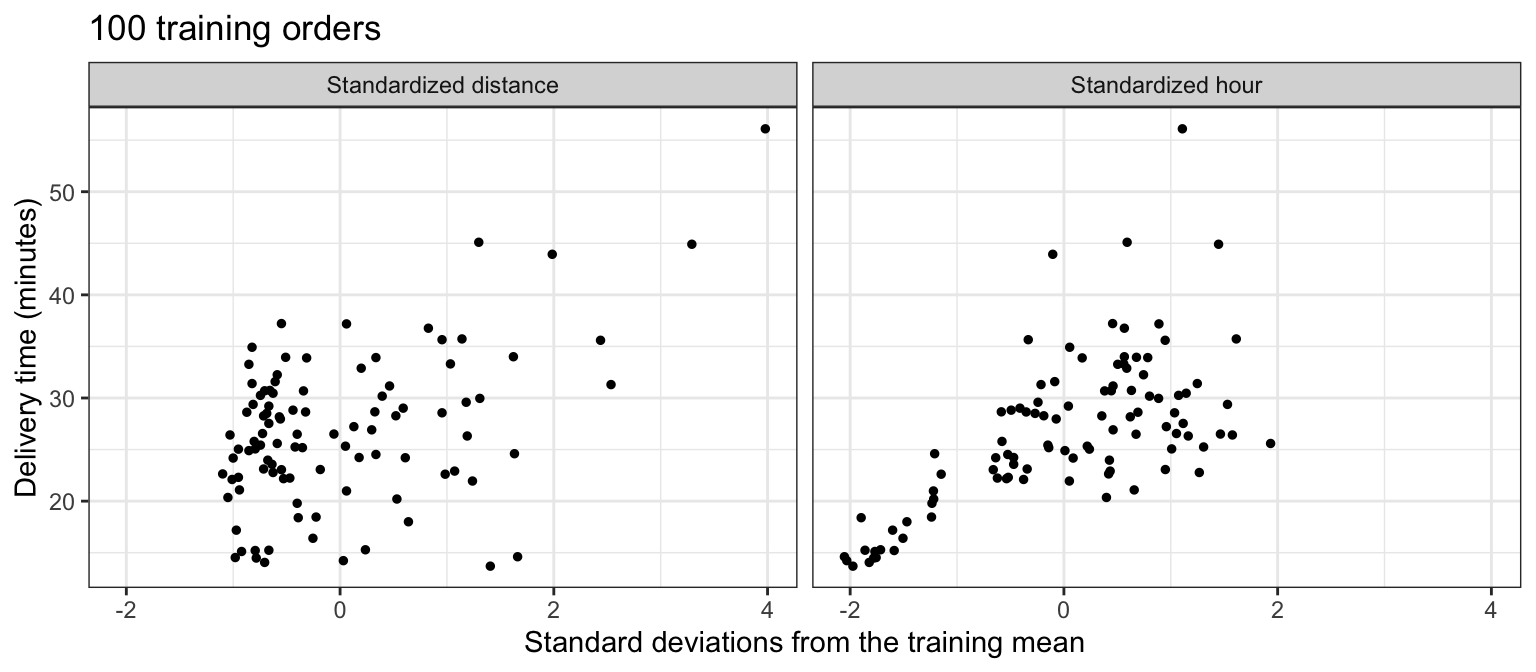
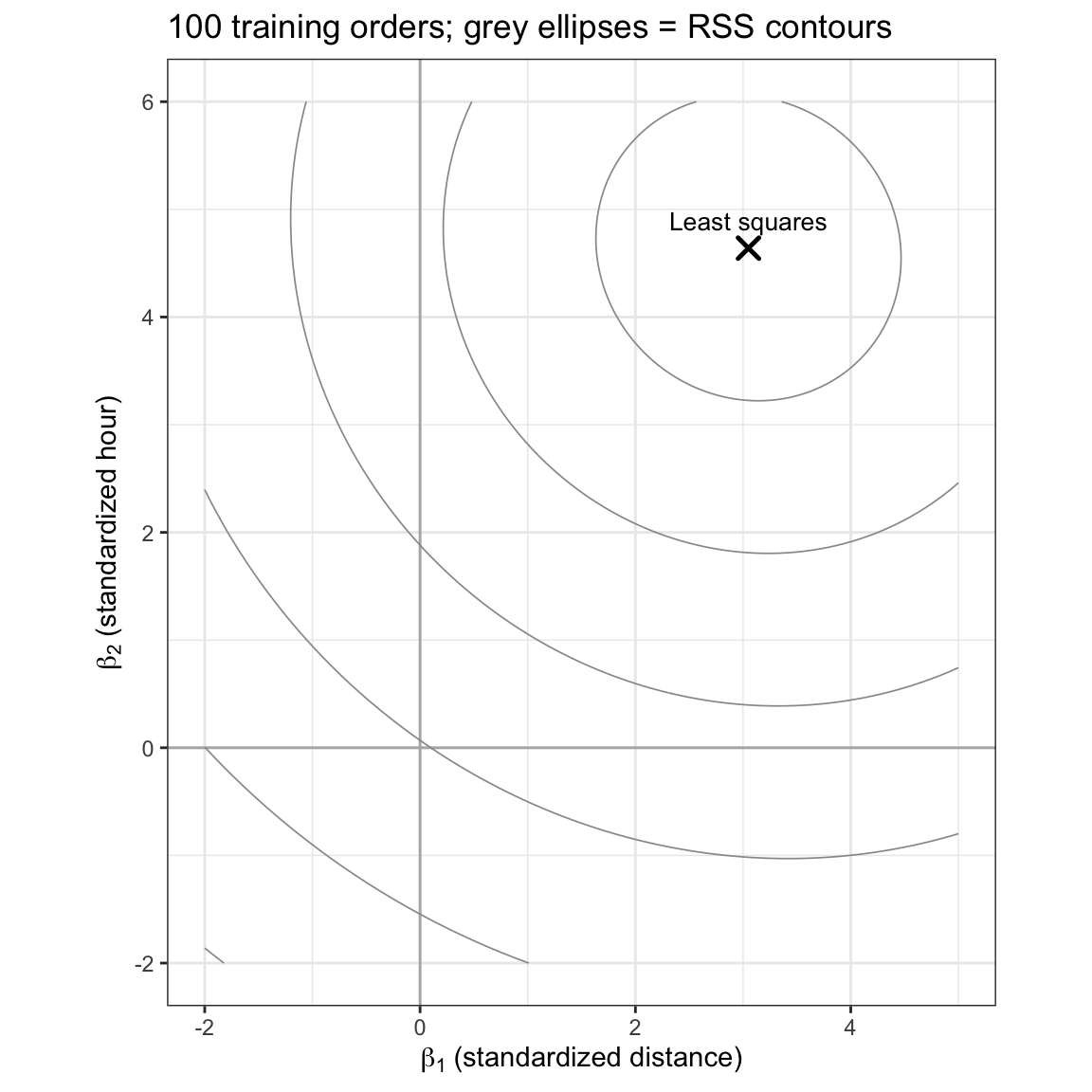
Two features
Penalized criterion
\[\sum_{i=1}^n\left(y_i - \beta_0 - \sum_{j=1}^p\beta_j\tilde x_{ij}\right)^2 + \lambda\sum_{j=1}^p\left|\beta_j\right| = RSS + \lambda\sum_{j=1}^p\left|\beta_j\right|\]
- \(\tilde x_{ij}\) — feature \(j\) of order \(i\), standardized
- \(\lambda \ge 0\) — tuning parameter
- \(\lambda\sum_{j=1}^p\left|\beta_j\right|\) — \(\ell_1\) penalty; ridge: \(\ell_2\) penalty \(\lambda\sum_{j=1}^p\beta_j^2\)
- \(\beta_0\) — intercept, not penalized
Maximum lambda
\[\lambda \ge \lambda_{\max} = \max_{j}\, 2\left|\sum_{i=1}^n\tilde x_{ij}\left(y_i - \bar y\right)\right|\]
- \(\lambda = 0\): least squares
- \(\lambda \ge \lambda_{\max}\): \(\widehat\beta_0 = \bar y\) and every slope estimate is zero, the null model
- Training orders: \(\lambda_{\max} = 967.4\), set by
hour
Constraint regions
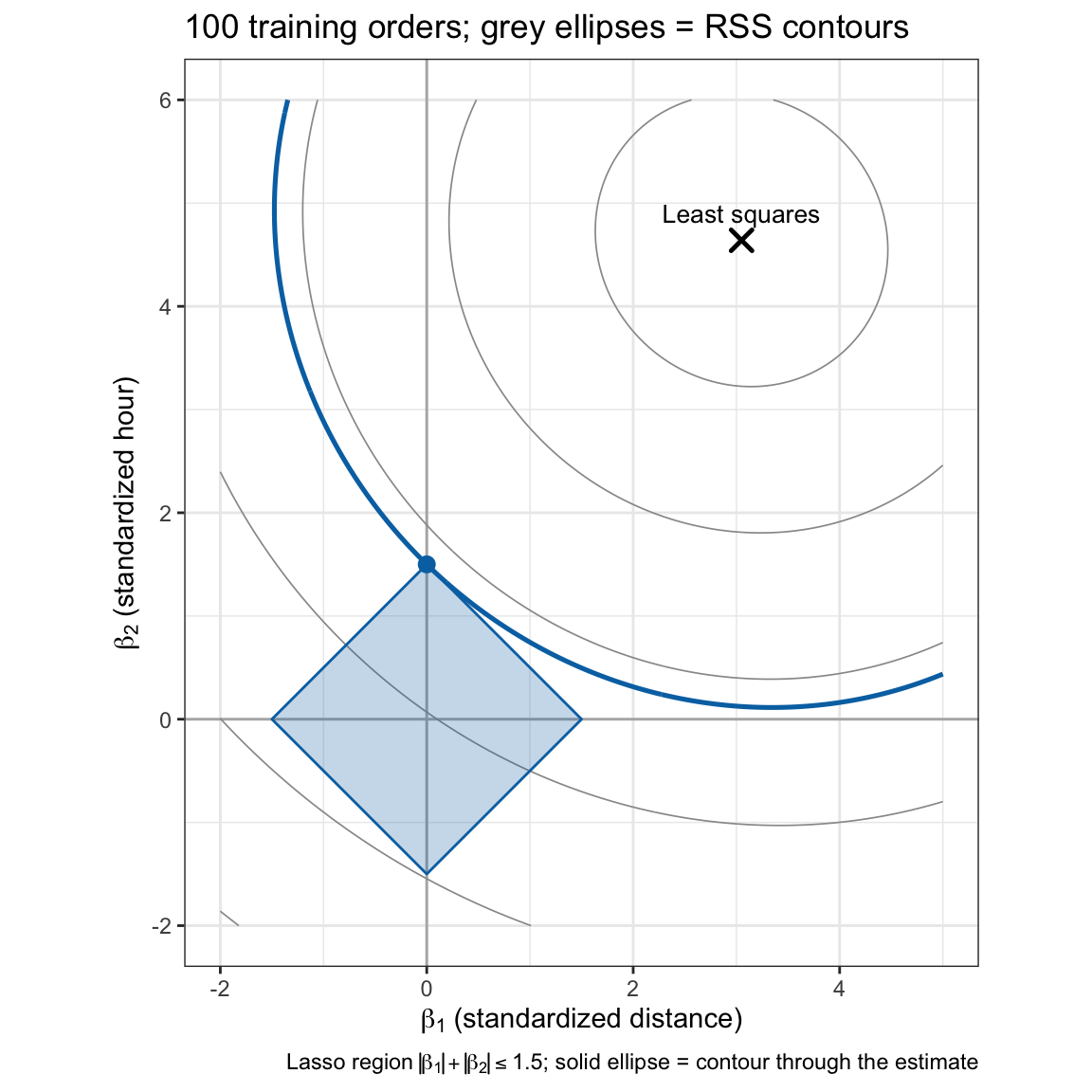
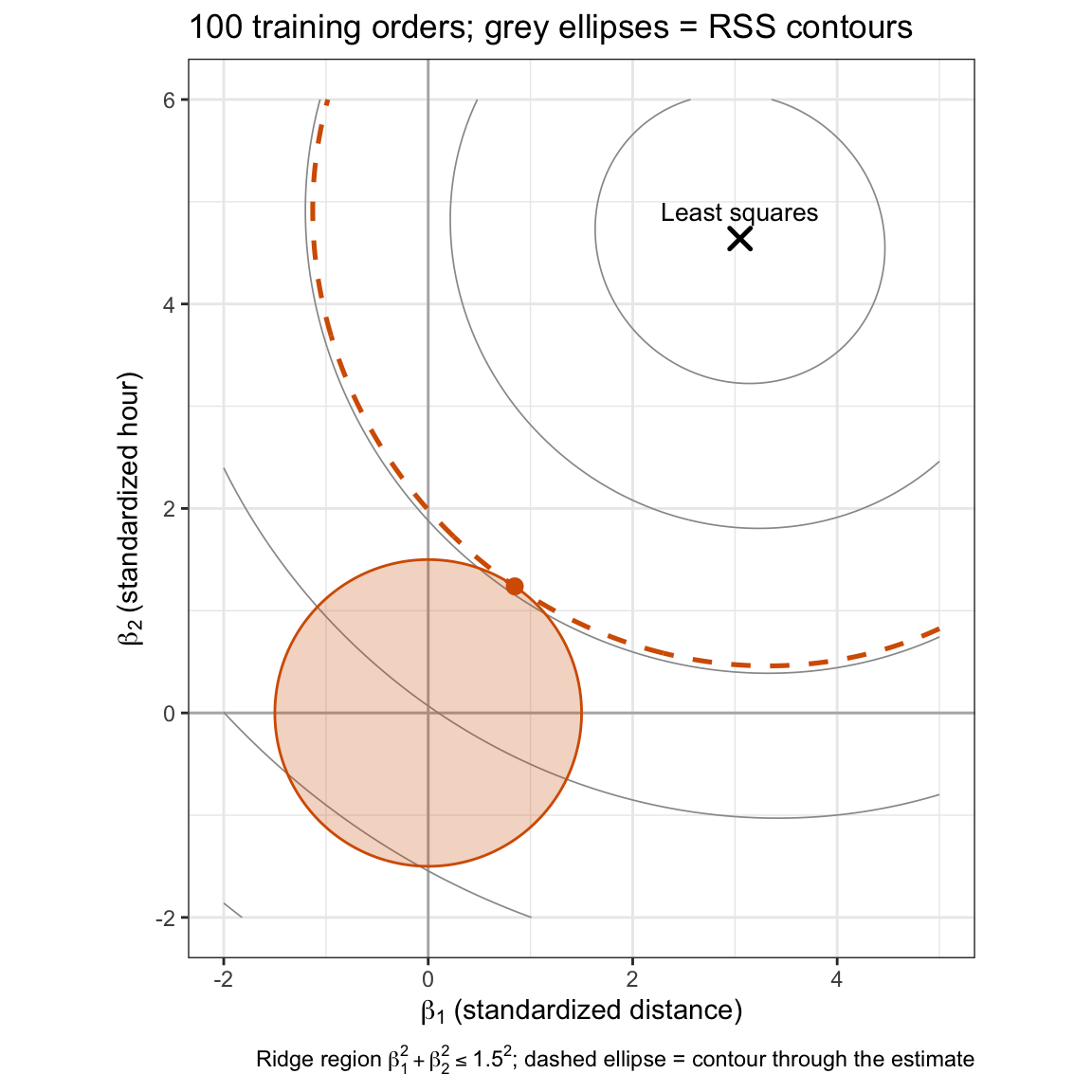
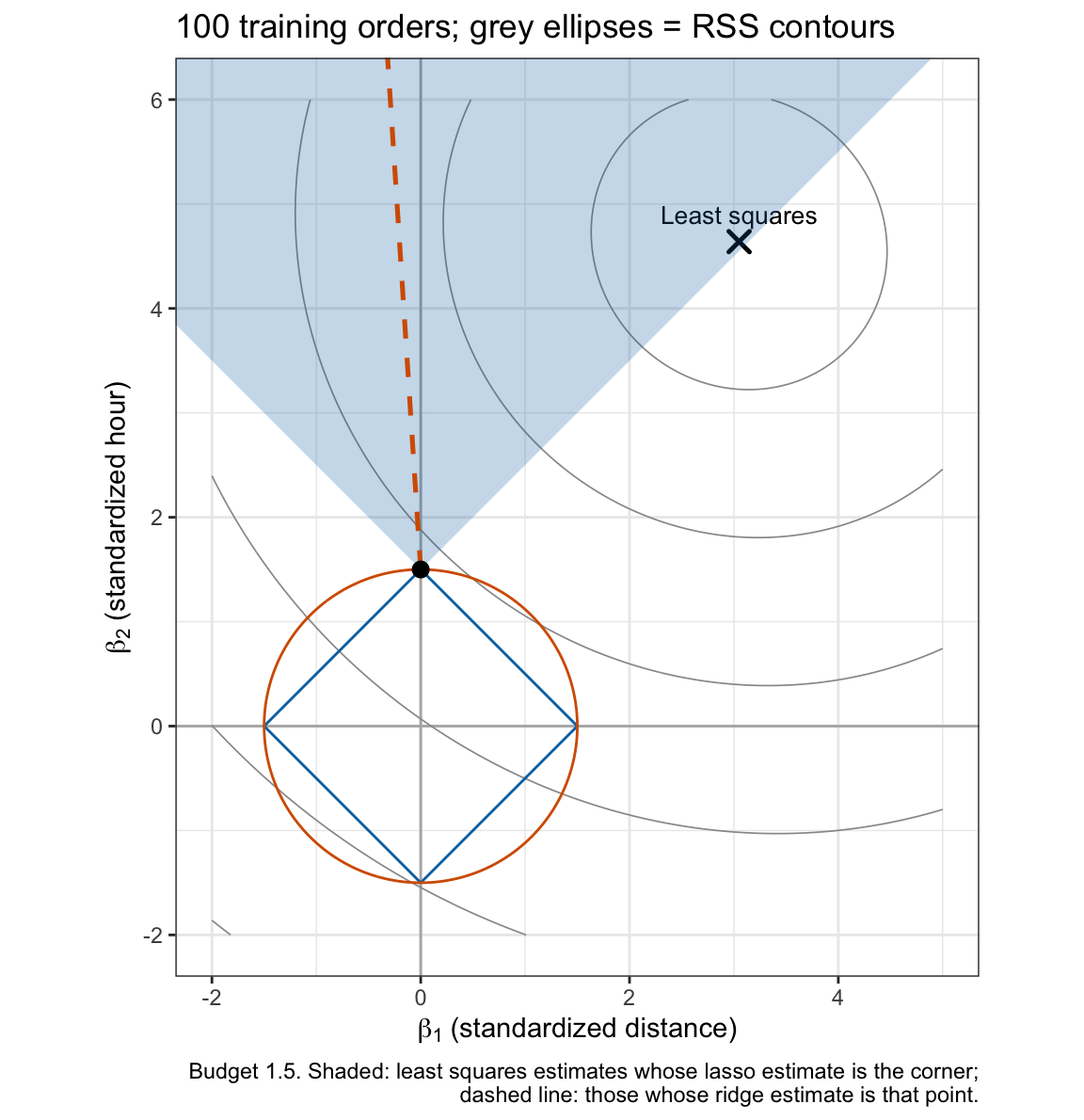
Minimize the RSS subject to
\[\sum_{j=1}^p\left|\beta_j\right| \le s, \qquad\text{and for ridge regression}\qquad \sum_{j=1}^p\beta_j^2 \le s\]
- \(s \ge 0\) — budget
- smaller \(\lambda\), larger \(s\)
Constraint regions, two features
Best subset selection
\[\sum_{j=1}^p\mathrm{I}\left(\beta_j \ne 0\right) \le s\]
- \(\sum_j\mathrm{I}\left(\beta_j \ne 0\right)\) — number of nonzero coefficients, the \(\ell_0\) penalty
- lasso: a convex relaxation
Soft thresholding
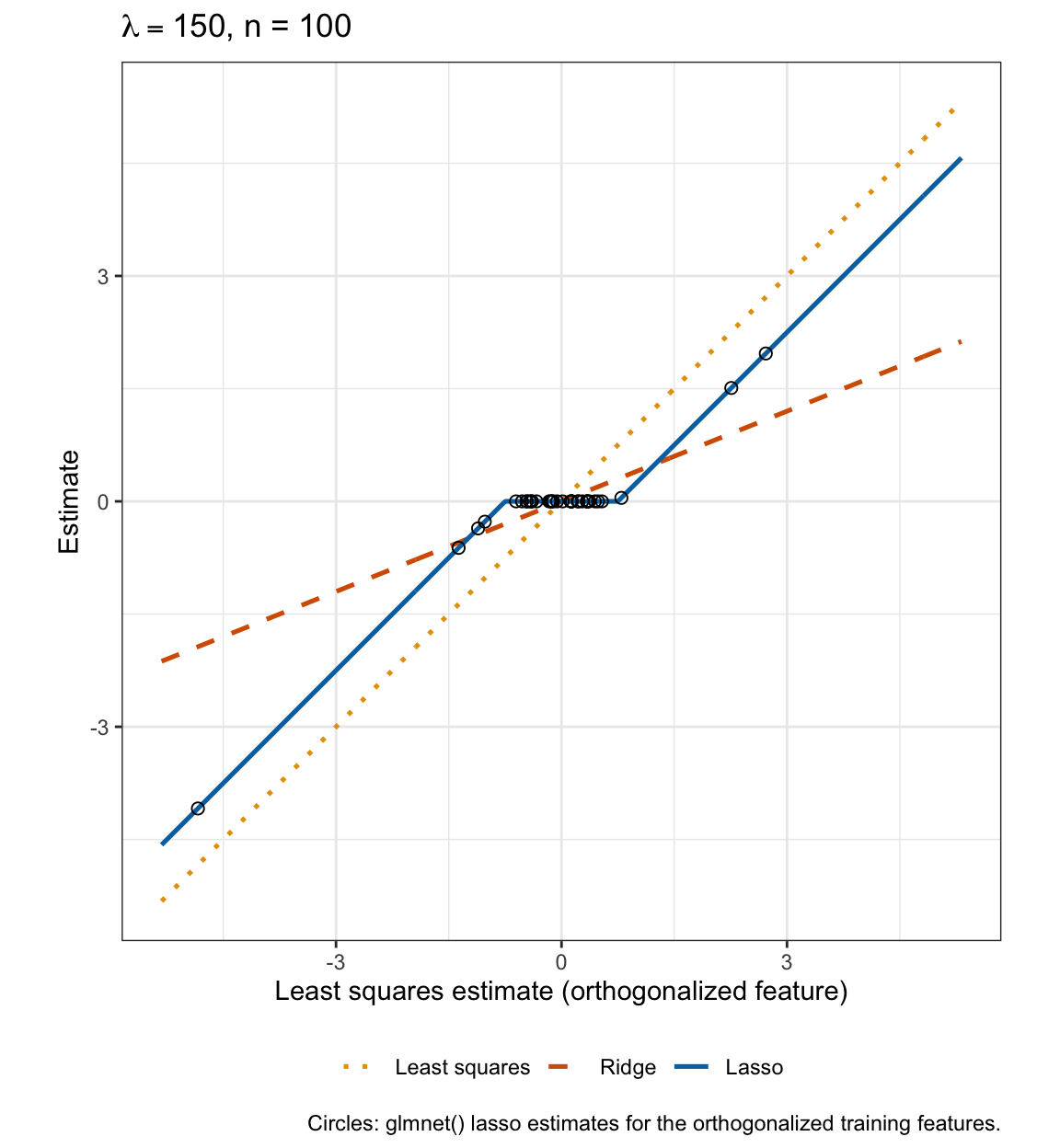
Orthogonal standardized features: \(\tilde{\mathbf{X}}^\top\tilde{\mathbf{X}} = n\mathbf{I}_p\)
\[\widehat\beta^L_{\lambda j} = \text{sign}\left(\widehat\beta_j\right)\left(\left|\widehat\beta_j\right| - \frac{\lambda}{2n}\right)_+, \qquad \widehat\beta^R_{\lambda j} = \frac{n}{n + \lambda}\widehat\beta_j\]
- \(\widehat\beta_j\) — least squares estimate
- \(\widehat\beta^L_{\lambda j}\) — lasso estimate
- \(\widehat\beta^R_{\lambda j}\) — ridge estimate
- \((u)_+ = \max(u, 0)\)
- \(\lambda/(2n)\) — threshold
Lasso and ridge estimates
glmnet scaling
\[\frac{1}{2n}RSS + \lambda_{\text{glmnet}}\sum_{j=1}^p\left|\beta_j\right|\]
\[\lambda = 2n\,\lambda_{\text{glmnet}}\]
- \(\lambda_{\text{glmnet}}\) — the value
glmnet()callslambda - no \(s_y\), unlike ridge regression’s \(\lambda = n\lambda_{\text{glmnet}}/s_y\)
Estimate path
Tuning parameter selection
Cross-validation
Test evaluation
| Method | \(\lambda\) | Nonzero estimates | Training MSE | 10-fold CV estimate | Test MSE |
|---|---|---|---|---|---|
| Least squares | 0 | 35 | 10.13 | 29.23 | 22.02 |
| Ridge | 28.2 | 35 | 12.23 | 24.57 | 20.38 |
| Lasso | 89.1 | 14 | 13.78 | 20.20 | 16.96 |
Lasso estimates
Interpretation
- Intercept, original scale: \(\widehat\beta_0 = -10.5\) minutes, for a Monday order at hour 0, distance 0, no items
- Hour: 1.76 minutes per hour (ridge 1.46, least squares 1.87)
- Distance: 2.37 minutes per mile (ridge 2.19, least squares 2.79)
- Day: keeps Tue, Fri, Sat; drops Wed, Thu, Sun, predicted like Monday
- Items: keeps 9 of 27, minutes per additional unit of the item
- Nonzero lasso estimates are shrunken toward zero
lm()standard errors and \(p\)-values do not apply
Repeated training samples
Test MSE
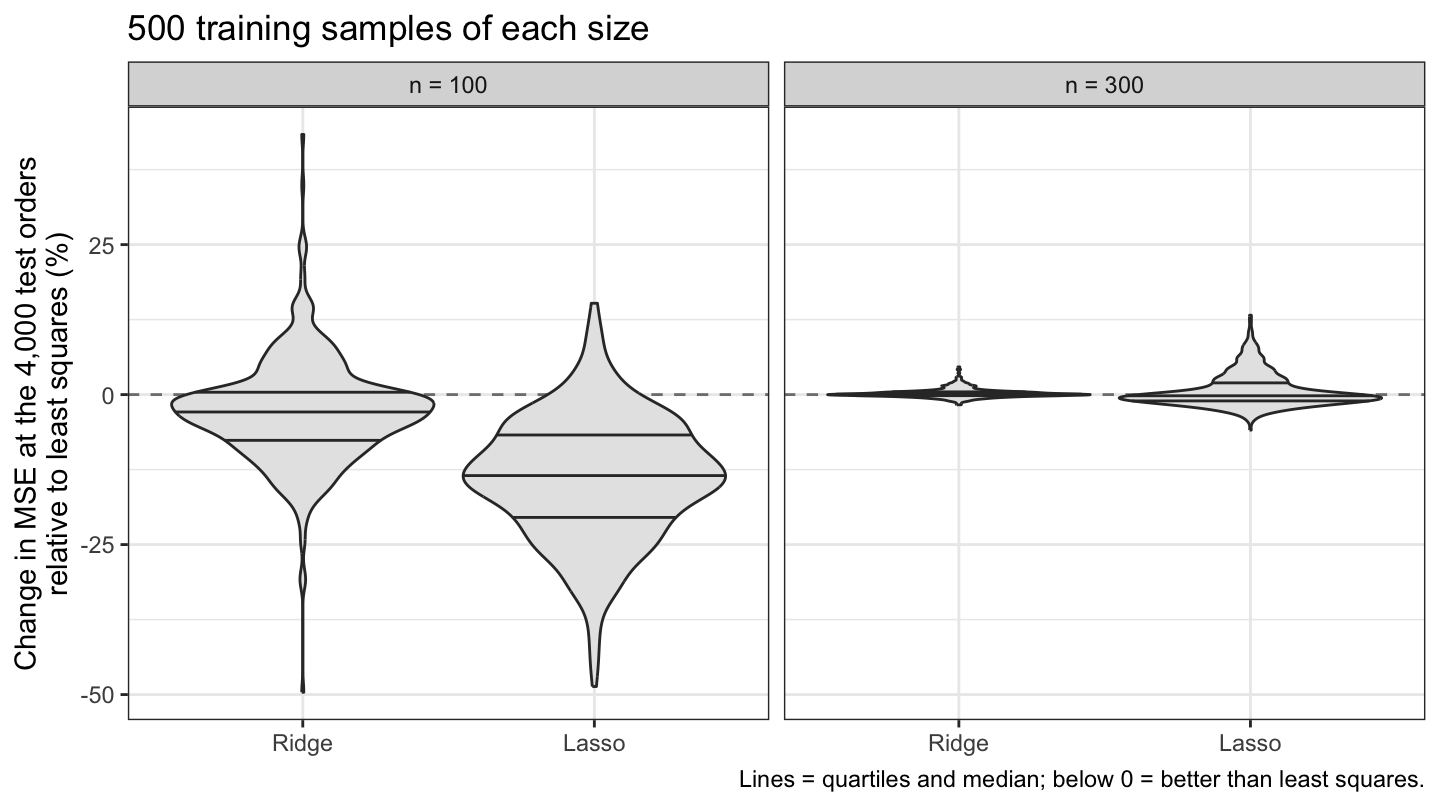
Average over samples
- \(n = 100\): the lasso has the lower MSE than least squares in 94% of the samples; its average MSE is 15.0% below
- \(n = 300\): the lasso has the lower MSE in 56% of the samples; its average MSE is 0.6% above least squares
Selected sets
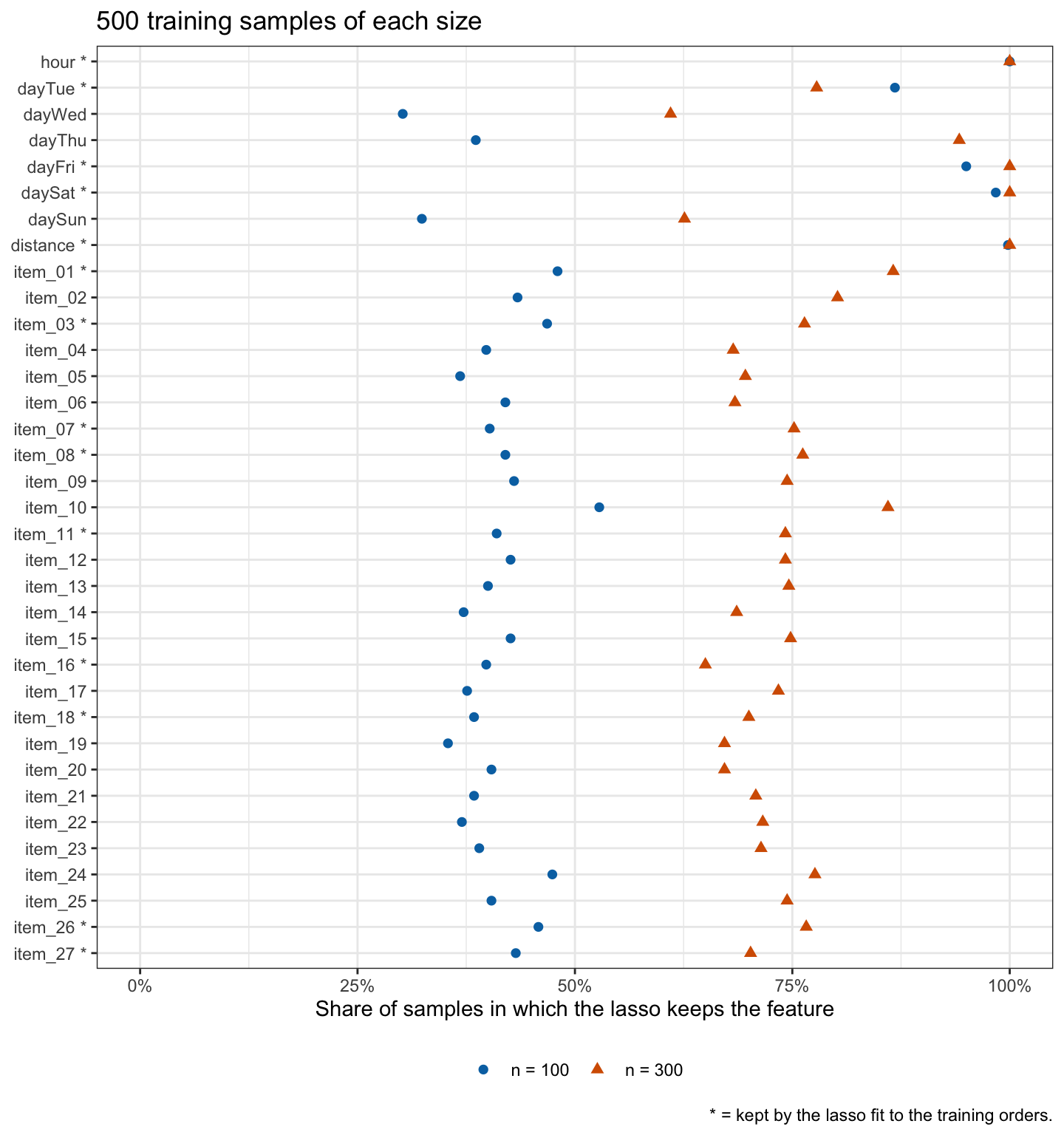
Estimator bias
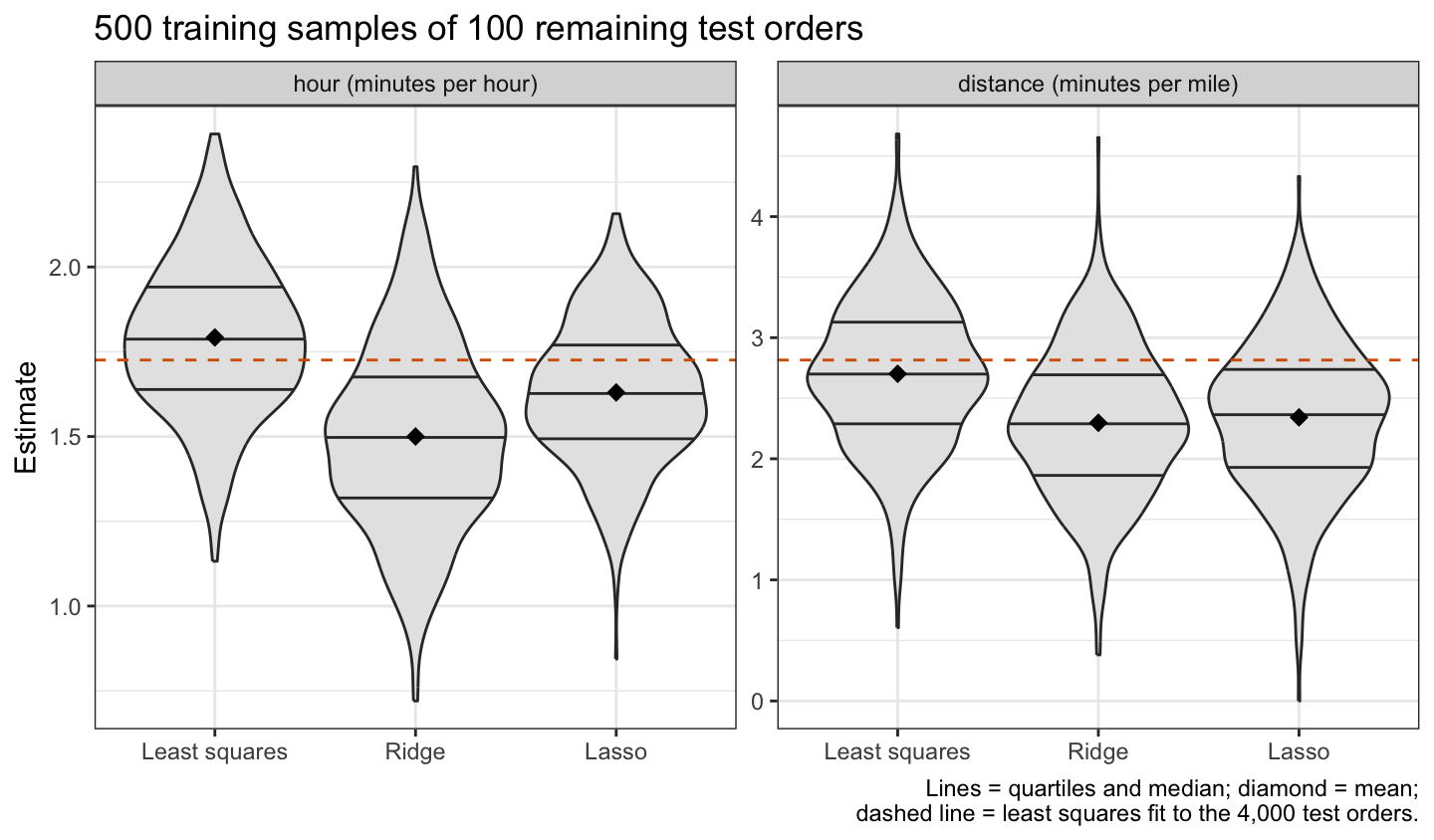
Conclusion
- The lasso penalizes absolute coefficients, so some estimates are exactly zero
- Soft thresholding shrinks estimates and zeroes the small ones
- Choose \(\lambda\) by cross-validation; evaluate once on test data
- Lasso versus ridge depends on how many features matter
- The selected set is unstable and the lasso estimator is biased toward zero
DS 3030