Method Comparison
Today
- Ames home sales
- Data
- Training homes
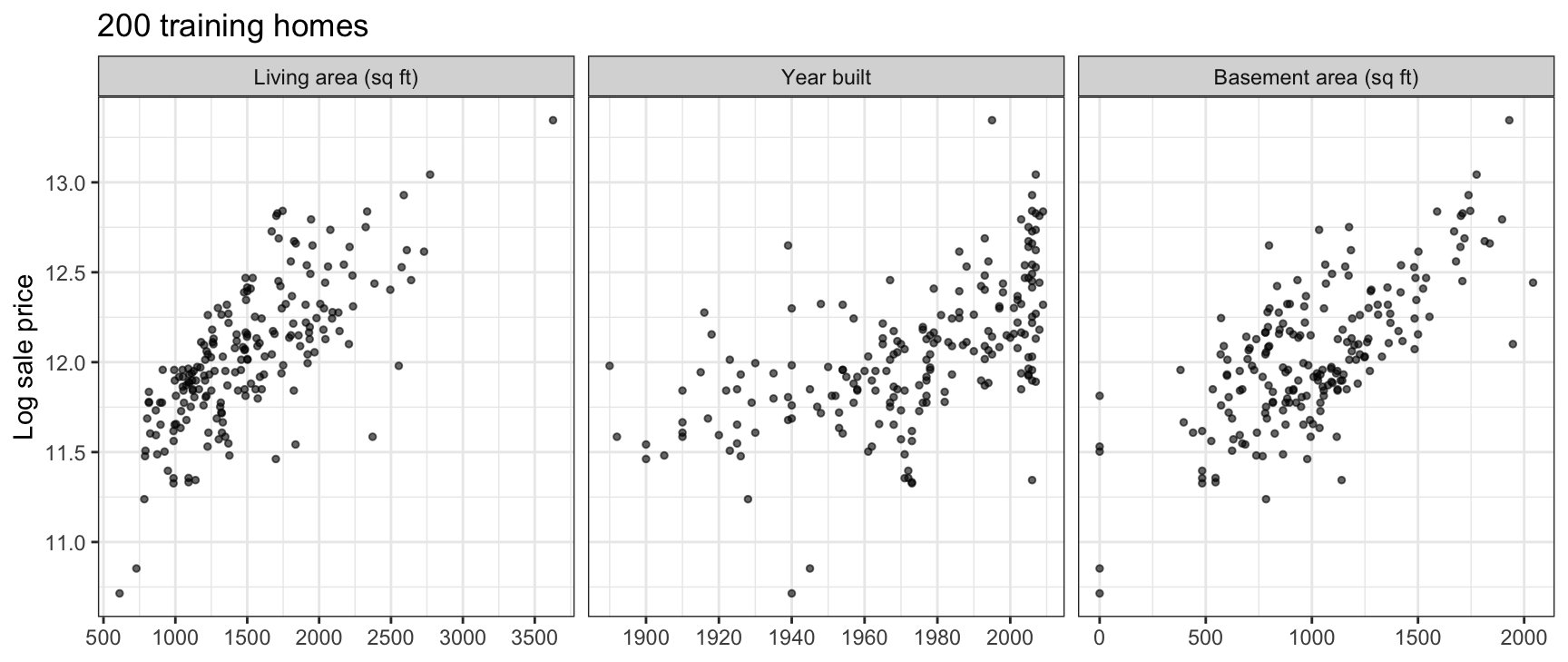
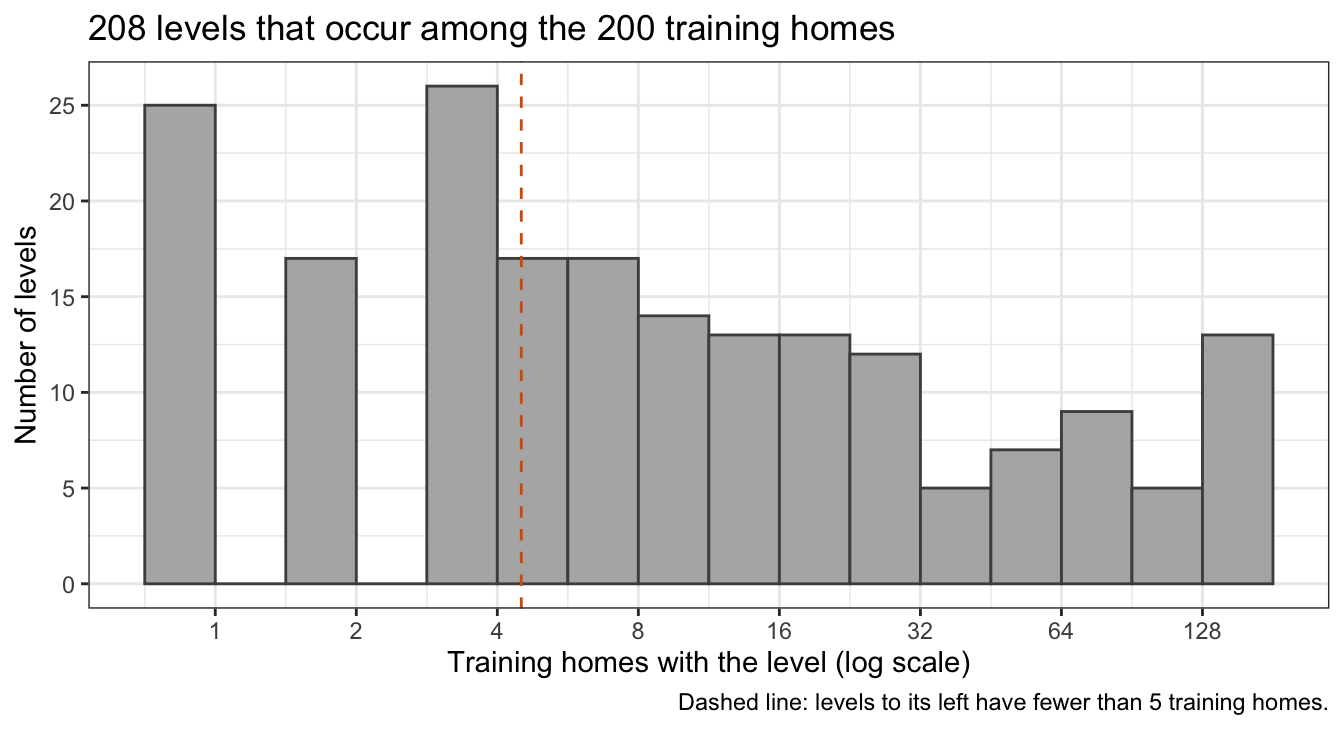
- Candidate features
- Training-sample fits
- Six fits
- Cross-validation curves
- Test evaluation
- Kept dummies
- Repeated training samples
- Method ranking
- Kept features
- Six methods compared
- Properties
- Expected settings
Ames home sales
Data
- Question: which of the six methods predicts the sale price of a home best, and what does each give up?
- Observation: a home
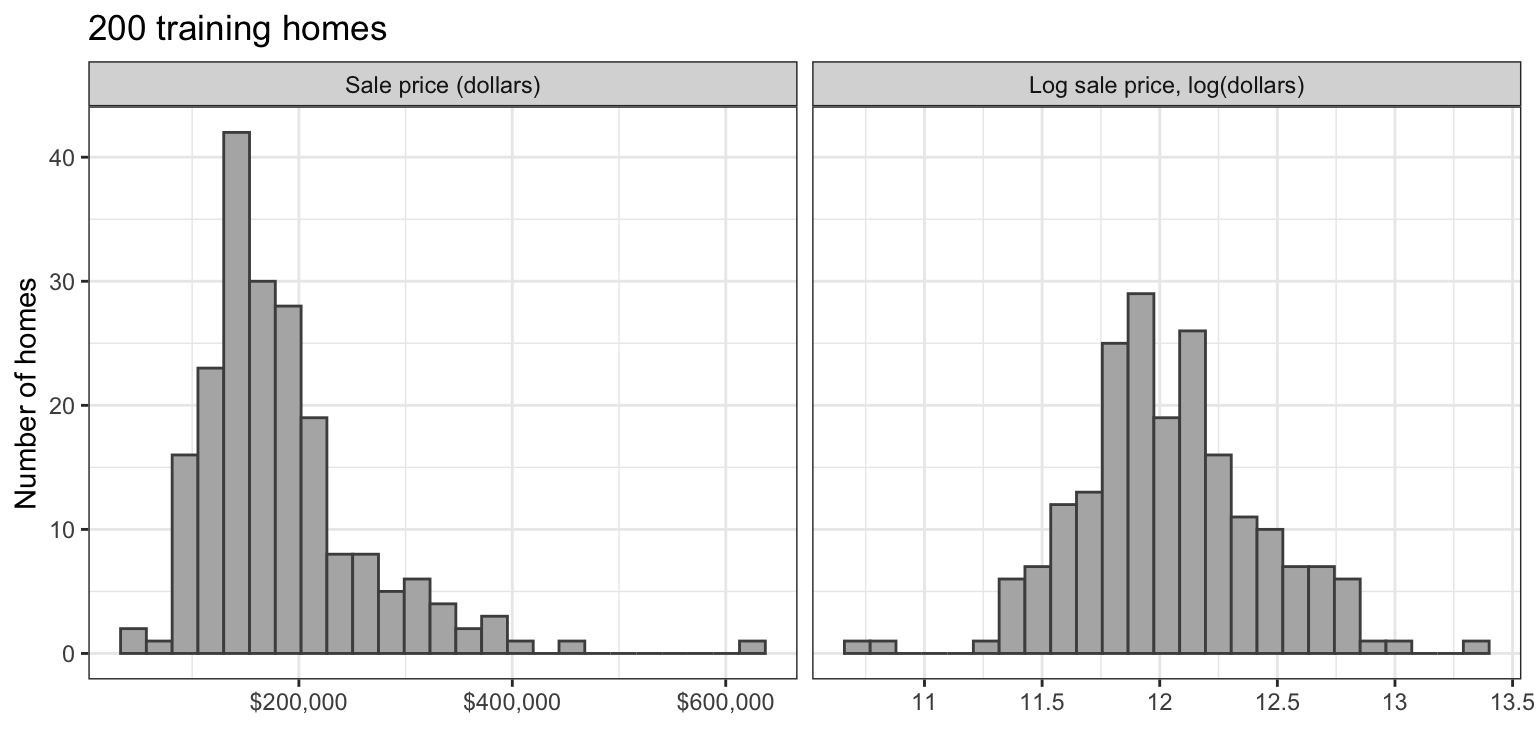
- Response variable:
Sale_Price, in dollars; the models use its logarithm - Explanatory variables: 33 numeric and 40 categorical
- Training sample: 200 homes, with \(p = 122\) candidate features
- Test homes: 2,725
Training homes
Candidate features
Training-sample fits
Six fits
- Least squares: all \(p\) features, no tuning parameter
- Forward stepwise selection: size \(d = 0, 1, \ldots, p\)
- Ridge regression: minimize \(RSS + \lambda\sum_{j=1}^p\beta_j^2\)
- The lasso: minimize \(RSS + \lambda\sum_{j=1}^p\left|\beta_j\right|\)
- PCR: first \(M\) principal components of the standardized features
- PLS: first \(M\) PLS directions
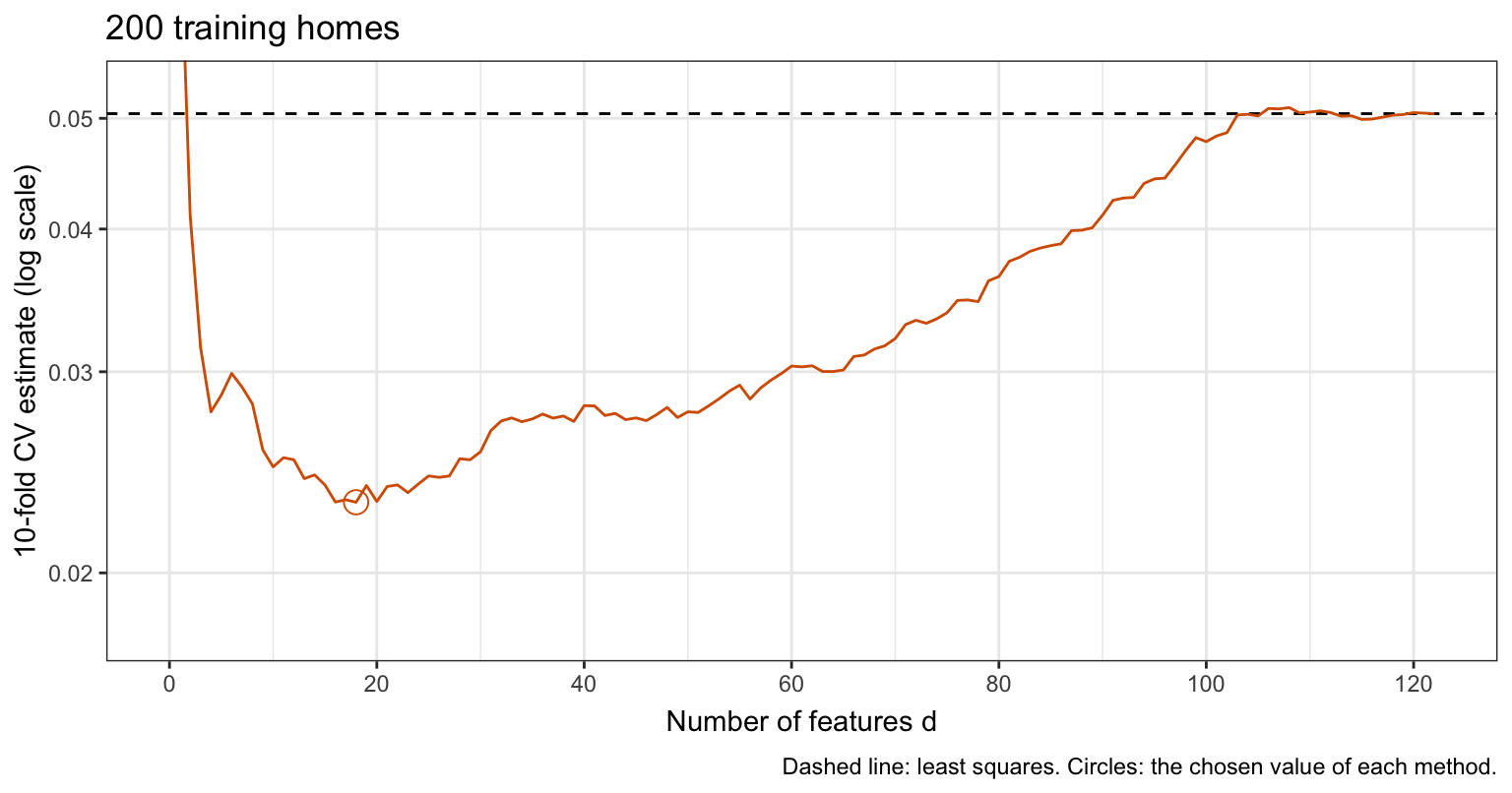
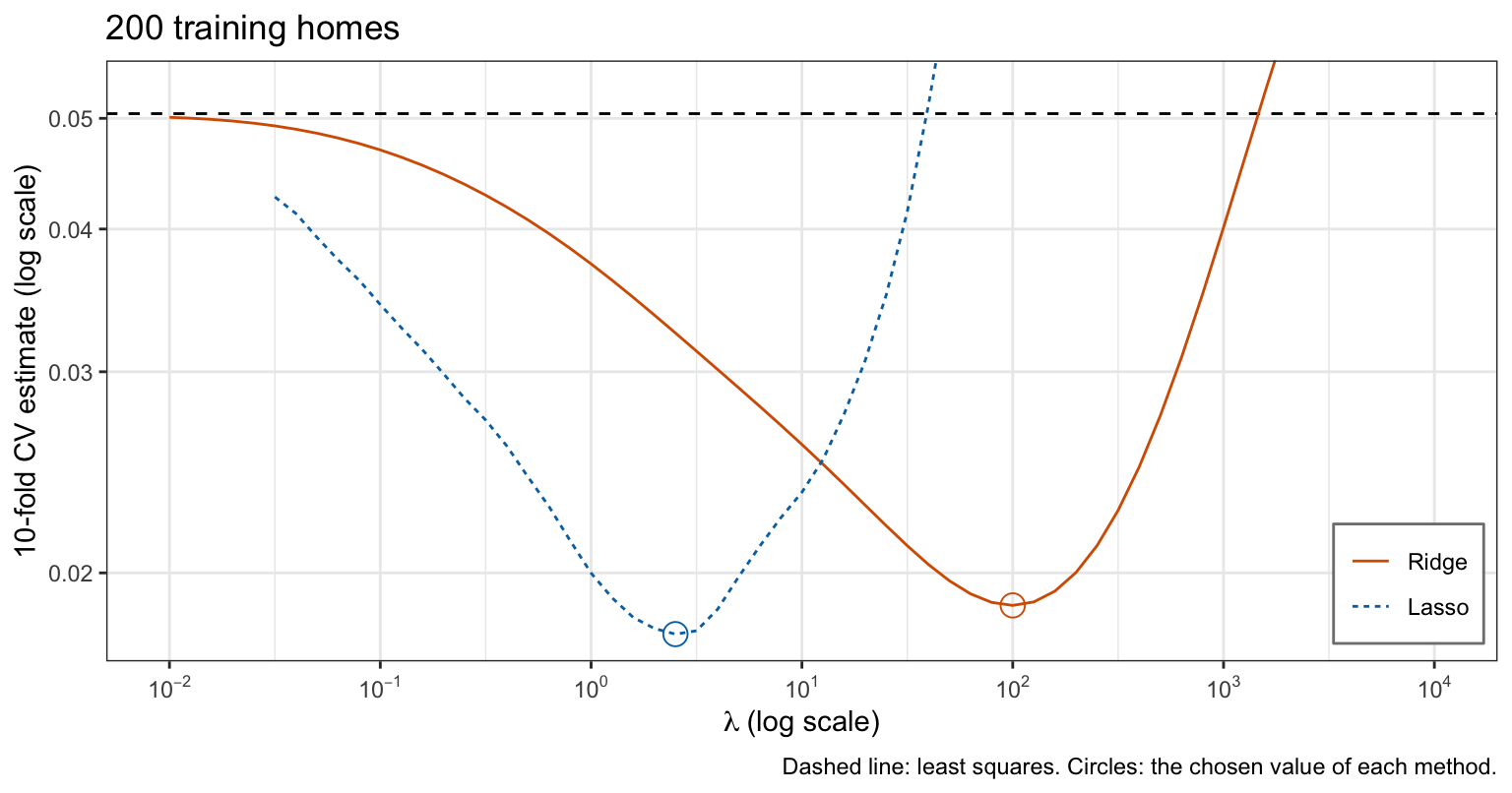
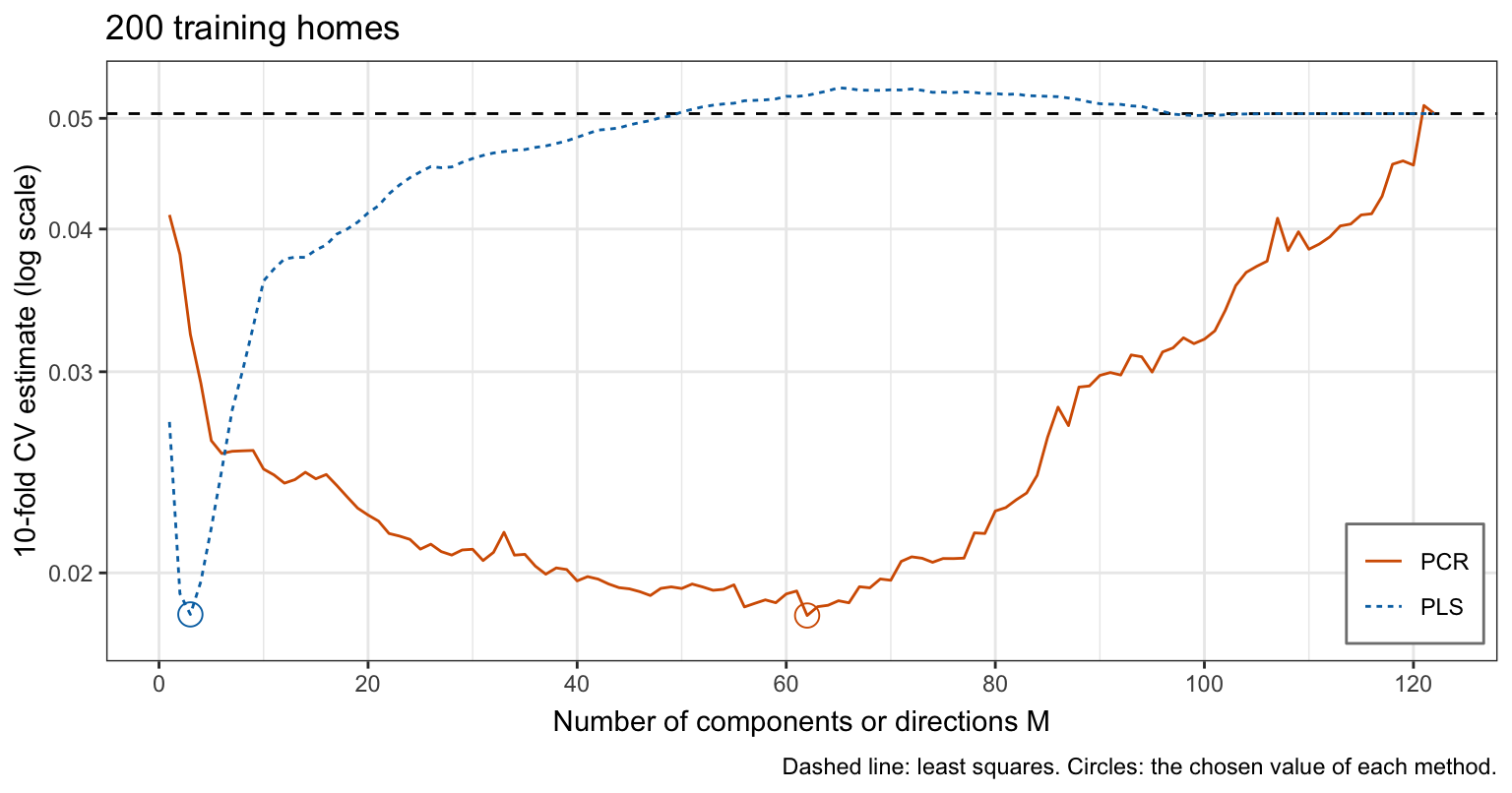
- \(d\), \(\lambda\) or \(M\) chosen by 10-fold cross-validation
- Standardization, forward stepwise path, components and directions recomputed in each fold
Cross-validation curves
Test evaluation
| Method | Tuning | Nonzero estimates | 10-fold CV estimate | Test MSE |
|---|---|---|---|---|
| Least squares | None | 122 | 0.0505 | 0.0462 |
| Forward stepwise | \(d = 18\) | 18 | 0.0231 | 0.0269 |
| Ridge | \(\lambda = 100.0\) | 122 | 0.0187 | 0.0241 |
| Lasso | \(\lambda = 2.51\) | 57 | 0.0177 | 0.0228 |
| PCR | \(M = 62\) | 122 | 0.0184 | 0.0262 |
| PLS | \(M = 3\) | 122 | 0.0184 | 0.0246 |
Kept dummies
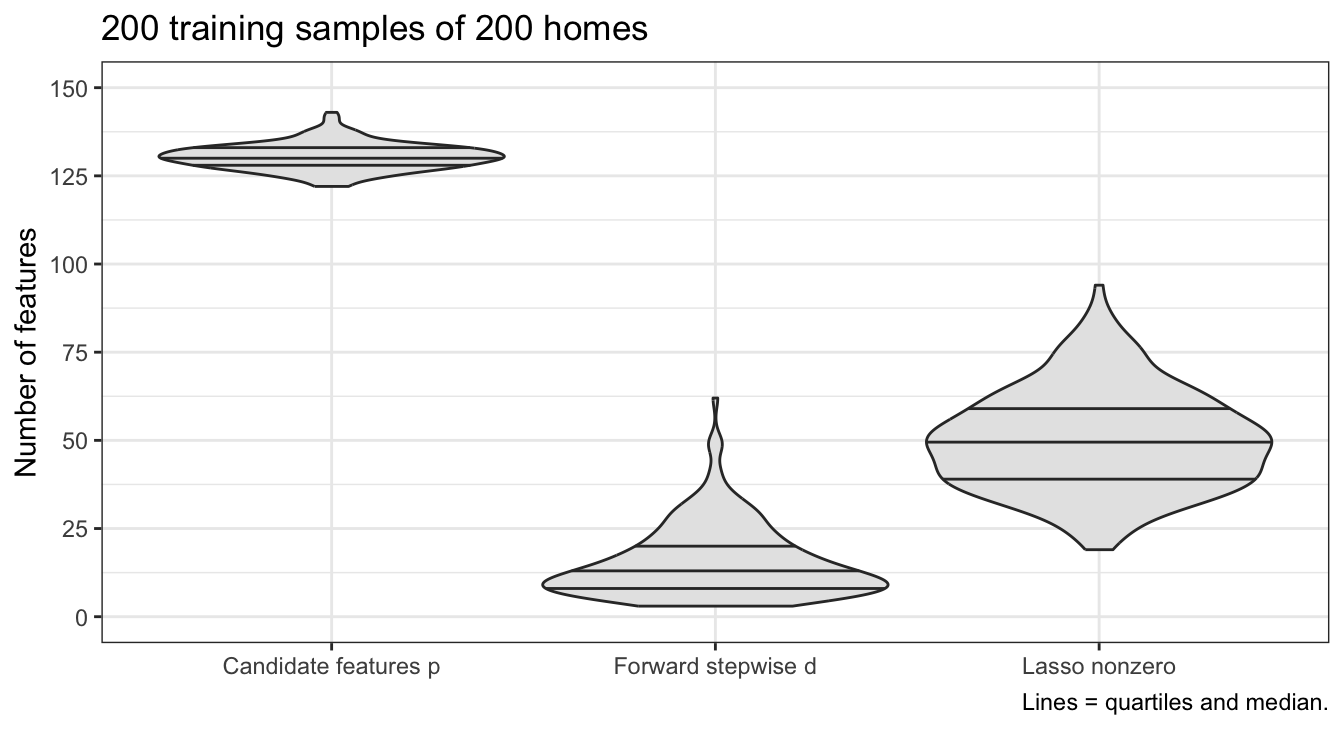
- Lasso keeps 57 of the 122 features, forward stepwise selection 18
- Neighborhood dummies: 15; the lasso keeps 8, forward stepwise selection 3
- Some but not all dummies of a variable kept: lasso 15 variables, forward stepwise selection 4
- Ridge regression, PCR and PLS: every dummy nonzero
- A dropped dummy merges its level into the reference,
North_AmesforNeighborhood
Repeated training samples
Method ranking
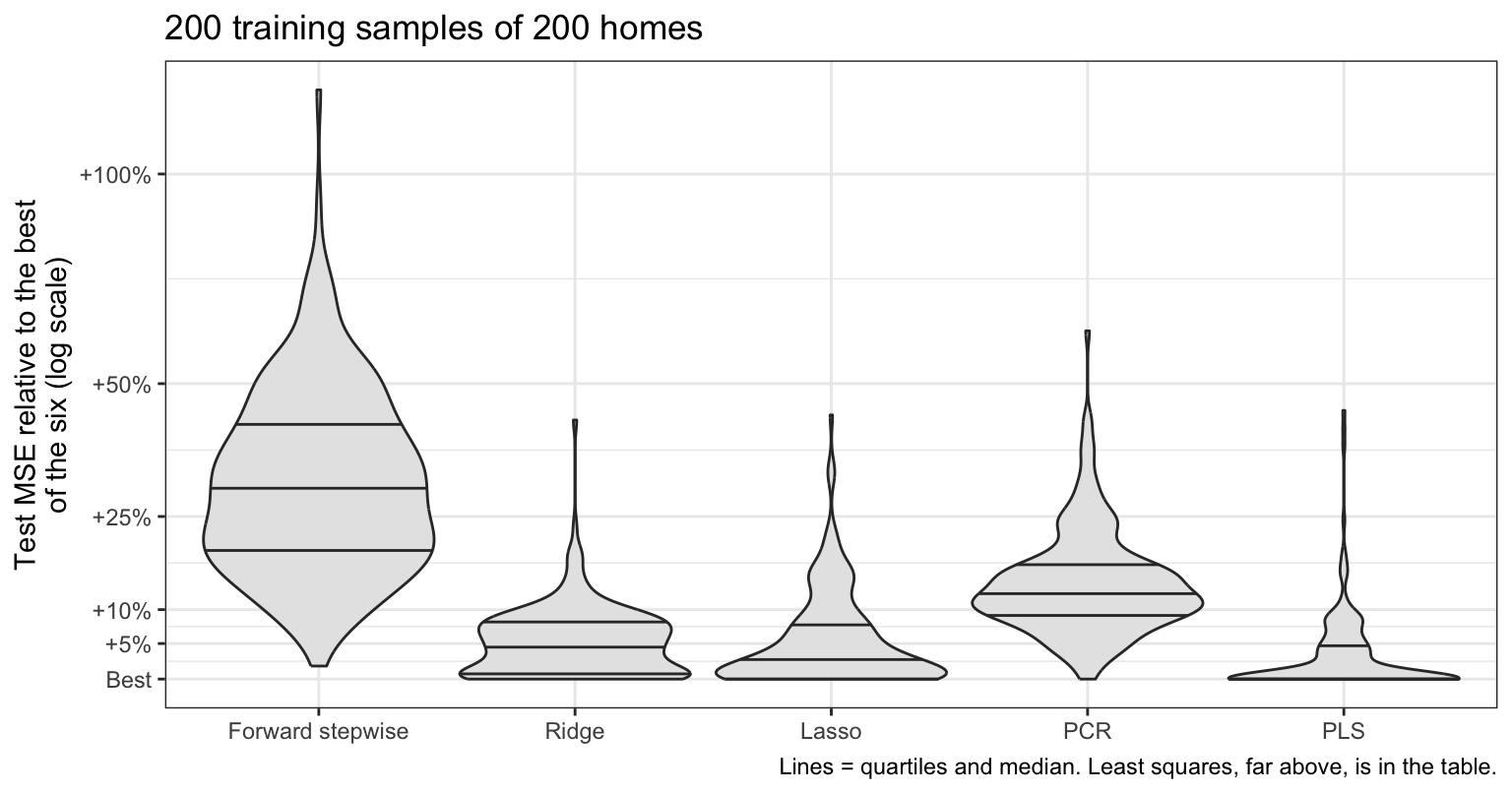
| Method | Mean test MSE | Median test MSE | Samples won | Median change from least squares |
|---|---|---|---|---|
| Least squares | 0.0614 | 0.0504 | 0 | |
| Forward stepwise | 0.0303 | 0.0295 | 0 | −42% |
| Ridge | 0.0242 | 0.0240 | 39 | −53% |
| Lasso | 0.0242 | 0.0239 | 52 | −53% |
| PCR | 0.0262 | 0.0258 | 1 | −49% |
| PLS | 0.0237 | 0.0233 | 108 | −54% |
Kept features
Six methods compared
Properties
| Property | Least squares | Forward stepwise | Ridge | Lasso | PCR | PLS |
|---|---|---|---|---|---|---|
| Estimates | Unconstrained | Kept: least squares; dropped: 0 | All shrunk toward 0, none 0 | Shrunk; some exactly 0 | In the span of the first \(M\) components | In the span of \(M\) directions |
| Selects features | No | Yes | No | Yes | No | No |
| Tuning parameter | None | Size \(d\) | \(\lambda\) | \(\lambda\) | \(M\) | \(M\) |
| Standardization | Not needed | Not needed | Needed | Needed | Needed | Needed |
| Needs from \(n\) and \(p\) | \(n > p\) | \(d < n\) | Any \(p\) | Any \(p\) | \(M\) at most the rank of \(\tilde{\mathbf{X}}\) | \(M\) at most the rank of \(\tilde{\mathbf{X}}\) |
| Computation | One fit | \(1 + p(p + 1)/2\) fits | One SVD for every \(\lambda\) | Coordinate descent for each \(\lambda\) | One SVD for every \(M\) | One step per direction |
| Interpretation | Every estimate | A least squares model on \(d\) features | Every estimate, shrunken | Some shrunken estimates | Directions; needs every feature | Directions; needs every feature |
Expected settings
- Least squares: \(n\) large relative to \(p\)
- Forward stepwise selection and the lasso: a few features carry the signal, the rest are noise
- Ridge regression: many features with small effects of similar size
- PCR: response related to the directions in which the features vary most
- PLS: response related to directions that are not the leading principal components
- Expectations from reasoning, not results: one dataset does not establish them
Conclusion
- The methods differ in what they do to the estimates
- Only forward stepwise selection and the lasso select features
- Cross-validate \(d\), \(\lambda\) or \(M\), recomputing the fit’s data-dependent steps in each fold
- A cross-validation estimate can miss the test MSE in either direction
- One training sample ranks the methods for that sample only
- One dataset cannot establish the expected settings
DS 3030