Random Forests
Today
- Data
- Bagging
- Unstable trees
- Averaging
- Bootstrap samples
- Bagged trees
- Out-of-bag error
- Out-of-bag prediction
- Out-of-bag and test error
- Random forests
- Definition
- Correlated trees
- Split restriction
- Fitting a random forest
- Forest size
- Choosing \(m\)
- Variable importance
- Two measures
- Interpretation
- Comparison
- Test error
- Extrapolation
- Interpretability and cost
Data
Concrete specimens
- Response:
compressive_strength - Explanatory variables:
cementblast_furnace_slagfly_ashwatersuperplasticizercoarse_aggregatefine_aggregateage
- Training specimens: 700
- Test specimens: 305
Bagging
Unstable trees
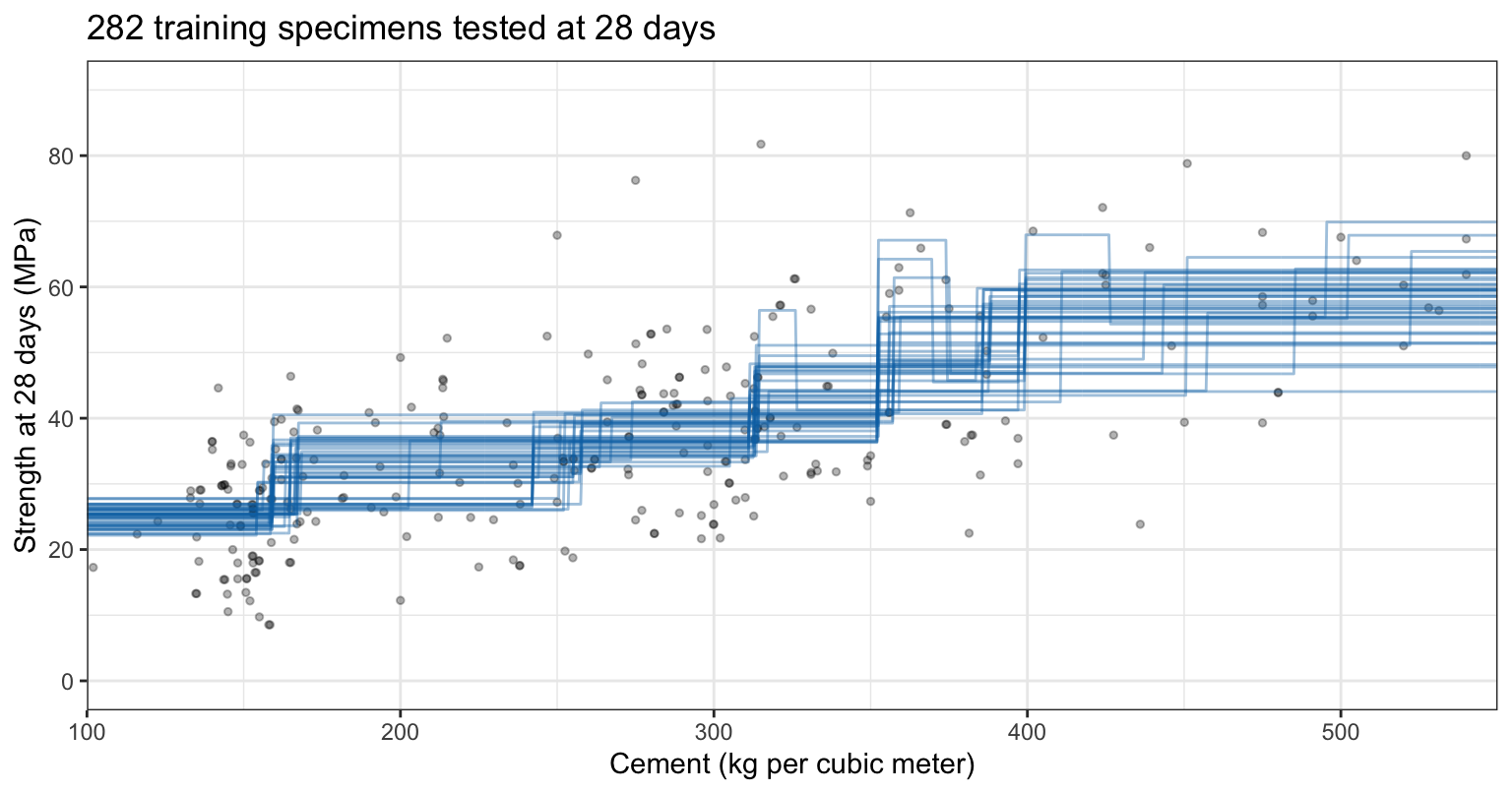
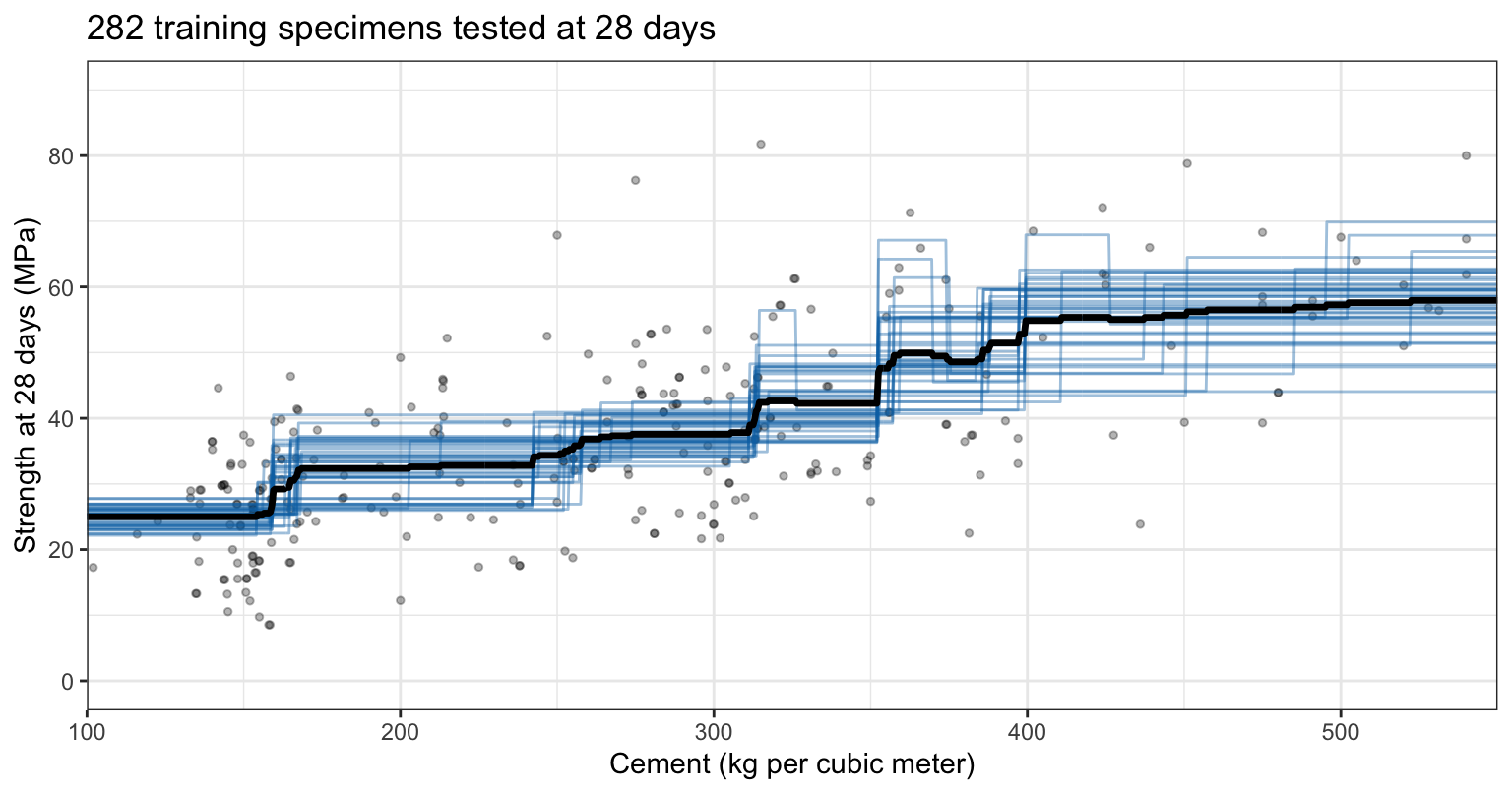
Averaging
\[ \begin{aligned} Var\left[\frac{1}{B}\sum_{b=1}^B \widehat f_b(x)\right] &= \frac{1}{B^2}\left\{\sum_{b=1}^B Var\left[\widehat f_b(x)\right] + \sum_{b \ne b'} Cov\left[\widehat f_b(x), \widehat f_{b'}(x)\right]\right\} \\ &= \frac{B\sigma^2 + B\left(B - 1\right)\rho\sigma^2}{B^2} = \rho\sigma^2 + \frac{1 - \rho}{B}\sigma^2. \end{aligned} \]
- \(B\) — number of predictions averaged, \(b = 1, \ldots, B\)
- \(\sigma^2\) — variance of one prediction at \(x\)
- \(\rho\) — correlation between two of them
Bootstrap samples
- Bootstrap sample
- \(n\) training observations
- \(n\) draws
- with replacement
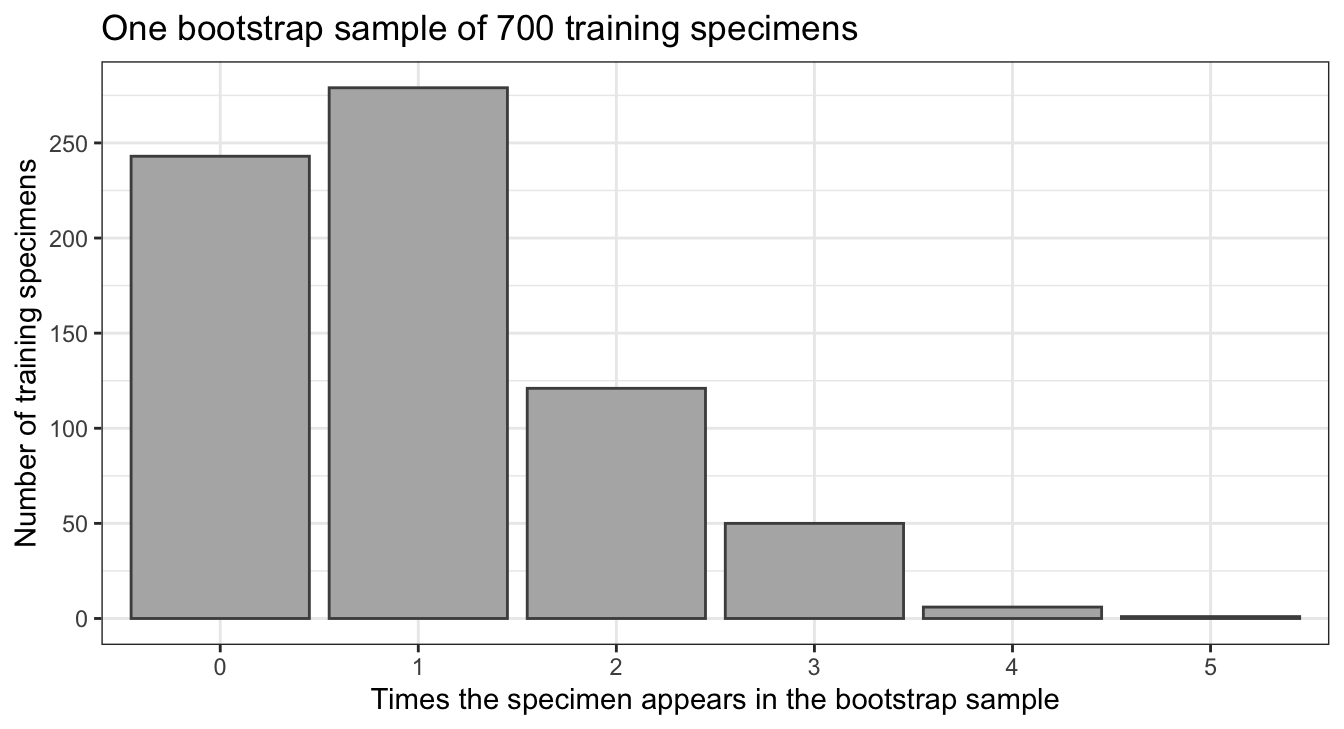
Probability that a given observation is missed by all \(n\) draws
\[\left(1 - \frac{1}{n}\right)^n \to e^{-1} \approx 0.368\]
Appearances in a bootstrap sample
Bagged trees
\[\widehat f_{\text{bag}}(x) = \frac{1}{B}\sum_{b=1}^B \widehat f^{*b}(x),\]
- \(\widehat f^{*b}(x)\) — prediction at \(x\) of the tree fit to bootstrap sample \(b\)
- \(\widehat f_{\text{bag}}(x)\) — bagged prediction
- Trees grown full, not pruned
Bagging from scratch
# Bagging from scratch: B full trees, each fit to a bootstrap sample.
B <- 300
grow <- rpart.control(cp = 0, minsplit = 2, minbucket = 1, xval = 0)
boots <- map(seq_len(B), \(b) sample(n_train, replace = TRUE))
trees <- map(boots, \(boot) {
  rpart(compressive_strength ~ ., data = train[boot, ], control = grow)
})
tree_pred <- sapply(trees, predict, newdata = test)
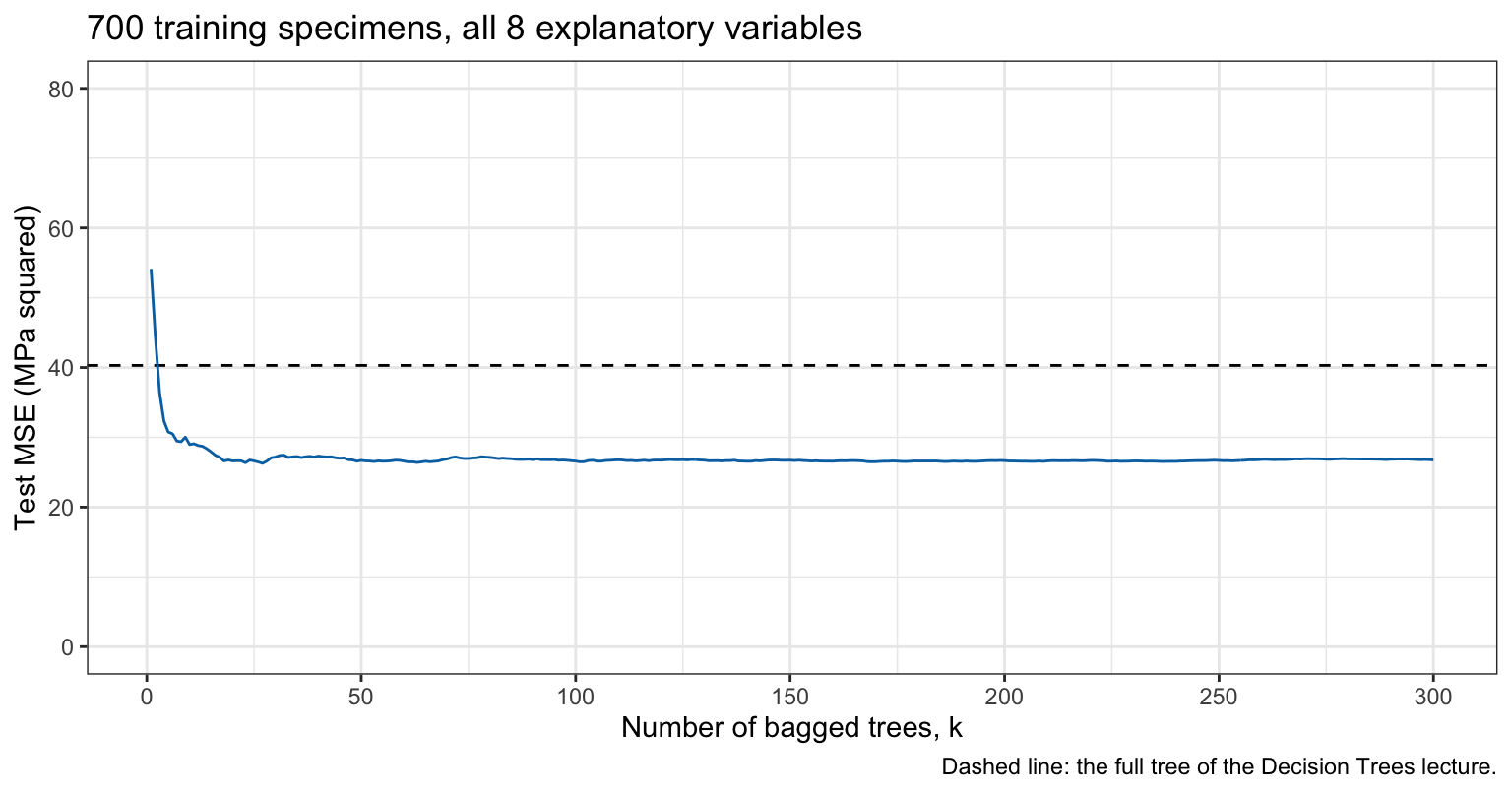
c(test_mse = mean((y_test - rowMeans(tree_pred))^2))
test_mse
26.76253 Bagged trees: test MSE
Out-of-bag error
Out-of-bag prediction
\[\text{MSE}_{\text{OOB}} = \frac{1}{n}\sum_{i=1}^n \left(y_i - \widehat f_{\text{OOB}}(x_i)\right)^2,\]
\[\widehat f_{\text{OOB}}(x_i) = \frac{1}{\left|\mathcal{O}_i\right|}\sum_{b \in \mathcal{O}_i} \widehat f^{*b}(x_i),\]
- \(\mathcal{O}_i\) — bootstrap samples that leave out observation \(i\); \(\left|\mathcal{O}_i\right|\) — their number
- \(\widehat f_{\text{OOB}}(x_i)\) — OOB prediction of observation \(i\)
Out-of-bag prediction in R
 oob_mse
27.03195 Out-of-bag and test error
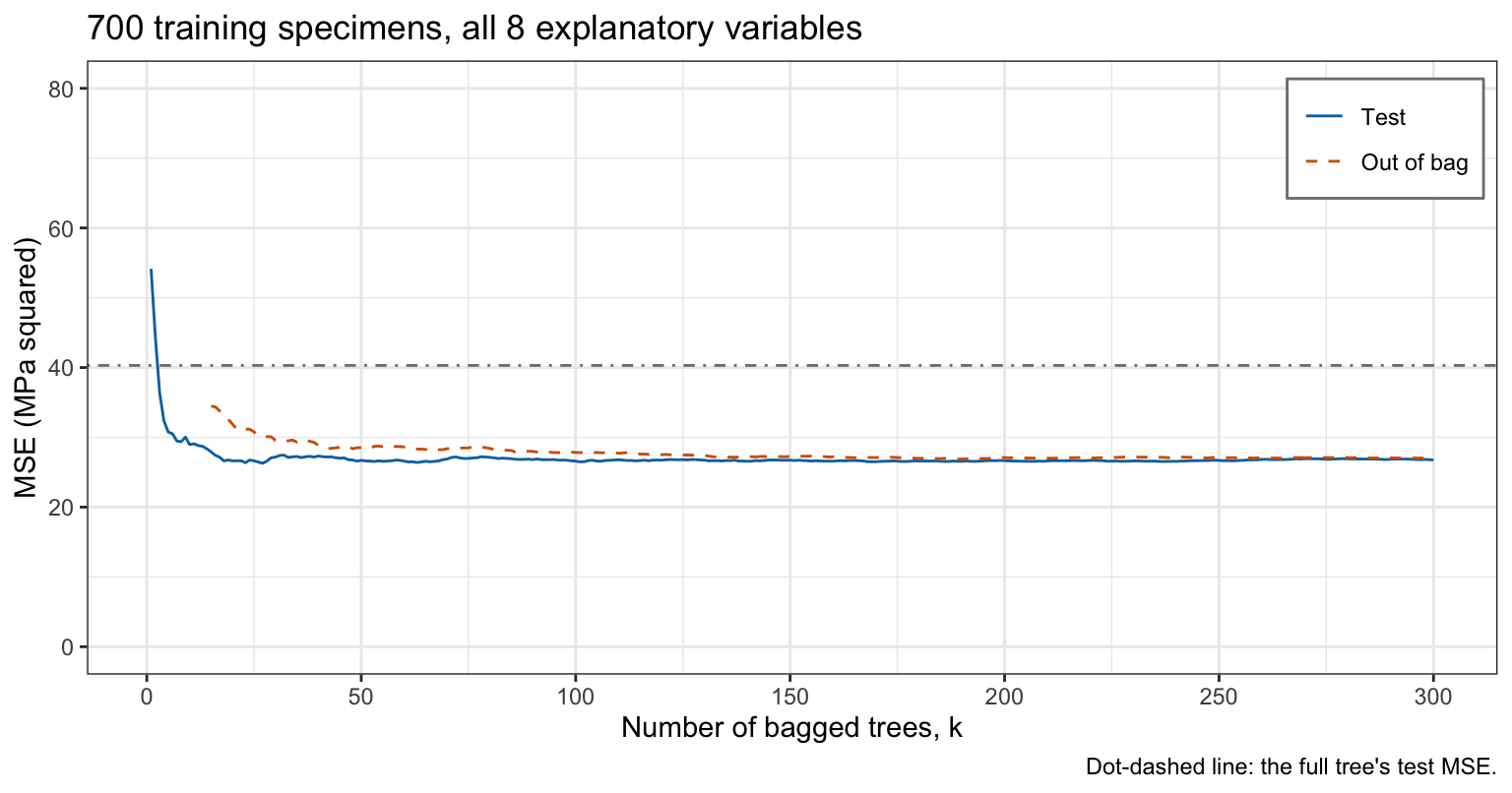
Random forests
Definition
- Bootstrap samples: each tree is fit to its own bootstrap sample of the training data
- Averaging: the forest predicts with the average of its trees’ predictions
- Random variable inclusion: at each split, the tree chooses among only a random subset of the explanatory variables
- Bagged trees have the first two; the third is the change a random forest makes
Correlated trees
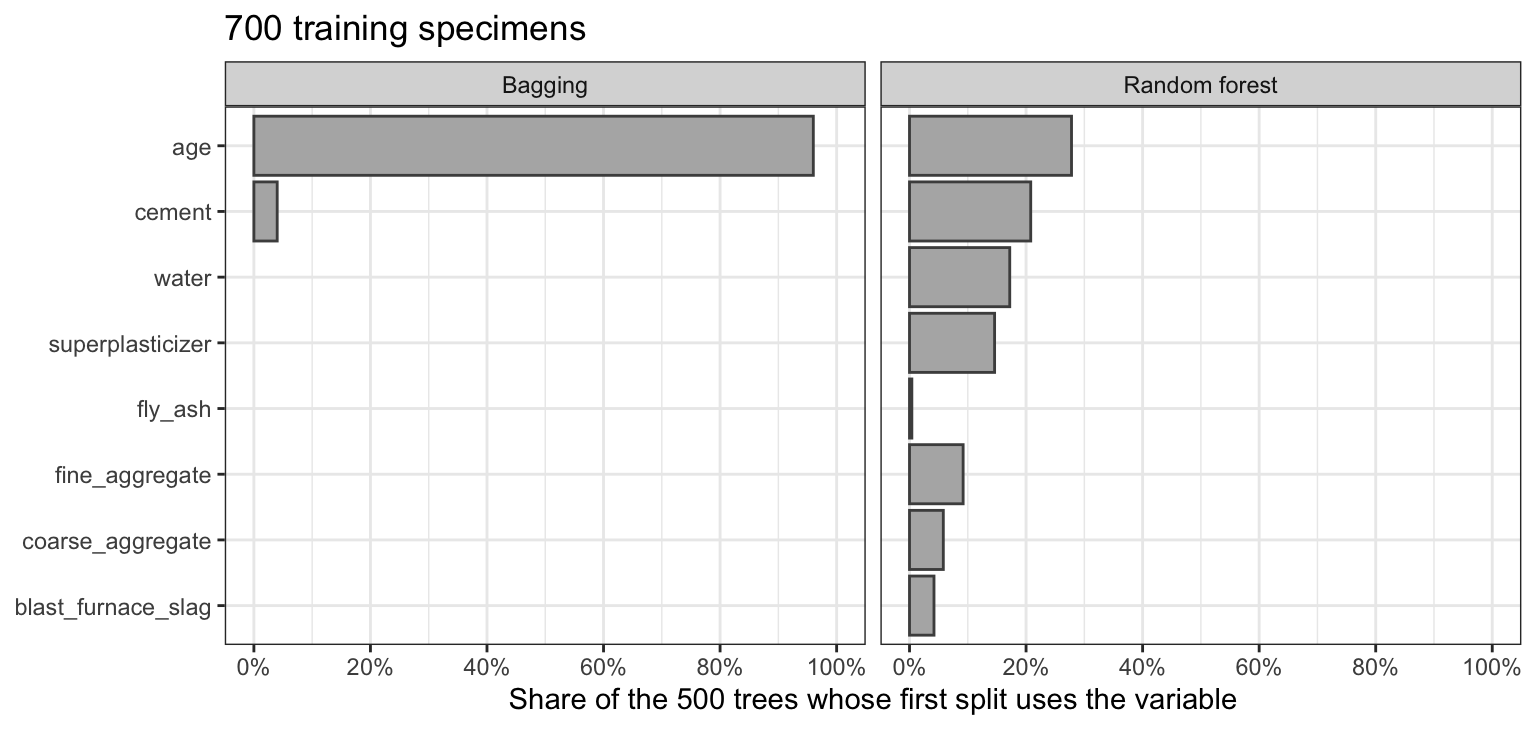
Split restriction
- At each split, a tree may use only \(m\) of the \(p\) explanatory variables, chosen at random anew for that split
- \(p\) — number of explanatory variables
- \(m \le p\) — number tried at each split
- \(m = p\) is bagging
- Default
randomForest(): \(m = \lfloor p/3 \rfloor\) for a numeric response
Split restriction: correlation
| Method | \(m\) | \(\widehat\sigma^2\) | \(\widehat\rho\) | \(\widehat\rho\widehat\sigma^2\) |
|---|---|---|---|---|
| Bagging | 8 | 62 | 0.09 | 5.8 |
| Random forest | 2 | 105 | 0.04 | 4.4 |
- \(\widehat\sigma^2\) and \(\widehat\rho\widehat\sigma^2\): averages over the 305 test specimens of values at one \(x\)
- Restriction: lower \(\widehat\rho\), higher \(\widehat\sigma^2\)
Fitting a random forest
Call:
 randomForest(formula = compressive_strength ~ ., data = train,      importance = TRUE)
               Type of random forest: regression
                     Number of trees: 500
No. of variables tried at each split: 2

          Mean of squared residuals: 32.1988
                    % Var explained: 88.07
test_mse
34.24721 Forest size
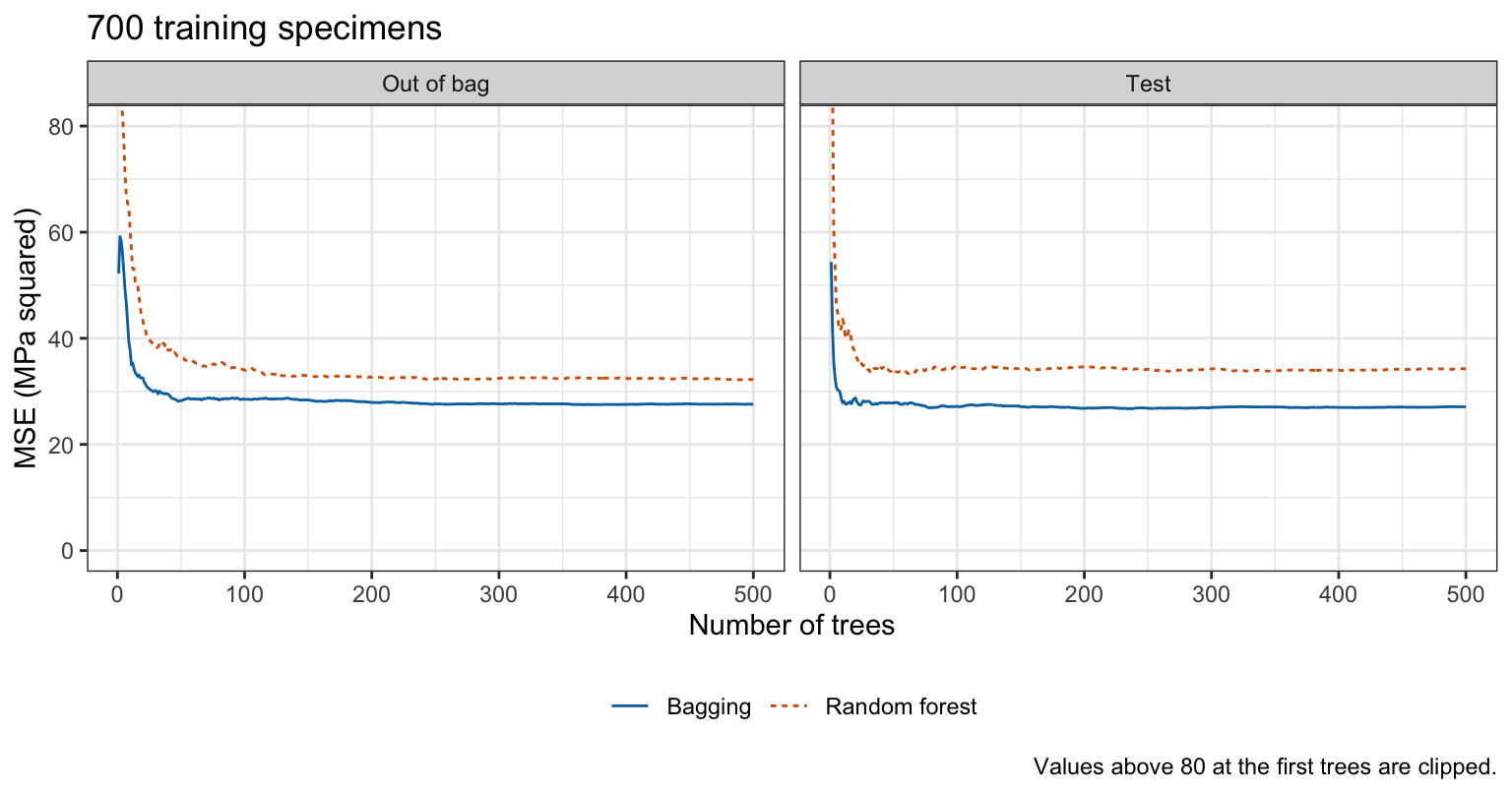
Choosing \(m\)
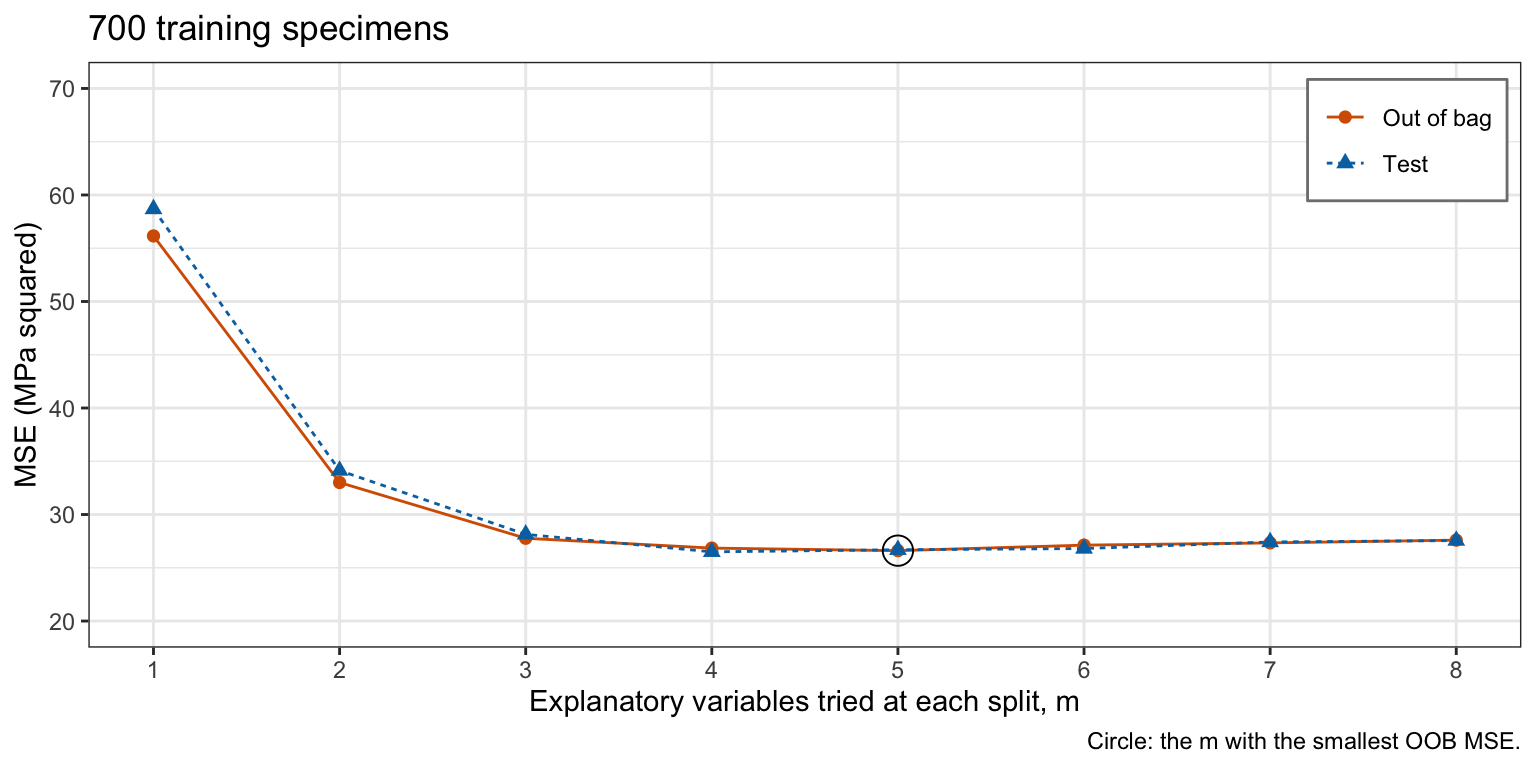
Variable importance
One tree
               age blast_furnace_slag             cement              water
5 2 4 3 Two measures
- Decrease in RSS (
IncNodePurity)- total decrease from the splits on the variable in a tree, averaged over the trees
- Permutation importance (
%IncMSE)- increase in a tree’s OOB MSE when the variable is shuffled among its OOB observations, averaged over the trees
Two measures in R
                     %IncMSE IncNodePurity
cement             128.80824     38055.659
blast_furnace_slag  40.40708     10765.080
fly_ash             30.74548      9337.777
water               95.72834     22962.469
superplasticizer    68.02636     15163.163
coarse_aggregate    32.06984     13284.344
fine_aggregate      44.18691     14802.340
age 164.19623 54983.954Importance by variable
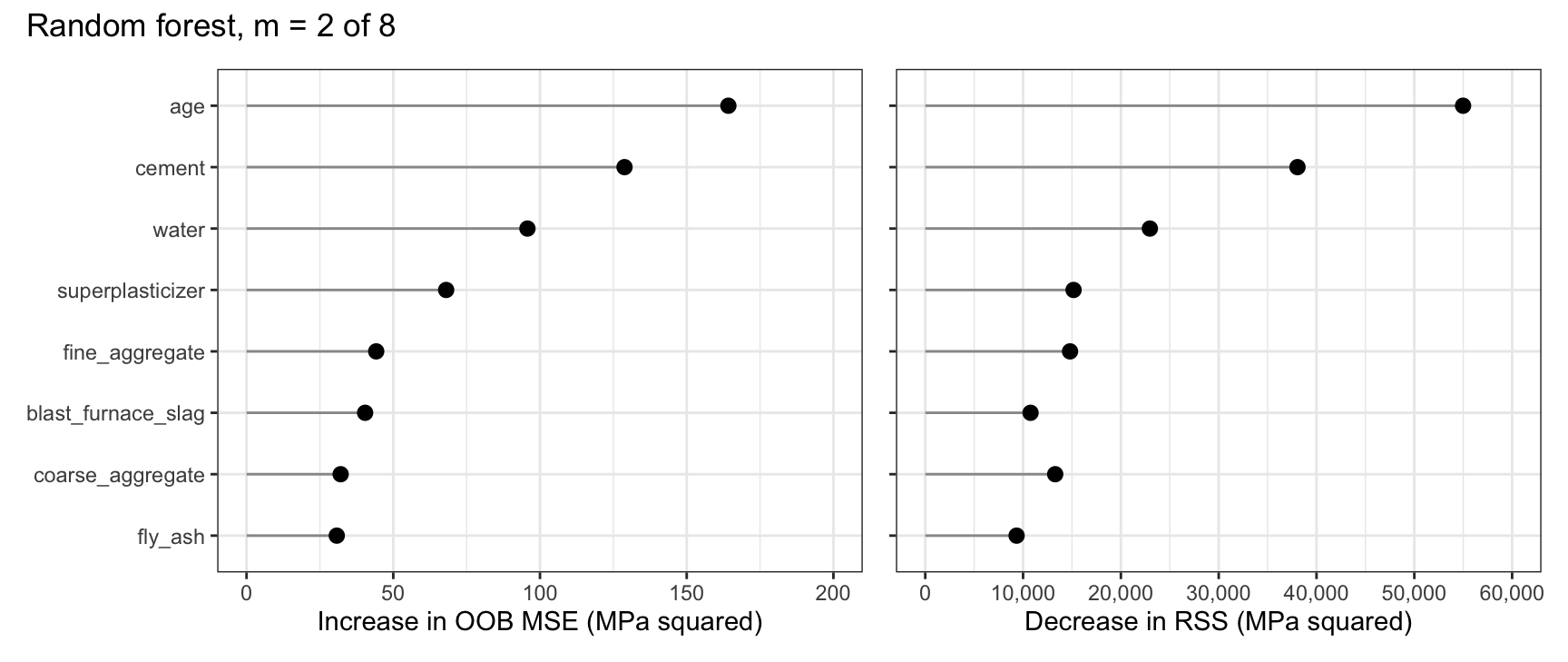
Interpretation
- Importance ranks the variables
- No direction
- No effect size
Comparison
Test error
| Method | Test MSE |
|---|---|
| Least squares, main effects | 106.4 |
| Least squares, main effects, log(age) | 48.5 |
| Default tree | 86.8 |
| Pruned tree | 42.2 |
| Full tree | 40.3 |
| Bagging, rpart() loop | 26.8 |
| Bagging, randomForest() | 27.1 |
| Random forest, m = 2 | 34.2 |
| Random forest, m = 5 | 26.7 |
- Least squares: no interactions or polynomial terms
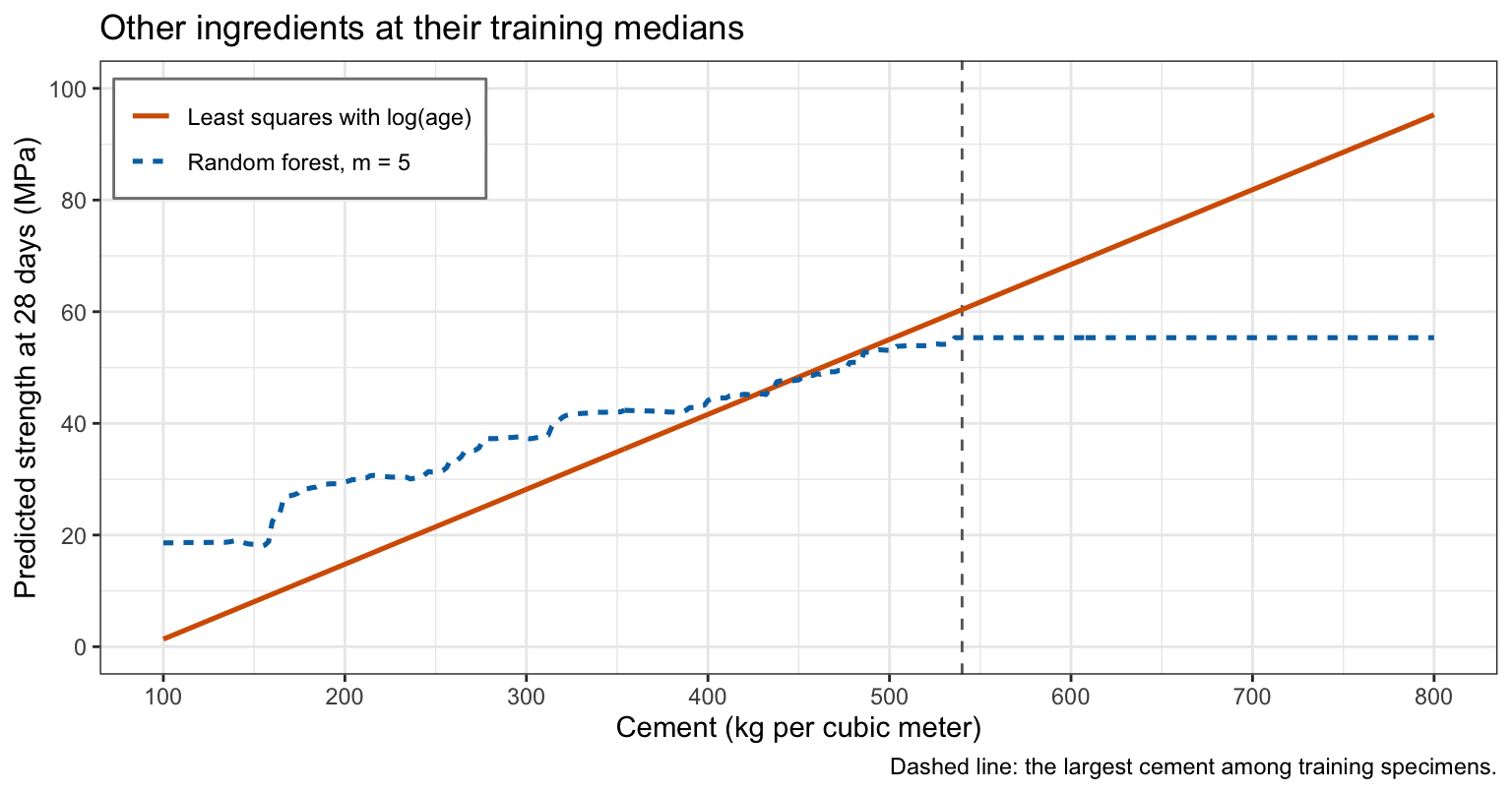
Extrapolation
Interpretability and cost
- Gives up the single tree’s interpretability: importance rankings only
- Hundreds of trees to store and evaluate
- Predictions still made of steps
Conclusion
- Averaging removes variance, but not \(\rho\sigma^2\)
- Bagging averages full trees; more trees do not overfit
- Out-of-bag error estimates test error
- A random forest decorrelates trees; choose \(m\) by out-of-bag error
- Importance ranks variables, with no direction or effect size
- Forests lose interpretability and cannot extrapolate
DS 3030