Support Vector Classifier
Today
- Cat sex
- Soft margin
- Overlapping classes
- Optimization problem
- Slack variables
- Fitting
- Penalty form
- Standardization
- Estimates
- Slack estimates
- Budget
- Bias and variance
- Cost and budget
- Support vectors
- Definition
- Refits
- Support vector count
- Cross-validation
- Error rate
- Curve
- Test error
- Confusion matrix
- Comparison
- Classifiers
- Measures
- Results
Cat sex
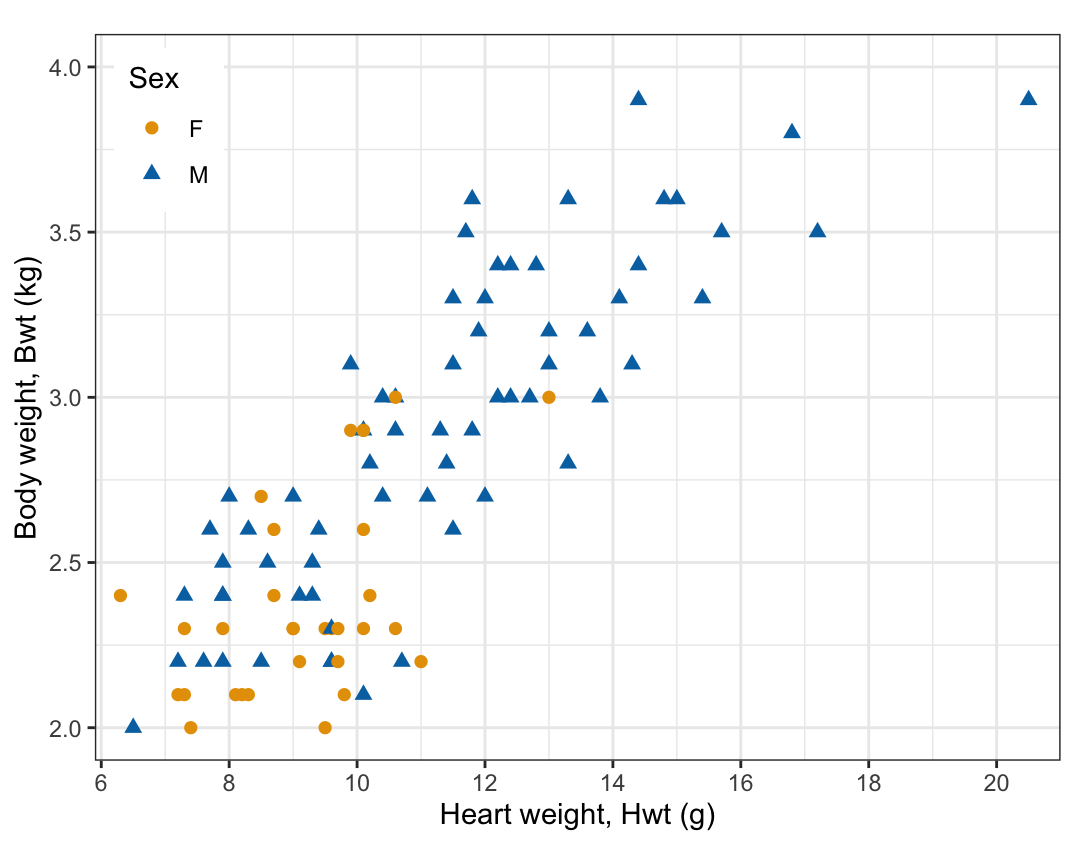
Cat sex
- Class:
Sex(M: \(y = 1\),F: \(y = -1\)) - Explanatory variables (\(p = 2\)):
Hwt: heart weight (g)Bwt: body weight (kg)
- Training cats: 96 (31
F, 65M) - Test cats: 48
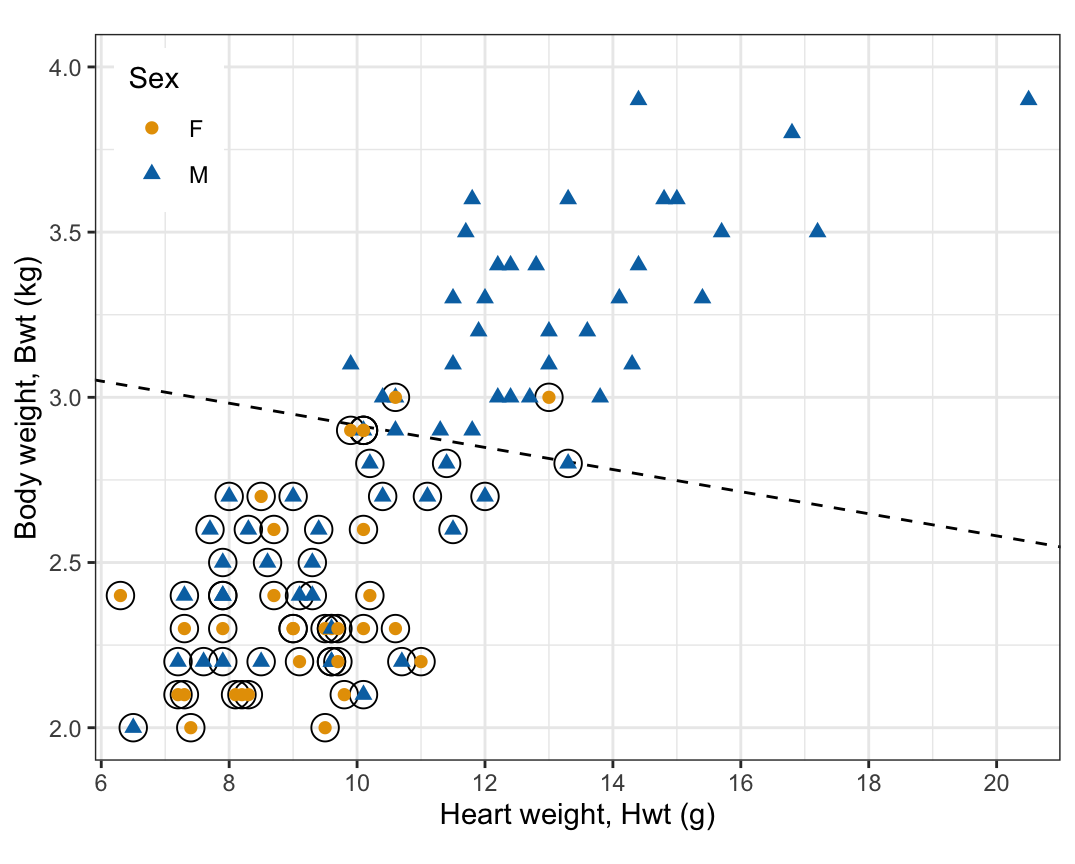
Cat sex: plot
Soft margin
Overlapping classes
- Not separable: in 3 places a female and a male cat share both measurements
- Maximal margin constraints cannot all hold with \(M > 0\):
\[ y_i\left(\beta_0 + \beta^\top x_i\right) \ge M \]
Optimization problem
Support vector classifier, constraints for all \(i = 1, \ldots, n\):
\[ \begin{aligned} \underset{\beta_0, \beta_1, \ldots, \beta_p, \epsilon_1, \ldots, \epsilon_n, M}{\text{maximize}} \quad & M \\ \text{subject to} \quad & \sum_{j=1}^p \beta_j^2 = 1, \\ & y_i\left(\beta_0 + \beta_1 x_{i1} + \cdots + \beta_p x_{ip}\right) \ge M(1 - \epsilon_i), \\ & \epsilon_i \ge 0, \quad \sum_{i=1}^n \epsilon_i \le C, \end{aligned} \]
- \(\epsilon_i\) — slack variable: violation of the margin, in units of \(M\)
- \(C \ge 0\) — budget: bounds the total slack
- \(\sum_j \beta_j^2 = 1\): \(f(x_i) = \beta_0 + \beta^\top x_i\) is the signed distance to the hyperplane
- \(y_i f(x_i) \ge M(1 - \epsilon_i)\): distance on own side at least \(M(1 - \epsilon_i)\); \(\epsilon_i = 0\) is the maximal margin constraint
Slack variables
With \(f(x_i) = \beta_0 + \beta^\top x_i\):
- \(\epsilon_i = 0\): \(y_i f(x_i) \ge M\), on the correct side and on or outside the margin
- \(0 < \epsilon_i \le 1\): \(0 \le y_i f(x_i) < M\), inside the margin on the correct side (on the hyperplane when \(\epsilon_i = 1\))
- \(\epsilon_i > 1\): \(y_i f(x_i) < 0\), on the wrong side of the hyperplane, misclassified
- At most \(C\) training observations are misclassified
Fitting
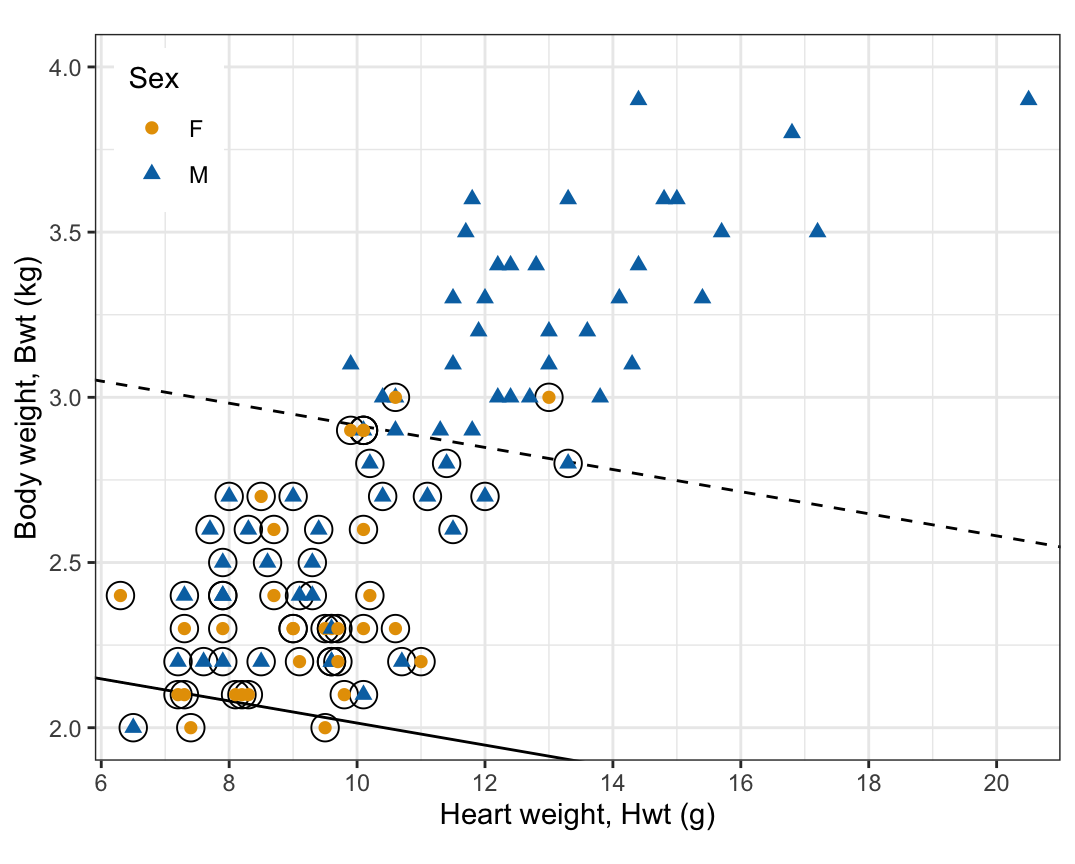
Fitting
Call:
svm(formula = Sex ~ Hwt + Bwt, data = train, kernel = "linear", cost = 1,
    tolerance = 1e-08)


Parameters:
   SVM-Type:  C-classification
 SVM-Kernel:  linear
       cost:  1

Number of Support Vectors: 58Penalty form
e1071::svm() solves
\[ \underset{w_0, w, \epsilon_1, \ldots, \epsilon_n}{\text{minimize}} \quad \tfrac{1}{2}\|w\|^2 + \texttt{cost}\sum_{i=1}^n \epsilon_i \quad \text{subject to} \quad y_i\left(w_0 + w^\top x_i\right) \ge 1 - \epsilon_i, \quad \epsilon_i \ge 0, \]
- \(w_0 = \beta_0/M\), \(w = \beta/M\), so \(\|w\| = 1/M\)
- \(\epsilon_i\) — slack variable of observation \(i\), as before
cost\(> 0\) — price of one unit of slack- Large
cost: slack is expensive, a small budget - Small
cost: slack is cheap, a large budget
Standardization
- Margin: a distance, adding the features’ squared differences in their own units
- Penalty: depends on the units too, so the same
costis a different budget
- Standardize each feature, as
svm()does by default (scale = TRUE):
\[ \tilde x_{ij} = \frac{x_{ij} - \bar x_j}{s_j}, \]
- \(\bar x_j\) — mean of feature \(j\) among the training observations
- \(s_j\) — its standard deviation
- \(\tilde x_{ij}\) — observation \(i\)’s value of feature \(j\), in standard deviations from that mean
Standardization: fits
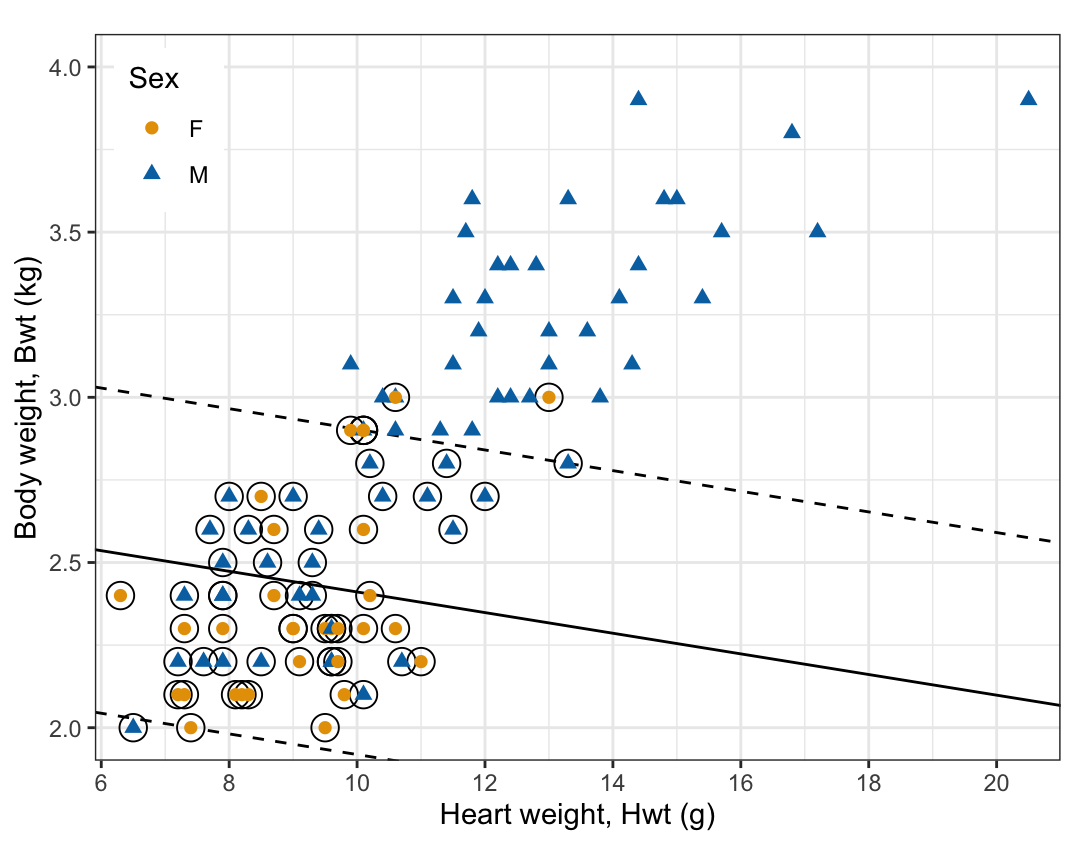
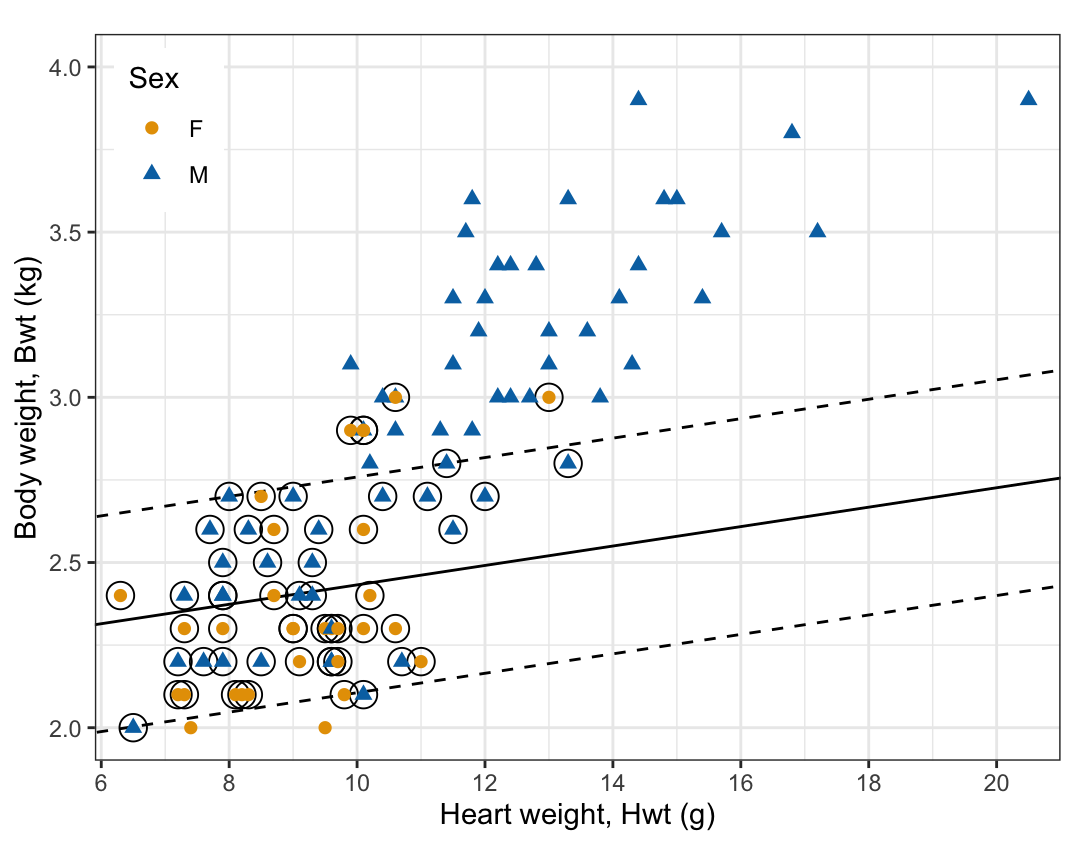
Estimates
  beta0     Hwt     Bwt       M
0.5519 -0.1502 0.9887 0.6426 Slack estimates
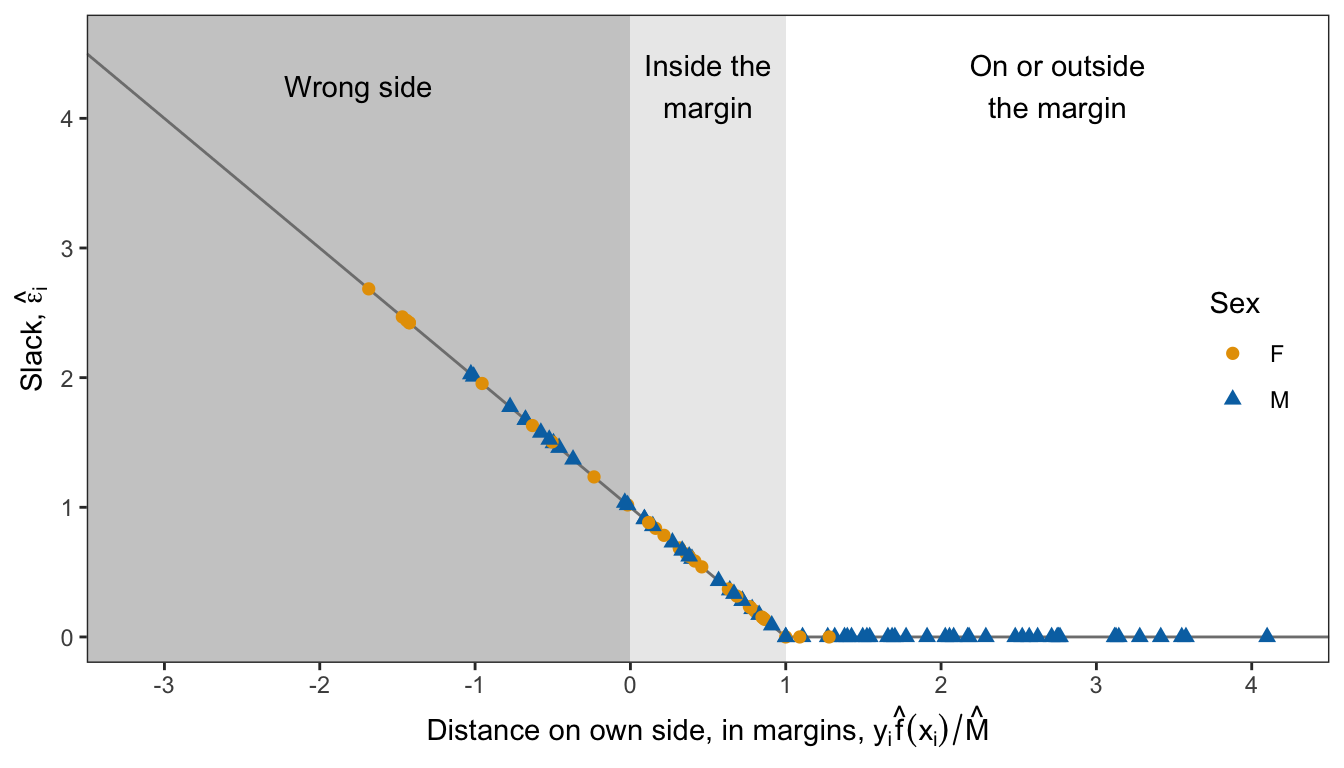
\[ \widehat\epsilon_i = \max\left(0,\ 1 - \frac{y_i \widehat f(x_i)}{\widehat M}\right), \]
- \(\widehat f(x)\) — fitted value
- \(\widehat M\) — margin
Budget
Budget
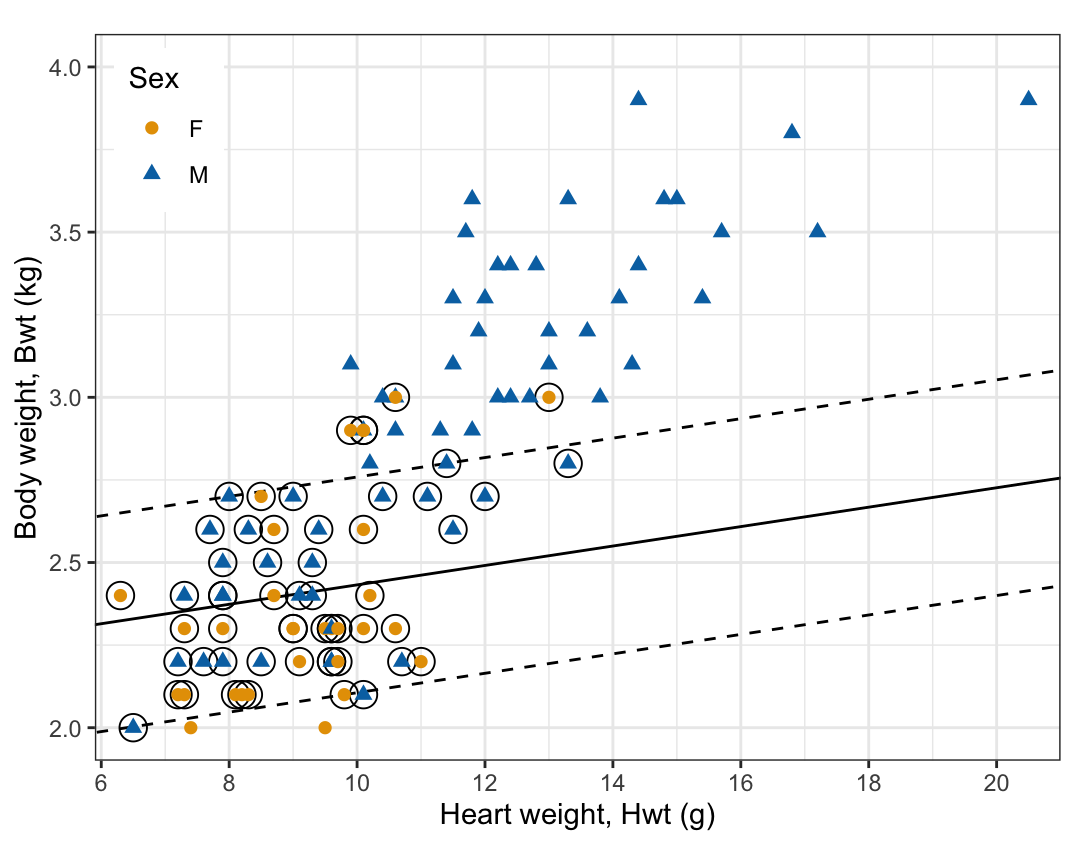
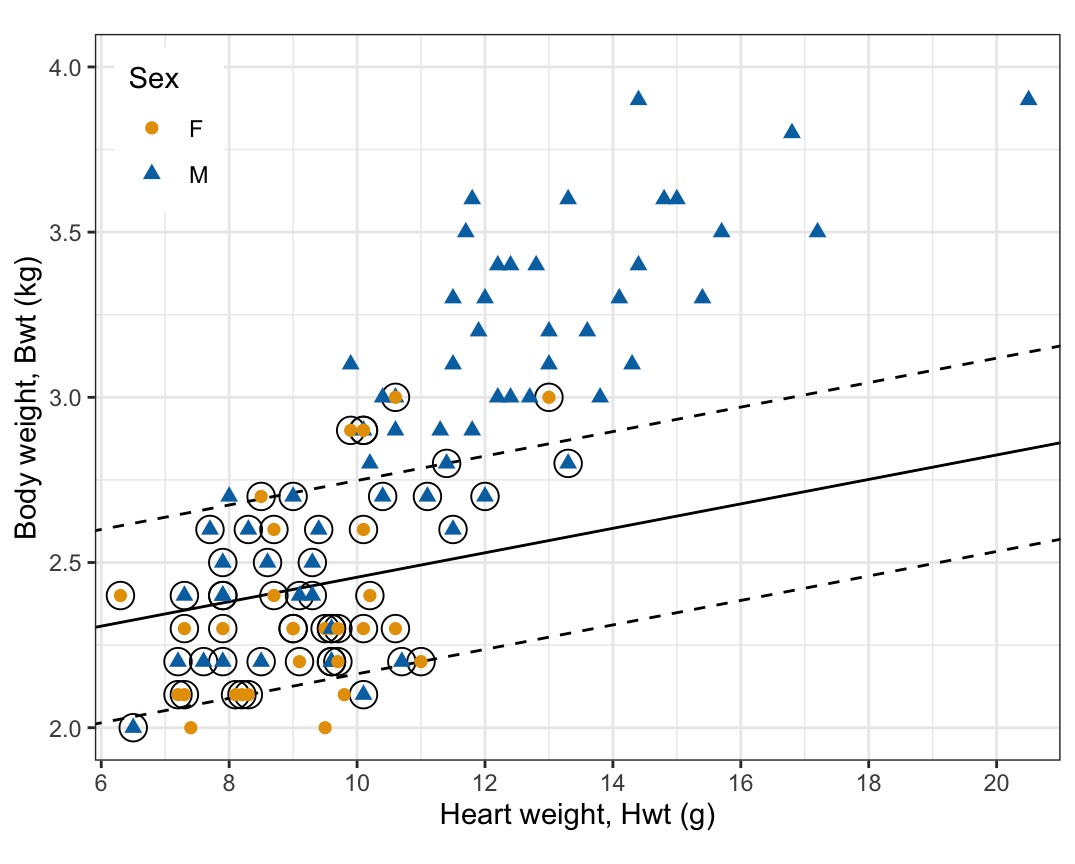
Bias and variance
- \(C = 0\): the maximal margin classifier, which exists only for separable classes
- Small \(C\): narrow margin, few support vectors, low bias, high variance
- Large \(C\): wide margin, many support vectors, low variance, more bias
Cost and budget
- Larger
cost: budget \(C\) no larger, margin \(\widehat M\) no wider cost\(\ne C\): the \(C\) acostgives depends on the datacost\(\to \infty\) on separable data: the maximal margin classifier
cost |
\(\sum_i\widehat\epsilon_i\) | \(\widehat M\) | Support vectors | Inside the margin | Wrong side | Training error rate |
|---|---|---|---|---|---|---|
| 0.01 | 61.68 | 17.68 | 62 | 31 | 31 | 0.323 |
| 0.10 | 58.80 | 1.77 | 62 | 34 | 28 | 0.292 |
| 1.00 | 54.55 | 0.64 | 58 | 33 | 22 | 0.229 |
| 10.00 | 54.41 | 0.57 | 56 | 32 | 21 | 0.219 |
Support vectors
Support vectors
Definition
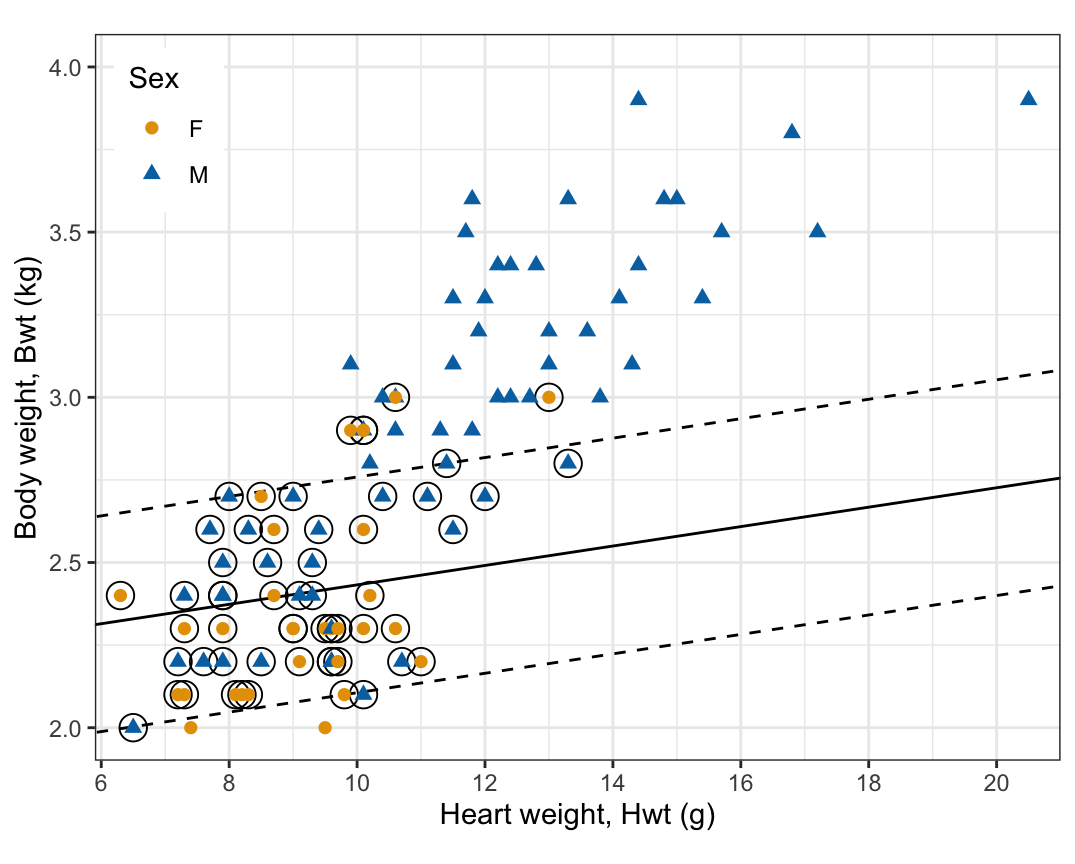
- Support vectors: \(y_i\widehat f(x_i) \le \widehat M\), on the margin, inside it, or on the wrong side of the hyperplane
- Wider than the previous lecture’s: the observations on the margin only, the case with no slack
- Circled cats: 58 of the 96
- The fitted hyperplane depends only on them
Refits
- Delete an observation outside the margin, or move it anywhere outside: the fit is unchanged
- Refit to the 58 support vectors alone: the same estimates, to six decimal places
- Maximal margin: a handful of support vectors; here, every observation inside the margin or on the wrong side
Support vector count
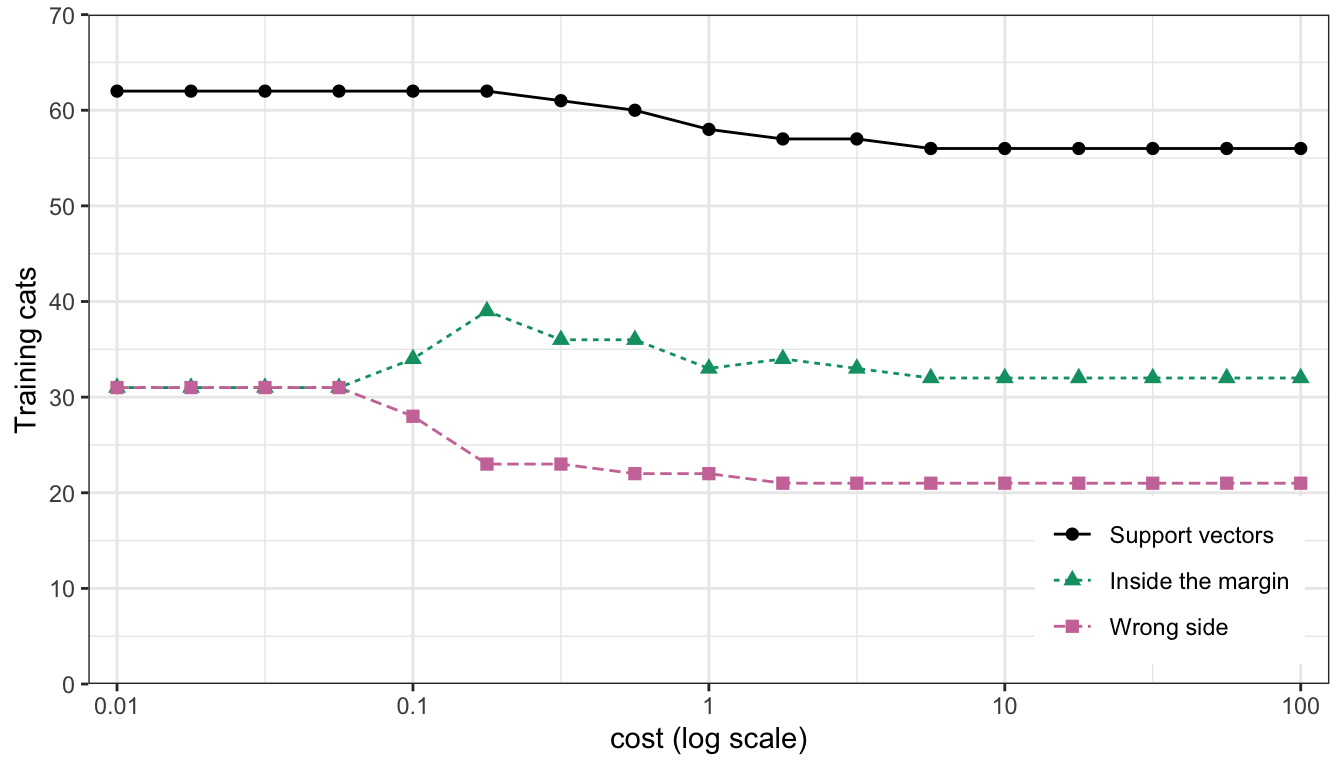
Cross-validation
Error rate
        cost     error dispersion
1 0.01000000 0.3255556  0.1478747
2 0.01778279 0.3255556  0.1478747
3 0.03162278 0.3255556  0.1478747
cost
10 1.778279Curve
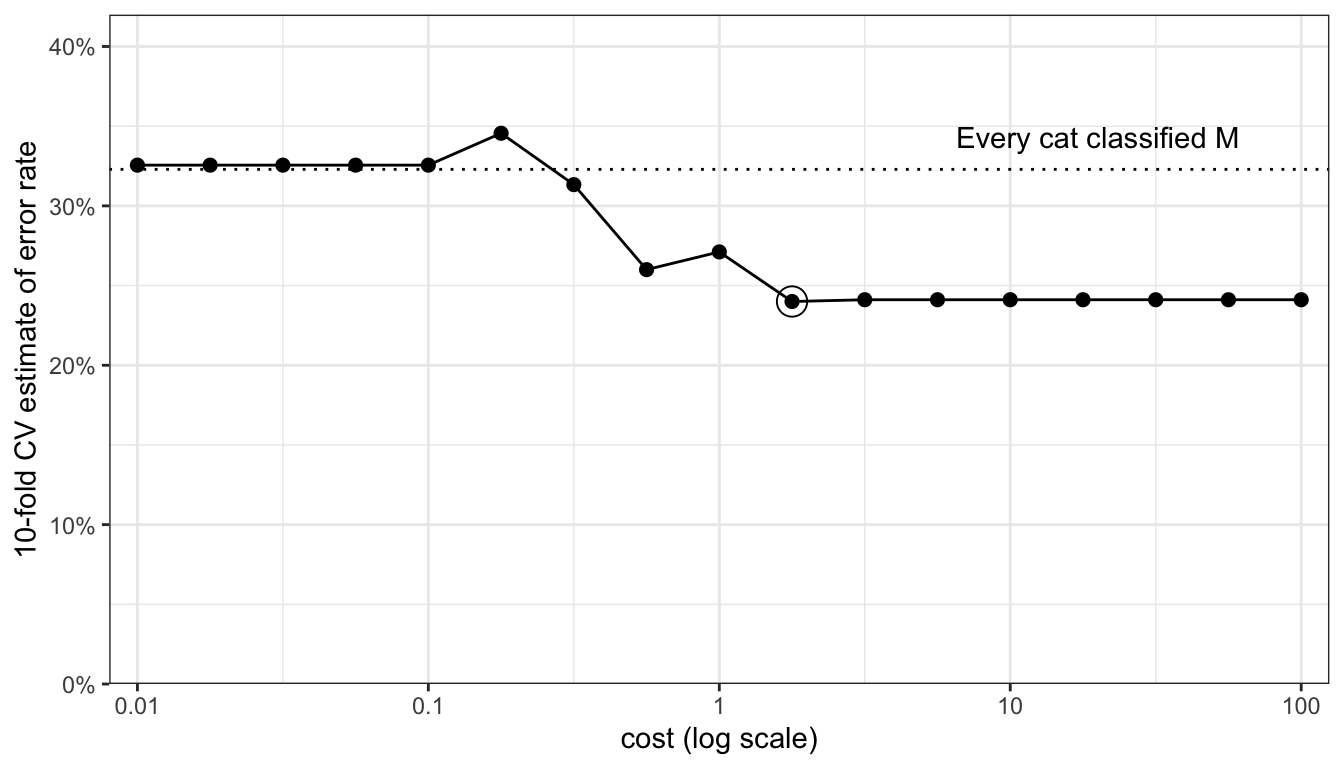
Test error
Test error
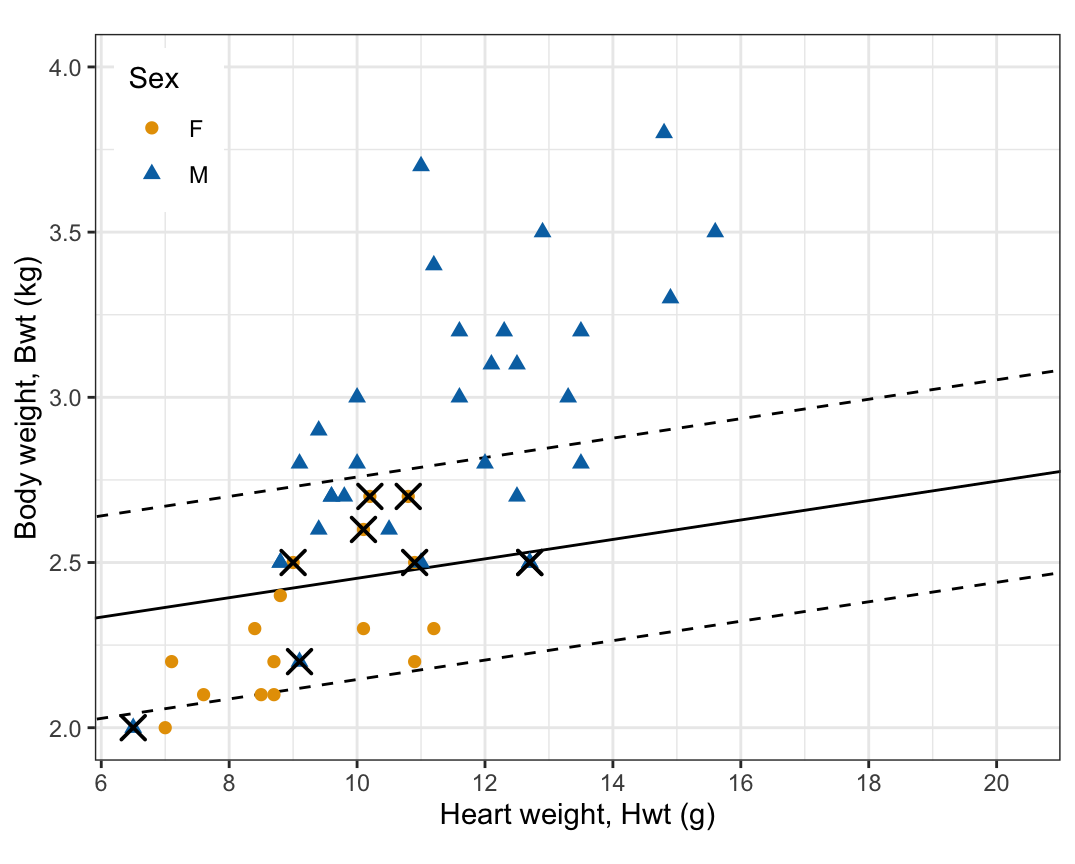
Confusion matrix
     Predicted
Truth  F  M
    F 11  5
M 4 28- Positive class:
M
- Test error rate: \((FP + FN)/n = (5 + 4)/48 = 0.188\)
- Classifying every test cat
M: 33.3%
Comparison
Classifiers
- Support vector classifier (chosen
cost) - Logistic regression: main effects; with interaction; with squares and interaction
- LDA, QDA
- Random forest
# Fits to the training cats; each gives a probability that a cat is M.
set.seed(20261114)
logit_fit <- glm(Sex ~ Hwt + Bwt, data = train, family = binomial)
lda_fit <- MASS::lda(Sex ~ Hwt + Bwt, data = train)
qda_fit <- MASS::qda(Sex ~ Hwt + Bwt, data = train)
rf_fit <- randomForest::randomForest(Sex ~ Hwt + Bwt, data = train)

# Probabilities of F and M that LDA gives the first three test cats.
head(predict(lda_fit, test)$posterior, 3)
F M
1 0.7219232 0.2780768
6 0.6667787 0.3332213
10 0.6774822 0.3225178Measures
- Error rate: proportion misclassified
\[ \text{log loss} = -\frac{1}{n}\sum_{i=1}^n \log \widehat p_i, \]
- \(\widehat p_i\) — probability given cat \(i\)’s observed sex
- \(n\) — number of cats
Results
| Classifier | CV error rate (%) | CV log loss | Test error rate (%) | Test log loss |
|---|---|---|---|---|
| Logistic, main effects | 22.9 | 0.510 | 16.7 | 0.418 |
| Logistic, interaction | 26.0 | 0.513 | 16.7 | 0.417 |
| Logistic, quadratic | 25.0 | 0.550 | 16.7 | 0.402 |
| LDA | 24.0 | 0.509 | 16.7 | 0.429 |
| QDA | 27.1 | 0.543 | 14.6 | 0.377 |
| Random forest | 22.9 | 0.567 | 20.8 | 0.406 |
| Support vector classifier | 24.0 | — | 18.8 | — |
Conclusion
- Overlapping classes need slack, bounded by a budget \(C\)
- At most \(C\) training observations are misclassified
- The fit depends only on the support vectors
- Small budget: low bias, high variance; large budget: the reverse
- Larger
cost: budget no larger, margin no wider; features standardized costby cross-validation; judged by the test error rate
DS 3030